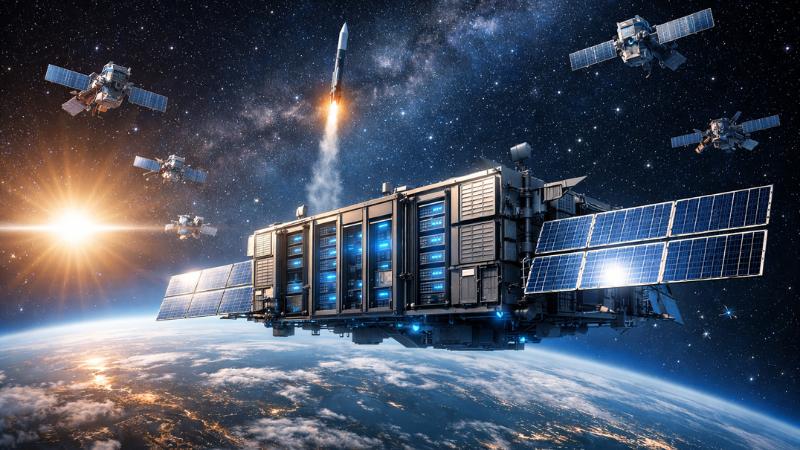
Elon Musk’s long-standing reputation for advancing unconventional technological ideas has taken another ambitious turn, with SpaceX formally proposing to build an orbital network of artificial intelligence data centres powered by solar energy. What initially appeared to be an eccentric concept has quickly moved into the regulatory phase, supported by official filings and public statements that suggest the company is serious about relocating a significant share of AI computing capacity beyond Earth’s atmosphere.
According to documents submitted to the Federal Communications Commission, SpaceX intends to develop a constellation of satellites equipped to function as space-based data centres capable of processing AI workloads in orbit. The proposal outlines an infrastructure that would rely on continuous solar exposure to generate electricity more efficiently than ground-based facilities. Regulators have accepted the filing and opened it for public comment, a procedural step that signals the project has entered formal review.
Speaking recently on a podcast, Musk argued that scaling AI infrastructure on Earth is becoming increasingly difficult due to land, power and cooling constraints. He said solar panels in space can produce significantly more energy than those on the ground because they operate without atmospheric interference or night cycles. This, he contends, could reduce the energy costs that currently dominate AI and cloud computing operations. Musk predicted that within three years, space could become the most economical location for high-performance computing.
The company already has experience operating large satellite networks through Starlink, which provides global internet coverage using thousands of spacecraft. The new proposal effectively expands that model into computing, transforming satellites into orbiting clusters designed to handle machine learning and GPU-intensive tasks. By pairing satellite launches with AI infrastructure, SpaceX could integrate its launch capabilities directly with a growing demand for advanced compute services.
However, analysts and engineers have noted potential hurdles. Data centres require regular maintenance, cooling systems and hardware replacement, tasks that are straightforward on Earth but considerably more complex in orbit. Servicing malfunctioning GPUs or upgrading components could require specialized missions, adding logistical and financial challenges. Critics also question whether the savings from solar energy would outweigh the costs of launching and maintaining such equipment in space.
Despite those concerns, Musk has expressed confidence that advances in reusable rockets and satellite manufacturing will make the approach viable. The broader data centre market is expanding rapidly, with global capacity projected to grow substantially by the end of the decade. If even a fraction of that demand shifts toward orbital computing, it could reshape the economics of cloud infrastructure and space technology alike.
For SpaceX, the initiative aligns with its strategy of monetizing space access while integrating new technology sectors. If realized, the plan could mark the first step toward moving AI systems beyond terrestrial facilities, redefining how and where the world’s most powerful computing networks operate.