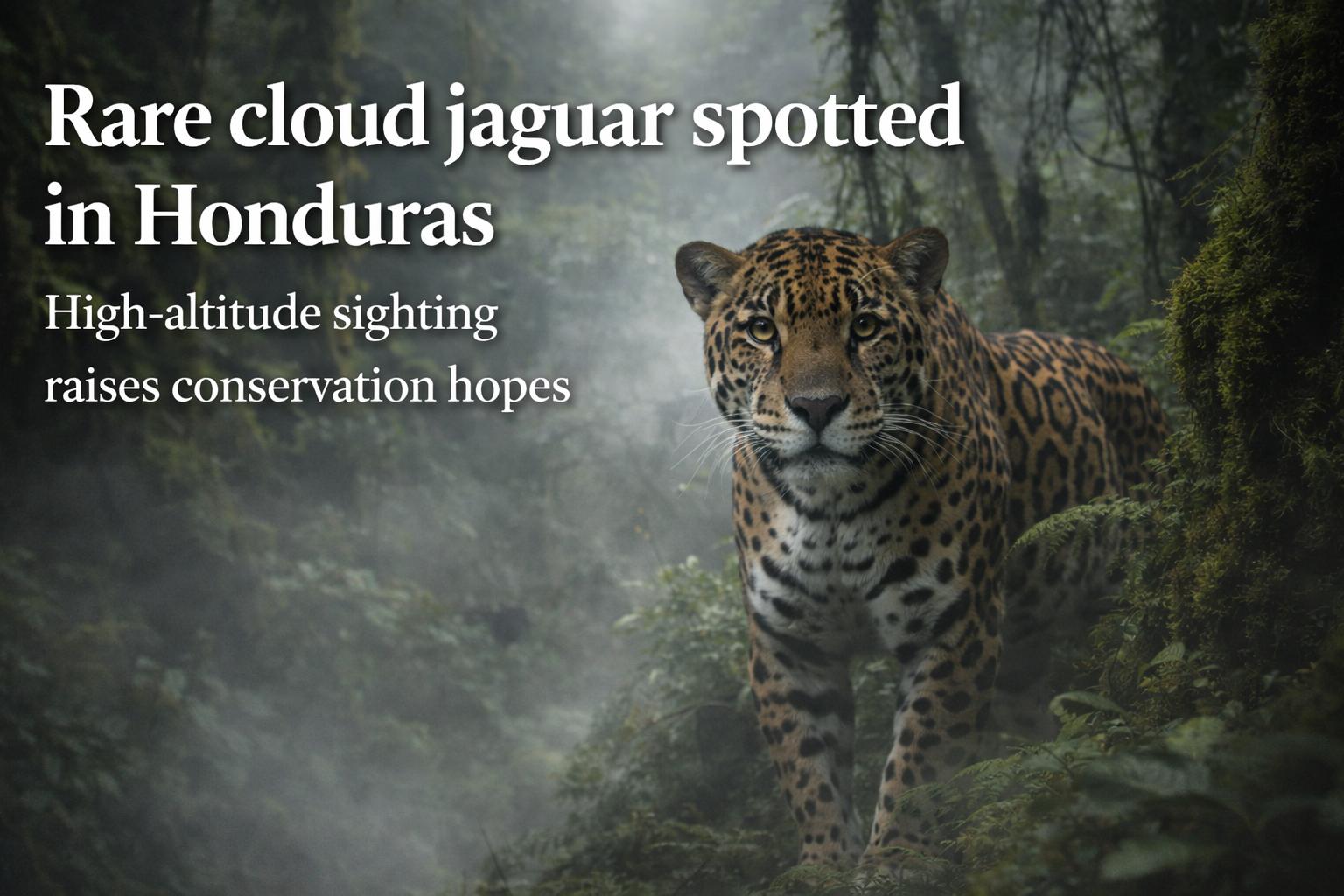
A rare sighting of a “cloud jaguar” in Honduras is offering renewed hope for wildlife conservation after the elusive big cat was photographed at high altitude for the first time in a decade. The lone male jaguar was captured on camera traps on Thursday, February 6, at approximately 2,200 meters (7,200 feet) in the Sierra del Merendón, a region known for its dense cloud forests.
The sighting is significant given the global decline of jaguars, which have lost nearly half of their historic range across the Americas. While the largest population remains in the Amazon, most other groups are now classified as endangered or critically endangered, underscoring the importance of protected habitats.
Honduras has faced severe environmental challenges, losing an estimated 1.5 million hectares of forest cover between 2001 and 2024 due to agricultural expansion and land use changes. In response, the government has introduced aggressive conservation measures, including its Zero Deforestation Plan 2029, aimed at restoring forests and protecting biodiversity through increased enforcement and monitoring.
Conservation groups have also intensified efforts in the Merendón range, deploying ranger patrols, camera traps, and acoustic monitoring systems while working to restore prey populations for large predators. These initiatives appear to be yielding results, with declining poaching rates and increased wildlife activity across the region.
The recent detection suggests a possible recovery of big cat populations in the area. Experts believe the jaguar may have been traveling between fragmented populations in Honduras and neighboring Guatemala, highlighting the importance of wildlife corridors for maintaining genetic diversity.
High-altitude jaguar sightings remain exceptionally rare, and researchers say it is unclear whether this behavior is new or previously undetected due to the remoteness of such environments. Nonetheless, the discovery is being viewed as a positive indicator of ecosystem recovery and the effectiveness of long-term conservation strategies in Central America.