A missing family member in the U.S. can leave relatives unsure where to begin. This guide explains when to contact law enforcement, what information to provide, how NamUs and NCMEC may assist, how to preserve useful records and how to use community and social media searches responsibly.
Report the disappearance promptly
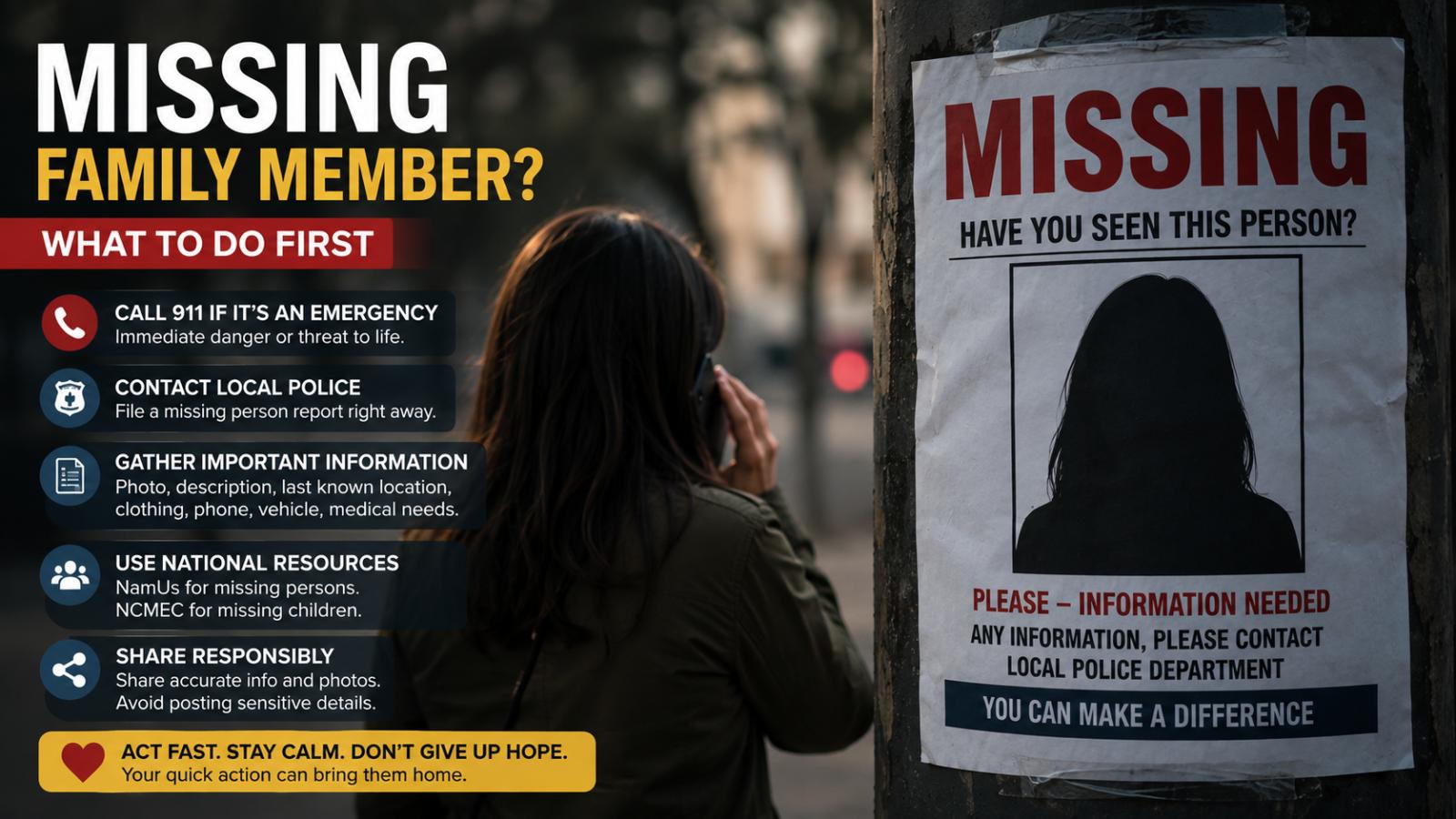
When a family member cannot be located, contact the law enforcement agency serving the place where the person was last seen or normally lives. If there is an immediate threat to life or safety, call 911; the National 911 Program says 911 is for situations requiring immediate police, fire or ambulance assistance.
For a missing child, the National Center for Missing & Exploited Children says families should act immediately and contact local law enforcement. After the police report is filed, families can contact NCMEC at 1-800-THE-LOST (1-800-843-5678).
For a missing adult, local procedures can differ, so families should contact the appropriate police or sheriff’s agency as soon as the disappearance appears concerning rather than assuming they must wait a fixed period.
Give police useful identifying information
Prepare the person’s full name, age or date of birth, recent photograph, physical description, clothing, phone number, vehicle details and last-known location.
Tell investigators about circumstances that may increase risk, such as age, disability, medication needs or unusual behavior before the disappearance.
Preserve messages, call information, photos, travel details and other records that could help establish the person’s movements. Avoid deleting or changing potentially useful information.
Use national missing-person resources
The National Missing and Unidentified Persons System, or NamUs, is a U.S. Justice Department-supported resource used by law enforcement and families in missing-person cases.
Family members can enter missing-person case information, but NamUs says an active law-enforcement missing-person report must be on file before a case can be published. The system also allows the public to search publicly available cases and connects investigators with forensic and analytical resources.
Share carefully and update authorities
Community appeals can sometimes help reconnect families, as seen in a recent case involving a Telugu-speaking woman in Dallas whose family was being sought through community networks.
Social media, places of worship and community organizations can widen a search, especially when language or cultural networks may help.
Share a recent photograph and verified identifying details, and direct credible tips to the investigating agency whenever possible.
Avoid posting passports, financial information, private medical records, home addresses or unverified accusations. Public attention should support the search without unnecessarily exposing the missing person or family.
If the person is located or returns home, notify the investigating law-enforcement agency promptly so records and active search efforts can be updated.
People who encounter someone who appears separated from family should also know what to do when they find someone lost or distressed in the U.S., including when to contact emergency services and how to protect the person’s privacy.