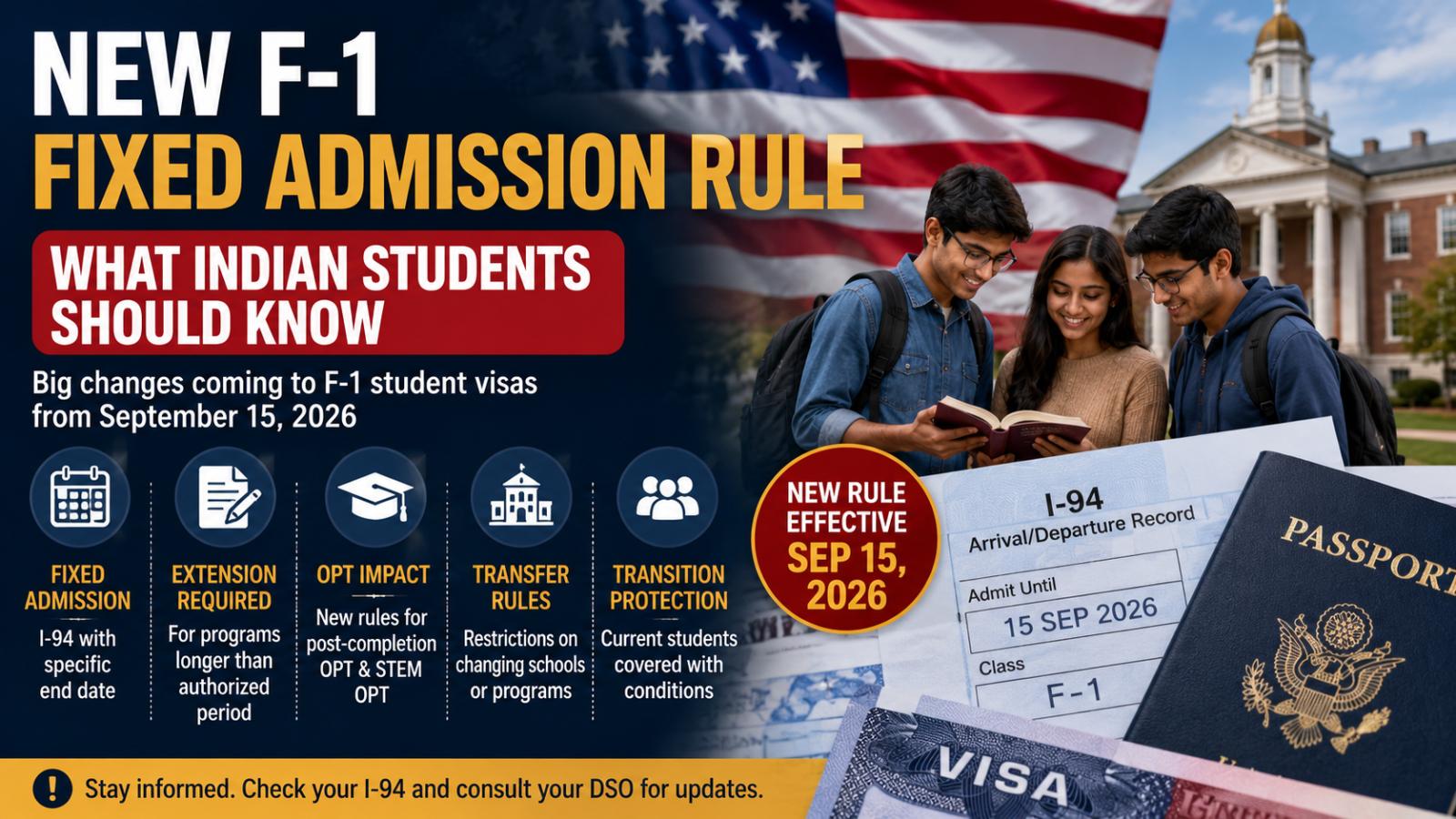
The F-1 fixed admission rule scheduled for September 15, 2026, would replace open-ended duration-of-status admissions with fixed periods. Indian students may face new requirements involving I-94 dates, program extensions, OPT, transfers and graduate study.
F-1 students would receive a fixed admission date
A major U.S. immigration rule scheduled to take effect on September 15, 2026, would end the longstanding “duration of status,” or D/S, system for F-1 students. Instead, students entering the United States would generally receive an authorized stay tied to the program listed on Form I-20, for up to four years. Their Form I-94 would show a specific end date. The rule remains subject to congressional review, and DHS says it will publish an update if the effective date changes.
The change has particular relevance for Indian students because India was the largest source country for international students in the United States in 2024-25, with 363,019 students.
Longer programs may require an extension
Students whose academic programs require more time than their authorized admission period would need to request an extension of stay from U.S. Citizenship and Immigration Services rather than relying only on an updated I-20. A student who timely files an extension may continue a full course of study while the application is pending.
For newly admitted F-1 students, the rule also reduces the post-study period generally available to prepare for departure or seek another lawful status from 60 days to 30 days.
Current students receive transition protection
Students already maintaining F-1 status under D/S when the rule takes effect are covered by transition provisions. They can generally remain through the program end date on their valid I-20, subject to a maximum transition period of four years. However, international travel after the effective date can move a student into the new fixed-admission system when they re-enter the United States.
That makes the I-94 increasingly important: students should check the authorized admission date after each U.S. entry rather than assuming their status automatically continues for the full academic program.
OPT and graduate students face important changes
For transition-period F-1 students who timely file for post-completion OPT or a STEM OPT extension on or before March 18, 2027, DHS provides temporary relief from filing a separate extension-of-stay application for that OPT period. After that temporary window, an extension may also be required when additional authorized stay is needed for post-completion OPT or STEM OPT.
The rule also introduces restrictions on changing programs and schools. Graduate-level F-1 students generally would not be permitted to change educational objectives or transfer during a program unless SEVP approves an exception for extenuating circumstances. Students completing one program would also generally need to move to a higher educational level rather than another program at the same or lower level. DHS retains authority to delay some of these provisions.
Indian students planning Fall 2026 study, graduate transfers, extended research programs or OPT should therefore pay closer attention to their Form I-20 and I-94 dates and guidance from their designated school official. Because the September 15 effective date remains subject to congressional review, students should also check DHS and SEVP updates before making immigration or travel decisions.