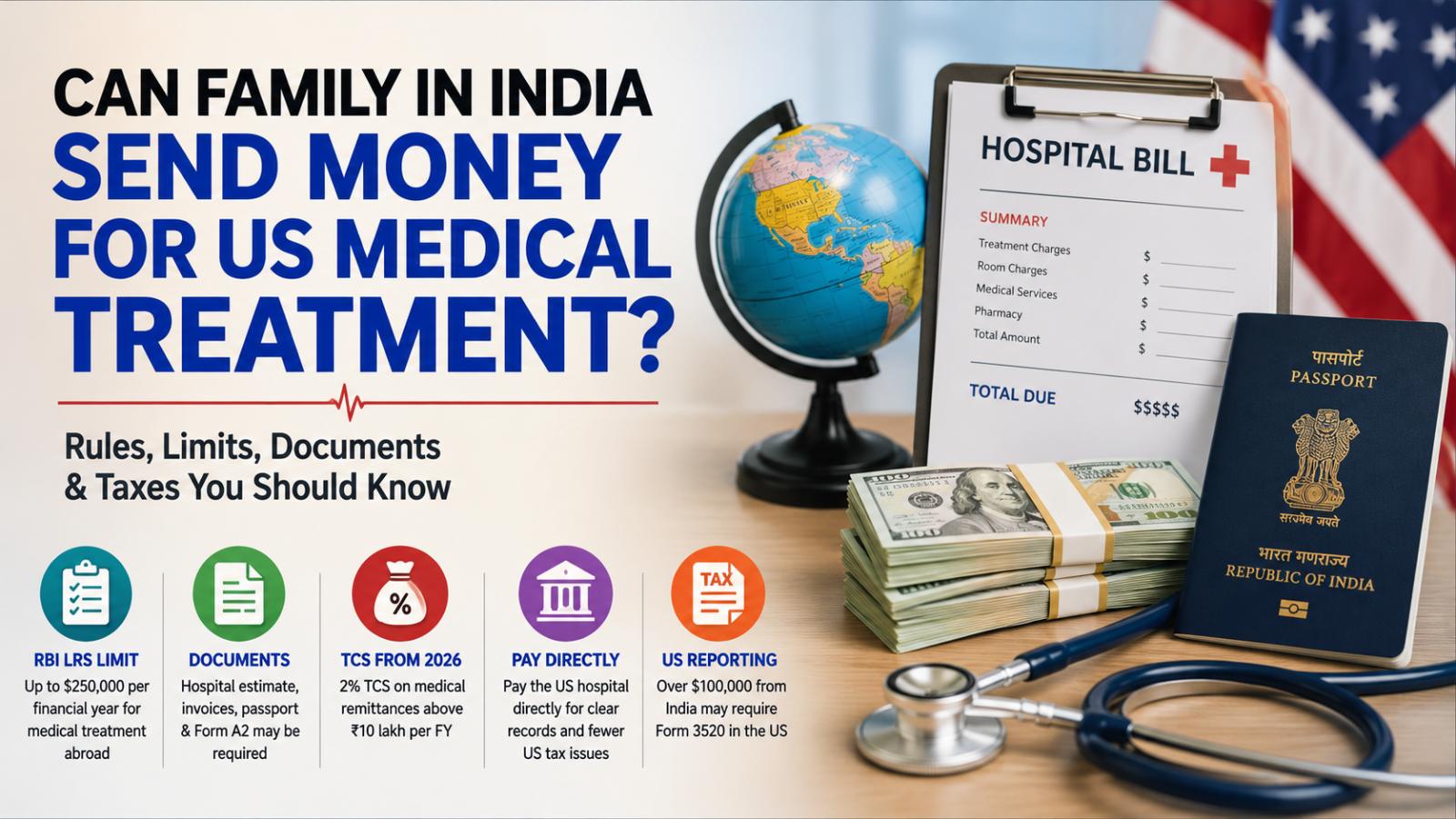
Family members in India can send money for a relative's medical treatment in the US under RBI rules. Medical remittances have specific LRS provisions, documentation requirements and 2026 TCS rules, while very large transfers may also create US reporting obligations.
Can family in India pay US medical expenses?
Yes. A resident individual in India can remit money abroad for medical treatment under the Reserve Bank of India's Liberalised Remittance Scheme.
RBI rules specifically recognize medical treatment abroad as a permitted purpose. Authorized dealers can release up to $250,000 or its equivalent per financial year for medical treatment without requiring an estimate from a hospital or doctor.
The $250,000 LRS ceiling is an overall annual limit, so other LRS remittances already made by that person during the financial year generally reduce the available limit.
What if US medical bills exceed $250,000?
Medical treatment receives an important exception.
For an amount exceeding $250,000, RBI guidance allows an authorized dealer to release additional foreign exchange under general permission when supported by an estimate from a doctor in India or a hospital or doctor abroad.
Families facing major hospital bills should therefore obtain treatment estimates, invoices and hospital details before approaching their bank.
Banks may also require the prescribed Form A2/LRS declaration and information necessary to establish the purpose and bona fides of the transfer.
How much TCS applies in 2026?
From April 1, 2026, the Income-tax Act, 2025, as amended by the Finance Act, 2026, provides a 2% TCS rate for LRS remittances for medical treatment when aggregate remittances exceed ₹10 lakh.
The 2% rate replaced the earlier 5% rate for education and medical-treatment remittances.
TCS is tax collected at source by the authorized dealer. It can appear in the remitter's tax-credit records and may be claimed in the income-tax return, subject to the applicable tax rules.
A transfer classified as a general gift rather than medical treatment can have different TCS treatment, so families should not select a remittance purpose merely because it appears convenient.
Should the family pay the hospital directly?
Where practical, paying the US hospital or medical provider directly can create a clearer record showing that the transfer was genuinely for medical treatment.
There can also be a U.S. reporting distinction. A U.S. person who receives more than $100,000 in gifts from a nonresident alien individual or foreign estate during a tax year may have a Form 3520 reporting requirement. The IRS says qualified medical payments made directly on behalf of a U.S. person are not treated as foreign gifts for this reporting rule.
Families making substantial transfers should confirm both the Indian remittance classification and any U.S. tax-reporting consequences before sending the funds.
This article provides general information and is not individual tax, legal or financial advice.