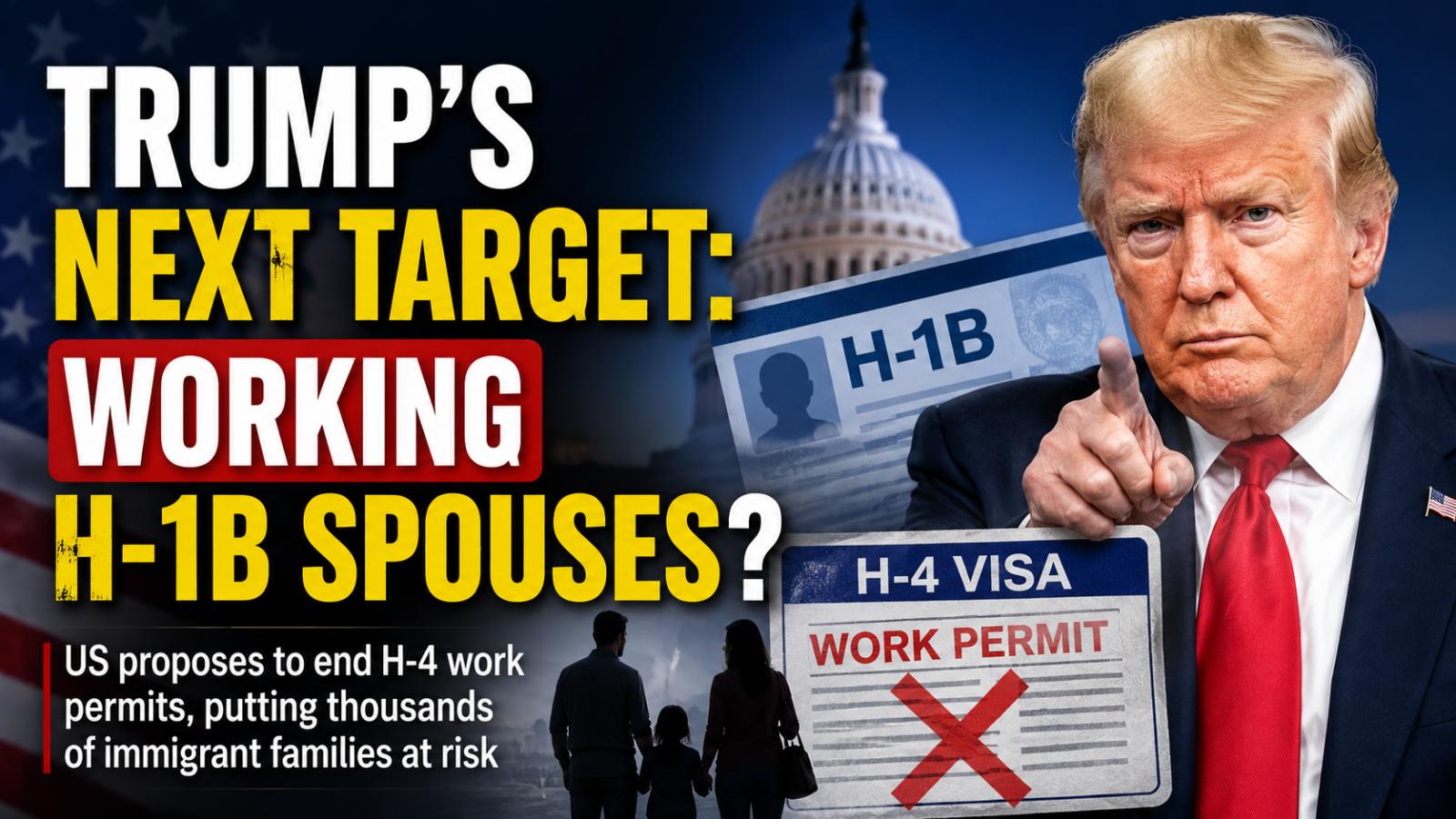
The US government is considering a proposal that could restrict or end work authorization for certain H-4 spouses of H-1B visa holders. No rule has taken effect yet, and current H-4 EAD holders can continue working unless a formal policy change is finalized.
Thousands of families living in the United States on H-1B visas could face a major financial and career setback if the federal government moves ahead with a proposal affecting employment rights for certain H-4 visa holders.
The Department of Homeland Security has reportedly placed a possible change to H-4 employment authorization on its long-term regulatory agenda. The proposal could eventually reverse a rule introduced in 2015 that allows certain spouses of H-1B workers to legally work in the United States while their families wait through the employment-based permanent residency process.
For now, however, no immediate change has taken effect. H-4 spouses who currently qualify for employment authorization can continue working unless and until a new rule is formally adopted.
What Could Change for H-4 Visa Holders?
H-4 visas are generally issued to spouses and dependent children of H-1B workers.
Under the existing system, some H-4 spouses can apply for an Employment Authorization Document, commonly known as an EAD, when the H-1B principal beneficiary has reached certain stages of the green card process.
A future rule could seek to end or significantly restrict that work authorization. Such a move would effectively return many H-4 spouses to a situation in which they could legally live in the United States but would not be permitted to work.
The potential change could have a particularly large impact on Indian immigrant families because many H-1B workers face lengthy employment-based green card backlogs.
Families Could Face Financial and Career Impact
For many H-1B households, employment by both spouses has become an important part of managing housing, childcare, education and other living expenses in the United States.
Removing work authorization could force some H-4 professionals to leave jobs and interrupt careers they have built over several years.
The impact could extend beyond household income. H-4 EAD holders work across sectors including technology, healthcare, finance, education and small businesses.
Supporters of tighter employment rules argue that limiting work authorization for dependent visa holders could create additional opportunities for American workers. Critics, however, say H-4 professionals already contribute to the US economy and that restricting their ability to work could make the country less attractive to highly skilled immigrants.
No Immediate Rule Change Yet
Immigrant families should note that the proposal has not yet become an enforceable policy.
A regulatory change of this kind would normally require the government to publish a proposed rule, provide a period for public comments, review those responses and then issue a final rule before implementation.
The timeline could therefore extend for months or longer, and the final policy could differ substantially from early proposals.
Until official regulations are published, reports suggesting that H-4 work permits will immediately disappear should be treated cautiously.
H-1B Families Closely Watching Next Steps
Any attempt to restrict H-4 employment authorization is expected to draw significant attention from immigrant communities, employers and immigration attorneys.
The issue is especially important for families already navigating long waits for permanent residency. Losing the ability of one spouse to work could influence decisions about remaining in the United States, changing employers or relocating to another country.
For now, H-4 EAD rules remain in effect. The key development to watch will be whether the Department of Homeland Security formally publishes a proposal to change the program and, if so, what categories of H-4 spouses would be affected.