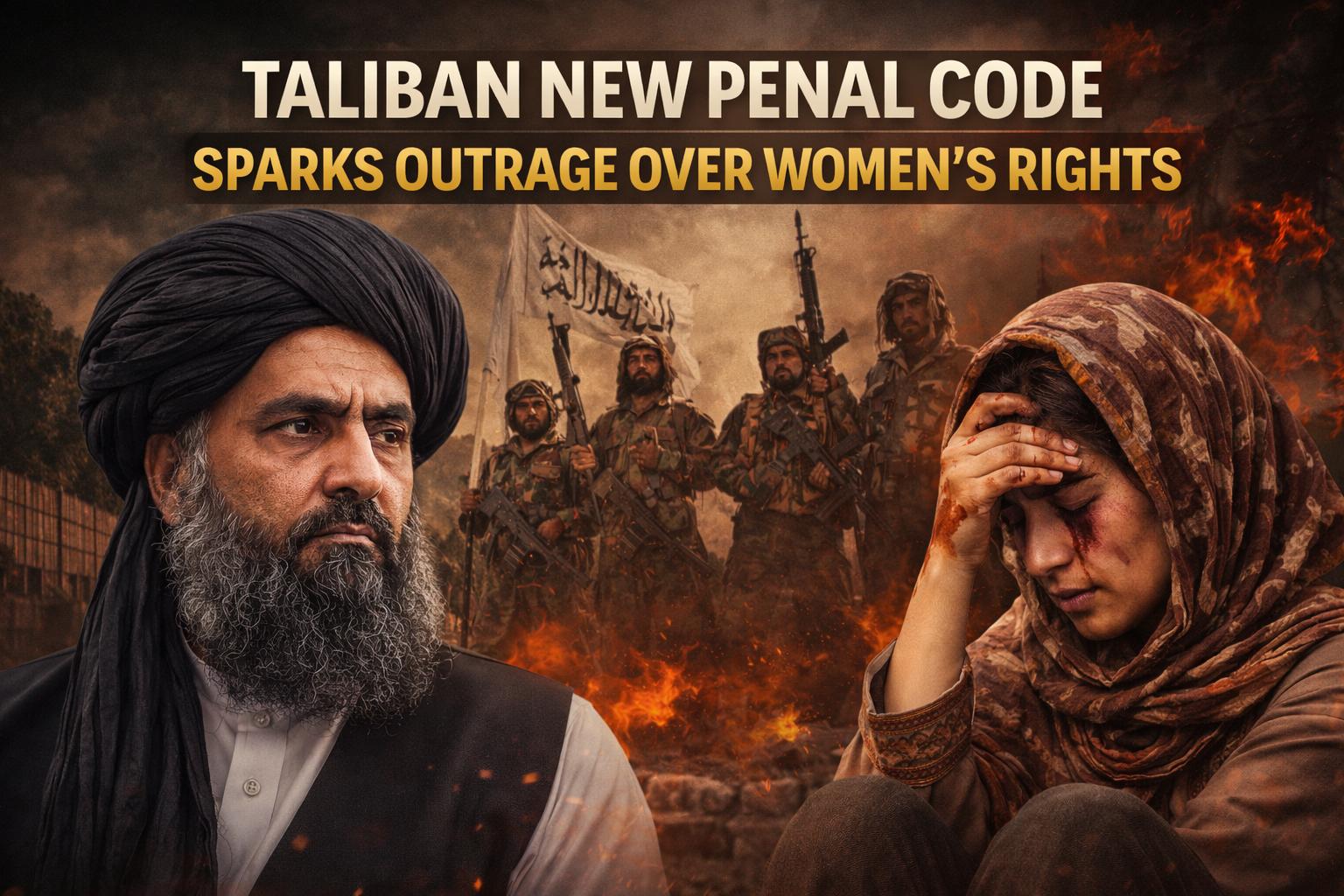
Taliban’s newly introduced penal code has sparked global concern after reports revealed provisions that allow husbands to physically punish their wives and children under certain conditions. The controversial law, signed by Taliban supreme leader Hibatullah Akhundzada, has drawn sharp criticism from human rights organisations and international observers, who warn that it severely undermines women’s rights and legal protections in Afghanistan.
According to reports, the penal code permits physical punishment within families as long as it does not result in visible fractures or open wounds. Even in cases where serious injury occurs, penalties remain minimal. If a husband causes fractures or visible injuries, he may face a prison term of only up to 15 days. Additionally, the burden of proof lies heavily on the victim, requiring women to present physical evidence of abuse in court. Women must also attend court accompanied by their husband or a male guardian, further complicating access to justice and legal protection.
The penal code introduces a hierarchical structure that categorises Afghan society into four groups: religious scholars, elite members, middle class, and lower class. Under this system, punishments vary significantly depending on social status rather than the nature of the crime itself. Religious scholars may receive only advice for criminal acts, while elite individuals may face court summons and counseling. In contrast, middle-class citizens face imprisonment, and those from lower social classes may receive both imprisonment and corporal punishment.
The new code also replaces the 2009 Elimination of Violence Against Women (EVAW) law, which had provided legal protections for women under the previous government. Human rights groups have warned that removing these protections leaves women increasingly vulnerable to abuse and limits their access to justice. Corporal punishments under the new code will reportedly be carried out by religious clerics rather than formal correctional institutions.
Global human rights organisations and United Nations officials have expressed deep concern over the implications of the new penal code. Advocacy groups have warned that fear and restrictions have created an environment where citizens are afraid to speak openly against the law. Some reports suggest that even discussing the penal code publicly could lead to punishment.
International human rights organisation Rawadari has called on the United Nations and global institutions to intervene and prevent the full implementation of the law. UN Special Rapporteur on violence against women and girls has also raised alarm, describing the situation as deeply troubling and urging the international community to take meaningful action.
The introduction of this penal code marks a significant shift in Afghanistan’s legal and social landscape. Critics warn that it could further isolate the country internationally and worsen conditions for women and vulnerable communities. As global attention focuses on Afghanistan, human rights advocates continue to urge diplomatic pressure and international intervention to protect fundamental rights and freedoms.