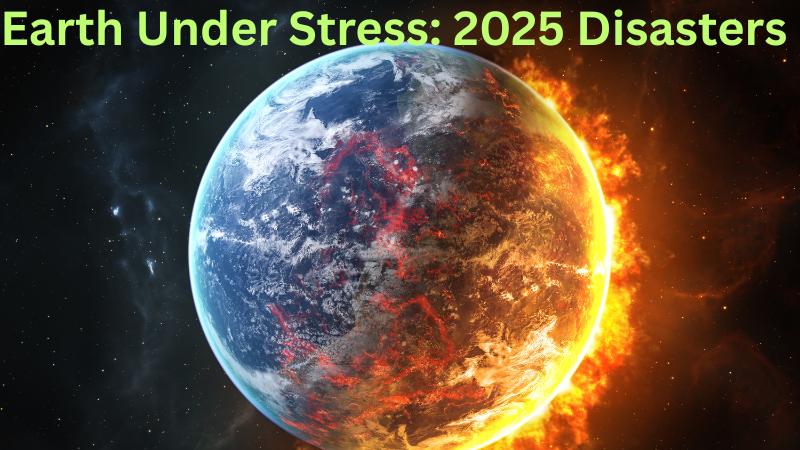
The year 2025 has become one of the most turbulent in recent memory as Earth experiences a wave of overlapping natural crises. A rare volcanic eruption in Ethiopia sent ash drifting thousands of kilometres toward Asia, Indonesia recorded more than 1,400 earthquakes in just 30 days, and California battled massive wildfires that claimed hundreds of lives. Severe monsoon flooding washed through India and Pakistan, and the planet was struck by the strongest solar storm in over twenty years. These simultaneous events have left many wondering whether Earth is undergoing a dramatic shift. Scientists, however, stress that the events are not a sign of planetary collapse but a combination of natural cycles amplified by human-driven climate change.
Seismic activity across the globe has appeared relentless, particularly in regions along the Pacific Ring of Fire. Despite public perception of an increase, long-term geological records show that the annual count of strong earthquakes remains within historical ranges. What has changed is humanity's growing exposure; expanding cities, vulnerable infrastructure and populations living on tectonic fault lines make every event feel increasingly devastating. Meanwhile, volcanic activity has drawn global attention. The Hayli Gubbi volcano in Ethiopia erupted for the first time in nearly twelve thousand years, sending ash columns more than sixteen kilometres high and impacting regional air travel. Experts explain that volcanic eruptions and earthquakes often overlap because both originate from the release of internal stress within Earth’s crust.
As the Sun reaches the peak of Solar Cycle 25, solar storms have intensified. These storms compress Earth's magnetosphere, interfere with satellites, disrupt navigation systems and create stunning auroras across high-latitude skies. Solar physicists say the Sun's magnetic turbulence is responsible for the increased number of flares and coronal mass ejections. Despite speculation, there is no proven link between solar storms and earthquakes or volcanic eruptions.
Climate-driven disasters, however, have shown a clear and measurable rise. A warmer atmosphere holds more moisture, leading to cloudbursts, extreme monsoon events and widespread flooding across South and Southeast Asia. California’s deadly wildfires were fuelled by years of drought, heat and expanding development into fire-prone areas. Scientists emphasise that climate change does not directly cause natural hazards, but it intensifies their triggers — from rainfall extremes to prolonged heatwaves and droughts that turn forests into explosive fuel beds.
Researchers are also examining whether long-term climate changes influence geological hazards. Rapid ice melt, heavy rainfall and shifting water loads can alter stress patterns on faults and volcanic systems. While tectonics remain the dominant force behind quakes and eruptions, climate-induced stress may, in some cases, influence timing or severity.
Taken together, the dramatic events of 2025 reflect an interconnected planet where Earth’s interior continues its slow geological rhythms, the Sun undergoes natural cycles of activity and a warming climate magnifies weather extremes. Scientists warn against interpreting these events as a single global upheaval. Instead, they represent multiple systems — atmosphere, oceans, tectonics and magnetosphere — interacting in complex ways while human populations become increasingly vulnerable. The planet is not becoming more unstable; rather, humanity is more exposed than ever to a world that has always been dynamic and restless.