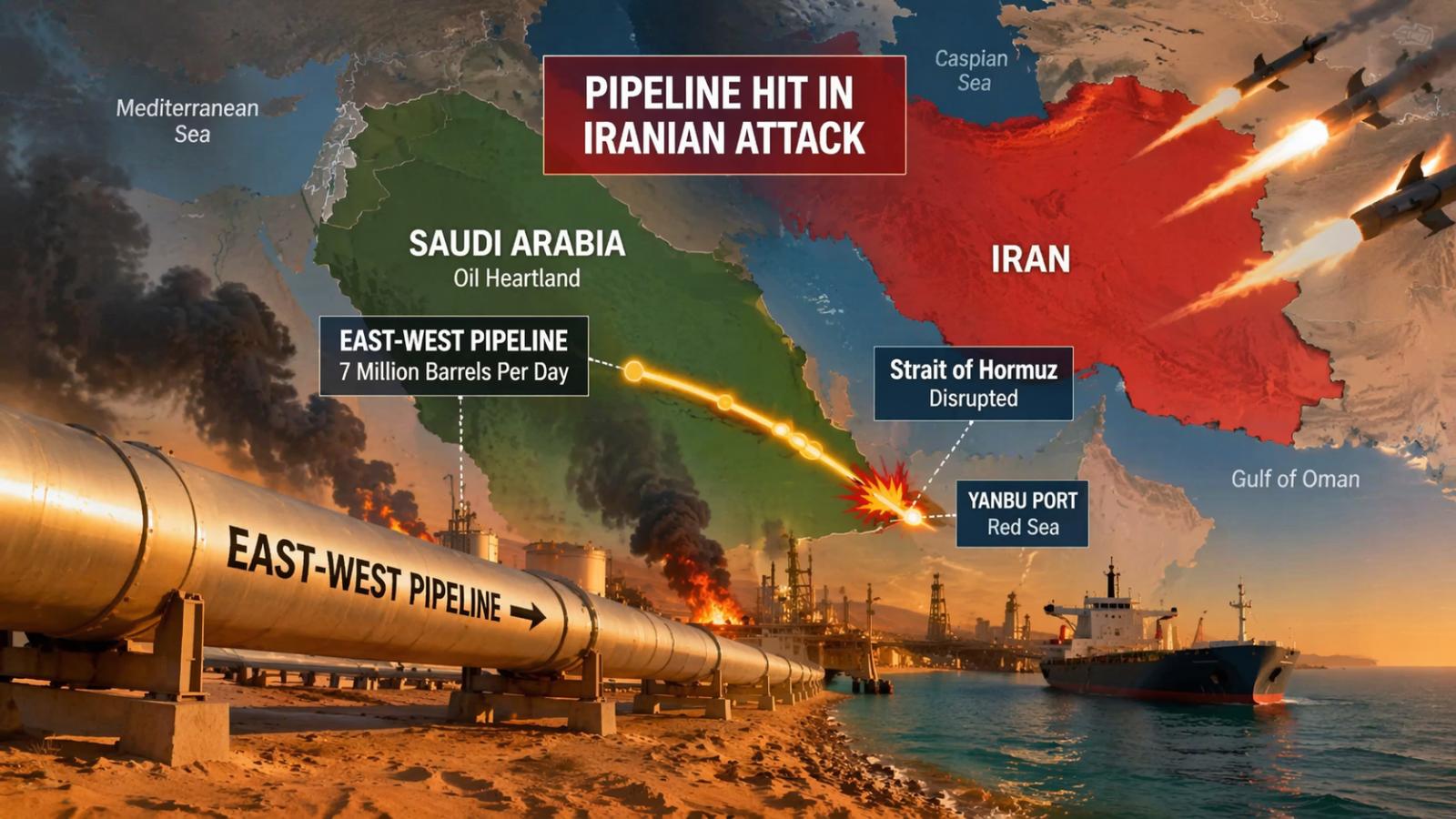
Saudi Arabia’s critical East-West oil pipeline, a key route for crude exports, was struck in an Iranian attack, according to an industry source on Wednesday. The pipeline, currently serving as the kingdom’s primary export outlet after disruptions in the Strait of Hormuz, was among several oil-related facilities targeted across the country.
The East-West pipeline plays a central role in maintaining Saudi Arabia’s oil supply chain, transporting approximately 7 million barrels per day from production fields in the eastern region to the Red Sea port of Yanbu. The route has become increasingly vital after Iran’s actions effectively limited traffic through the Strait of Hormuz, a major global shipping corridor, trapping significant volumes of oil and gas and contributing to sharp volatility in global energy markets.
Preliminary assessments indicate that flows through the pipeline could be affected, though the full extent of the damage is still under evaluation. Any disruption to this infrastructure could further strain global supply, intensifying what analysts describe as one of the most severe energy crises in recent history.
Saudi Aramco typically allocates around 2 million barrels per day for domestic consumption, leaving approximately 5 million barrels per day available for export. Shipping data shows that crude loadings at Yanbu averaged about 4.6 million barrels per day in the week beginning Sunday, March 23, 2026, operating close to maximum capacity despite earlier attacks targeting the port on Wednesday, March 19, 2026.
In a statement released on Wednesday, Iran’s Islamic Revolutionary Guard Corps said it had carried out coordinated missile and drone strikes on multiple targets across the region. The group claimed that the operation included oil facilities linked to American companies in Yanbu, underscoring escalating geopolitical tensions that continue to disrupt global oil flows and heighten concerns over energy security.
The East-West pipeline plays a central role in maintaining Saudi Arabia’s oil supply chain, transporting approximately 7 million barrels per day from production fields in the eastern region to the Red Sea port of Yanbu. The route has become increasingly vital after Iran’s actions effectively limited traffic through the Strait of Hormuz, a major global shipping corridor, trapping significant volumes of oil and gas and contributing to sharp volatility in global energy markets.
Preliminary assessments indicate that flows through the pipeline could be affected, though the full extent of the damage is still under evaluation. Any disruption to this infrastructure could further strain global supply, intensifying what analysts describe as one of the most severe energy crises in recent history.
Saudi Aramco typically allocates around 2 million barrels per day for domestic consumption, leaving approximately 5 million barrels per day available for export. Shipping data shows that crude loadings at Yanbu averaged about 4.6 million barrels per day in the week beginning Sunday, March 23, 2026, operating close to maximum capacity despite earlier attacks targeting the port on Wednesday, March 19, 2026.
In a statement released on Wednesday, Iran’s Islamic Revolutionary Guard Corps said it had carried out coordinated missile and drone strikes on multiple targets across the region. The group claimed that the operation included oil facilities linked to American companies in Yanbu, underscoring escalating geopolitical tensions that continue to disrupt global oil flows and heighten concerns over energy security.