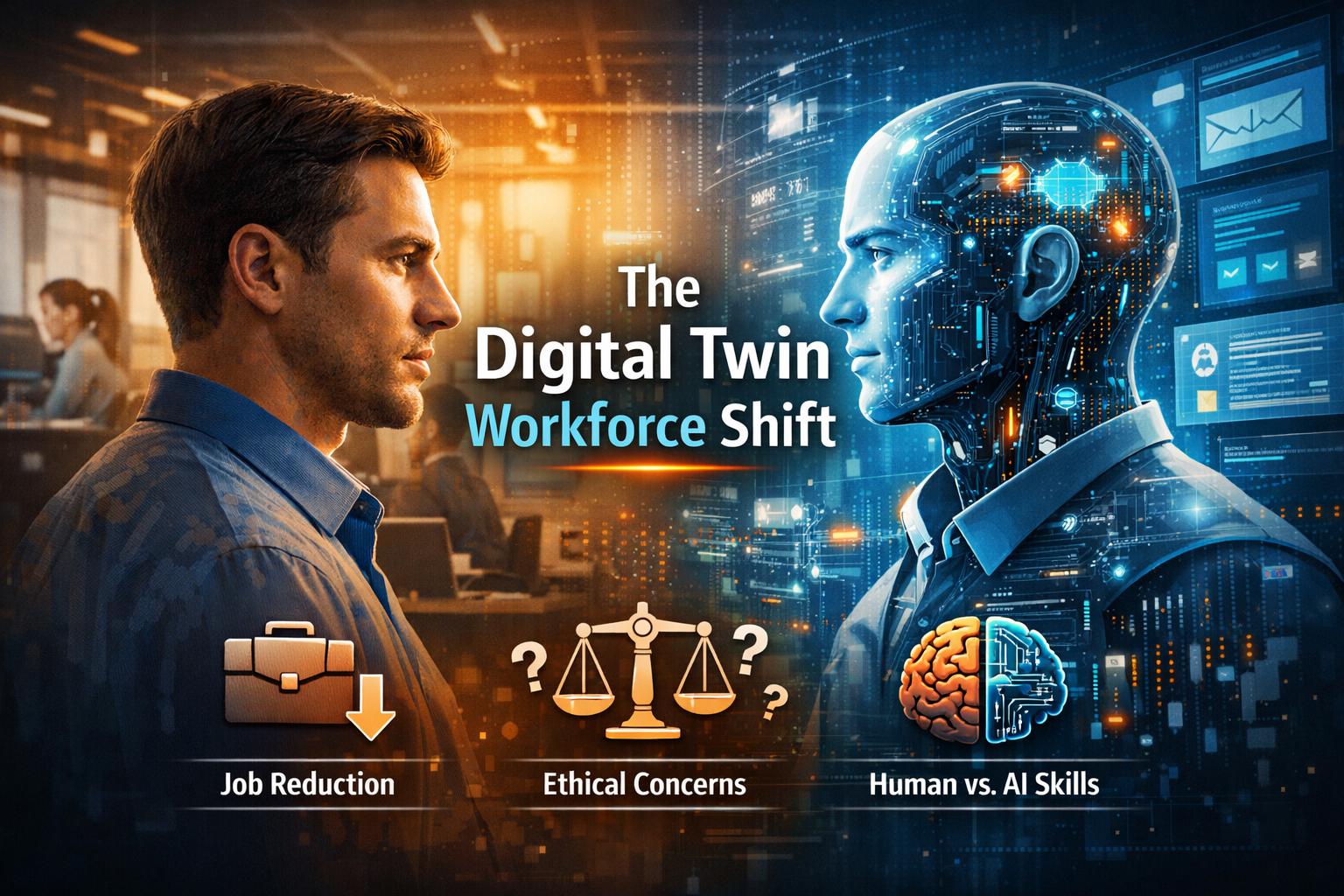
The rise of AI-powered digital twins is no longer just a tech trend—it’s quickly turning into a digital twin job loss crisis that could reshape how millions of people work. Companies are building AI versions of employees that can think, respond, and make decisions like humans. While this promises efficiency, it also raises a serious concern: are workers unknowingly training their own replacements?
How Digital Twins Are Replacing Human Roles
Digital twins in the workplace are AI systems trained on an employee’s data—emails, meetings, workflows, and decision patterns. These systems can replicate how a person works and even respond to tasks in their style. Some companies have already created AI replicas of key employees. These “AI superworkers” can:
- Handle business queries instantly
- Assist in decision-making
- Work across teams without delays
Unlike human employees, they don’t take breaks, don’t demand salaries, and can operate 24/7. This shift is pushing organizations toward workplace AI automation, where fewer people are needed to manage larger workloads.
Why the Digital Twin Job Loss Crisis Matters
The biggest impact of this trend is not just technological—it’s economic and social.
For businesses, digital twins mean:
- Lower operational costs
- Faster decision-making
- Reduced dependency on human expertise
But for employees, the reality is more complex. As AI takes over repetitive and knowledge-based tasks, companies may reduce hiring or restructure teams. Mid-level roles—especially those involving analysis, customer interaction, or routine decision-making—are most vulnerable.
This creates a growing gap where:
- Fewer workers are needed
- Remaining employees face higher expectations
- Job security becomes uncertain
The AI workforce impact could redefine employment itself, shifting from stable jobs to performance-based or contract roles.
The Hidden Risk: Who Owns Your Digital Twin?
One of the most overlooked issues in this transformation is ownership. When a digital twin is created using your work data, questions arise:
- Does the employee own the AI version?
- Or does the company control it?
If an employee leaves, companies may still retain their digital twin. That means your expertise could continue generating value—even without you.
This raises serious concerns about:
- Data privacy
- Intellectual ownership
- Ethical use of personal work patterns
Current laws are not fully prepared to handle these challenges, making this a potential legal battleground in the coming years.
From Productivity Tool to Workforce Disruption
Digital twins are often marketed as tools to boost productivity and improve work-life balance. And to some extent, they can help employees automate routine tasks.
However, there’s a critical gap in this narrative. Increased productivity does not always translate to better pay or reduced workload. Instead, companies may:
- Expect higher output from fewer employees
- Replace entire teams with AI-driven systems
- Use digital twins to scale operations without hiring
This is where the future of jobs AI becomes uncertain. What starts as a productivity tool can quickly become a cost-cutting mechanism, accelerating job displacement.
Which Jobs Are Most at Risk?
Not all professions will be equally affected, but certain roles face higher risk in the digital twin job loss crisis. Jobs that rely heavily on:
- Data analysis
- Customer communication
- Predictable decision-making
- Knowledge-based processes
are more likely to be replicated by AI systems. Industries such as consulting, customer support, finance, and operations management are already seeing early signs of this shift. The more structured and repeatable a role is, the easier it becomes for a digital twin to replace it.
What Happens Next in the AI Workforce Revolution
The adoption of digital twins is expected to grow rapidly as companies compete to stay efficient.
In the near future, we may see:
- New laws defining AI ownership rights
- Changes in employment contracts
- Increased focus on AI-human collaboration
At the same time, employees will need to adapt by developing skills that AI cannot easily replicate—such as creativity, emotional intelligence, and complex problem-solving. The workforce may shift toward a model where humans work alongside AI rather than being replaced entirely—but that transition will not be smooth.
The digital twin job loss crisis is not a distant possibility—it is already unfolding. While AI superworkers offer undeniable benefits in speed and efficiency, they also challenge the traditional idea of job security. The balance between innovation and responsibility will determine whether this technology empowers workers or replaces them. One thing is clear: the future of work will not just depend on AI itself, but on how humans choose to control and adapt to it.