Updated Thursday, June 18, 2026
FCNR deposits vs U.S. CDs can both provide fixed returns on dollar savings, but the higher advertised rate does not automatically make one the better choice for every NRI.
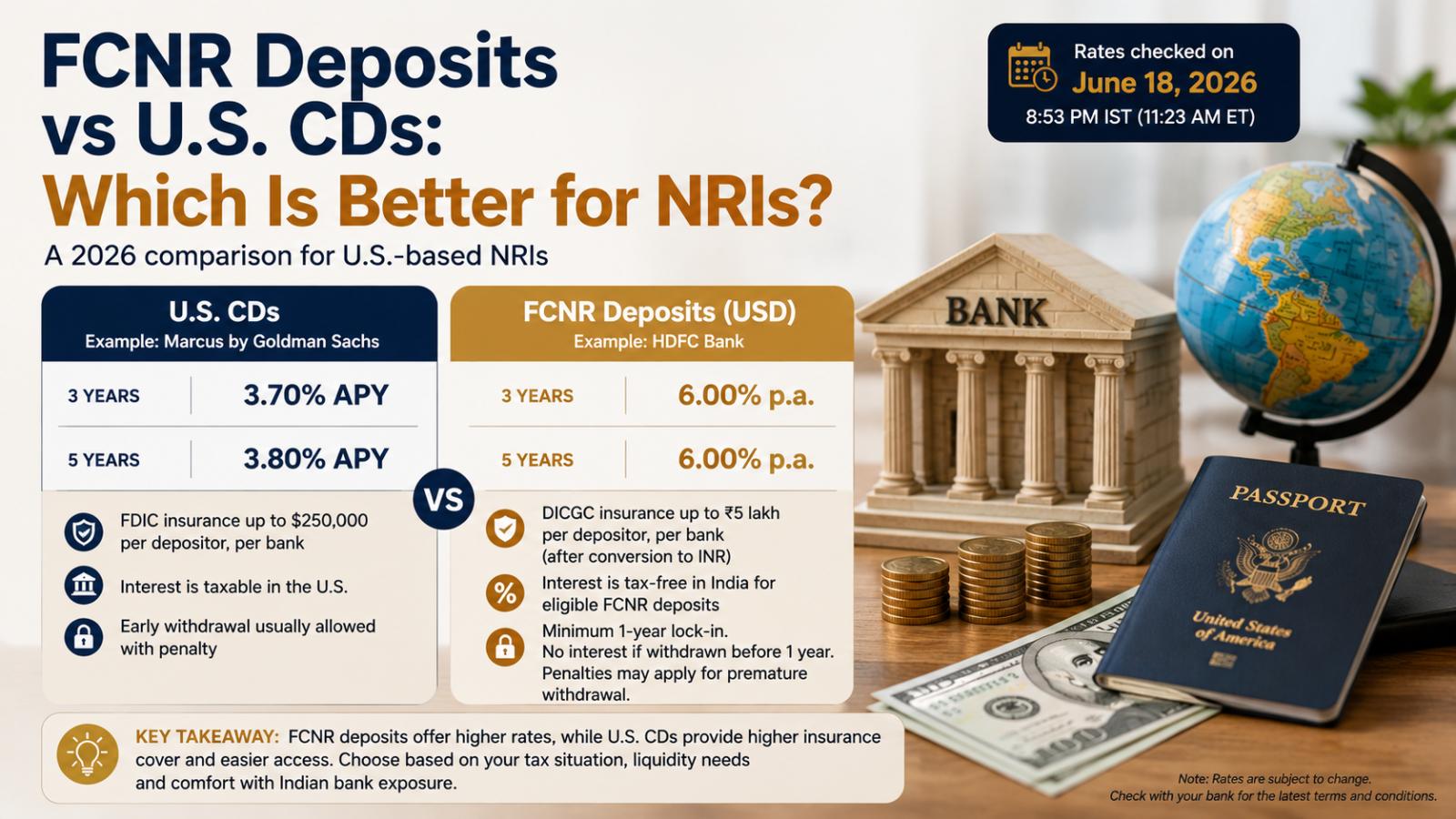
As of Thursday, June 18, 2026, HDFC Bank listed 6.00% annually on eligible three- to five-year U.S. dollar FCNR deposits. Marcus by Goldman Sachs listed 3.70% APY on a three-year CD and 3.80% APY on a five-year CD.
Add after the second paragraph of the introduction, before the heading “FCNR Deposits vs U.S. CDs: Rate Snapshot.”
FCNR Deposits vs U.S. CDs: Rate Snapshot
| Deposit | 3-year rate | 5-year rate |
|---|---|---|
| HDFC Bank USD FCNR | 6.00% p.a. | 6.00% p.a. |
| Marcus U.S. CD | 3.70% APY | 3.80% APY |
The quoted measures are not identical: FCNR banks may state an annual interest rate, while U.S. banks generally advertise APY, which reflects compounding.
Why an FCNR Deposit May Appeal
An FCNR deposit keeps principal and interest in the chosen foreign currency, avoiding direct rupee-conversion risk. Eligible interest is tax-free in India, and the balance is repatriable.
NRIs who are still deciding between foreign-currency and rupee-based accounts can read our detailed comparison of FCNR, NRE and NRO accounts, including their currency, tax and repatriation differences.
For U.S. citizens and resident aliens, however, foreign interest generally remains reportable as worldwide income. FBAR or Form 8938 reporting may also apply, depending on account values and individual circumstances.
Liquidity can be restrictive. FCNR deposits withdrawn before completing one year generally earn no interest, while longer promotional deposits may carry a one-year lock-in and premature-withdrawal penalty.
Deposit insurance is also different. Eligible FCNR deposits at insured Indian banks are covered by DICGC only up to ₹5 lakh per depositor per bank after conversion to rupees.
Why a U.S. CD May Be Simpler
A CD at an FDIC-insured U.S. bank is generally covered up to $250,000 per depositor, per bank and per ownership category. It also keeps the funds within the U.S. banking system and avoids foreign-account administration.
U.S. CD interest is taxable, and early withdrawals usually carry penalties. However, domestic access, clearer insurance coverage and shorter-term choices may outweigh a lower rate for some savers.
For NRIs comfortable holding money with an Indian bank and meeting U.S. reporting obligations, an FCNR deposit may offer the stronger pre-tax rate. For those prioritizing insurance coverage, simpler compliance and access to funds in the United States, a U.S. CD may be more practical.
The decision should be based on net after-tax return, deposit insurance, withdrawal rules, bank strength and reporting obligations—not the headline rate alone.