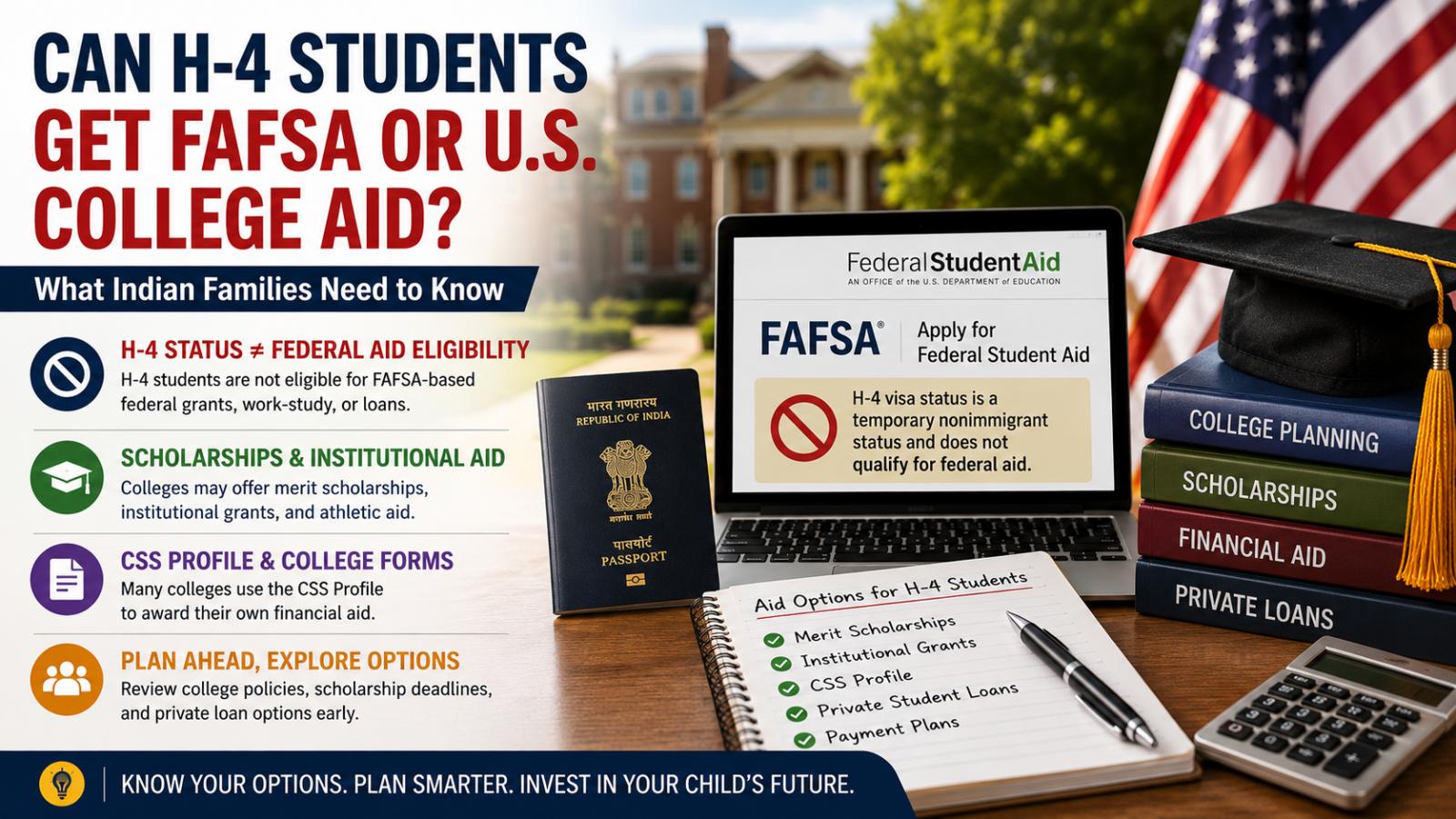
H-4 students can attend U.S. colleges, but H-4 status alone does not qualify them for FAFSA-based federal grants, work-study or loans. Families should explore institutional aid, merit scholarships, CSS Profile colleges and immigration-status changes.
Children of H-1B workers often complete high school in the United States and apply to American colleges while remaining in H-4 dependent status. They may attend school without changing to F-1 status, but admission permission and financial-aid eligibility are separate issues.
H-4 Status Does Not Qualify for Federal Aid
Students generally must be U.S. citizens, nationals, permanent residents or members of another eligible-noncitizen category to receive federal grants, work-study or student loans.
Federal Student Aid guidance specifically lists H-series visas among temporary nonimmigrant categories that do not establish eligibility for federal Title IV aid. Therefore, H-4 status alone does not qualify a student for Pell Grants, federal work-study or Direct Loans.
An SSN Does Not Change Immigration Eligibility
Some H-4 students may have Social Security numbers because of earlier or separate circumstances. However, an SSN by itself does not prove federal student-aid eligibility.
Students normally need an SSN to create a StudentAid.gov account, except for limited categories such as citizens of the Freely Associated States. Families should verify the student’s actual immigration classification rather than treating an SSN as proof of eligibility.
College Grants and Scholarships May Be Available
Federal ineligibility does not automatically eliminate every form of college assistance. Colleges may offer merit scholarships, athletic awards, need-based institutional grants or international-student aid under their own rules.
The CSS Profile is used by participating colleges and scholarship programs to award nonfederal institutional aid. It collects details about family income, assets and expenses, including information from families with finances outside the United States.
H-4 students should ask each college:
- Whether they are treated as domestic or international applicants
- Whether institutional aid is available to H-4 dependents
- Whether the CSS Profile or another form is required
- Whether merit scholarships have separate deadlines
- Whether state residency affects tuition
Parent PLUS Loans May Also Be Unavailable
Federal Parent PLUS eligibility generally requires both the borrowing parent and the dependent student to be U.S. citizens, nationals or eligible noncitizens. H-1B or H-4 status alone does not meet that requirement.
Families may need to compare savings, payment plans, scholarships and private education loans. Private loans can require a creditworthy U.S. citizen or permanent-resident cosigner and should be reviewed carefully before borrowing.
Plan Before College Applications Begin
H-4 families should calculate the full four-year net cost rather than relying on the advertised tuition price. Scholarship deadlines, immigration status, work authorization and access to loans can substantially affect affordability.
A later change to permanent residence or another eligible status may alter federal-aid eligibility, but families should build the original college plan around the student’s confirmed status when aid applications are submitted.