





















#fafsa
Can H-1B Parents Get Parent PLUS Loans for College?
H-1B parents generally cannot obtain Parent PLUS loans based on H-1B status alone, even when their child is a U.S. citizen. Families may still use FAFSA, student federal loans, institutional aid, 529 funds and other financing options. An H-1B parent may help a child complete the FAFSA, but that does not automatically make the parent eligible to borrow a federal Parent PLUS loan.
Can H-1B Parents Get Parent PLUS Loans for College?
H-1B parents generally cannot obtain Parent PLUS loans based on H-1B status alone, even when their child is a U.S. citizen. Families may still use FAFSA, student federal loans, institutional aid, 529 funds and other financing options. An H-1B parent may help a child complete the FAFSA, but that does not automatically make the parent eligible to borrow a federal Parent PLUS loan.
How 529 Plans Work for NRI and Indian-American Families
A 529 plan for NRI families can provide tax-advantaged savings for U.S. education and certain eligible foreign colleges. Indian-American parents should verify qualified expenses, FAFSA treatment, state tax benefits and cross-border tax consequences. A 529 plan can help NRI and Indian-American families save for college without immediately sacrificing retirement funds. Contributions are made with after-tax
How 529 Plans Work for NRI and Indian-American Families
A 529 plan for NRI families can provide tax-advantaged savings for U.S. education and certain eligible foreign colleges. Indian-American parents should verify qualified expenses, FAFSA treatment, state tax benefits and cross-border tax consequences. A 529 plan can help NRI and Indian-American families save for college without immediately sacrificing retirement funds. Contributions are made with after-tax
Can H-4 Students Get FAFSA or U.S. College Aid?
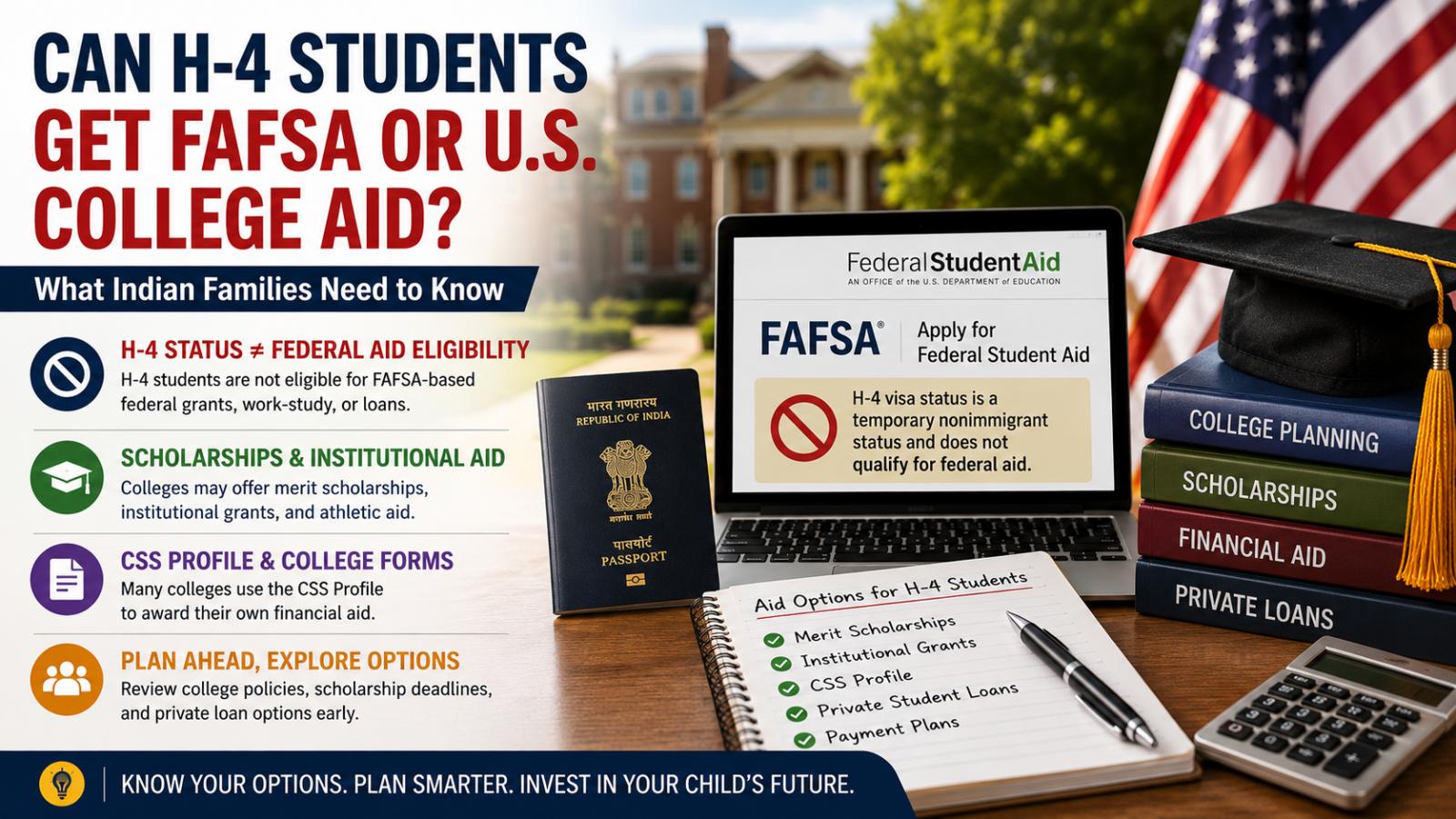
H-4 students can attend U.S. colleges, but H-4 status alone does not qualify them for FAFSA-based federal grants, work-study or loans. Families should explore institutional aid, merit scholarships, CSS Profile colleges and immigration-status changes. Children of H-1B workers often complete high school in the United States and apply to American colleges while remaining in H-4 dependent status. They may attend school without
Can H-4 Students Get FAFSA or U.S. College Aid?
H-4 students can attend U.S. colleges, but H-4 status alone does not qualify them for FAFSA-based federal grants, work-study or loans. Families should explore institutional aid, merit scholarships, CSS Profile colleges and immigration-status changes. Children of H-1B workers often complete high school in the United States and apply to American colleges while remaining in H-4 dependent status. They may attend school without
FAFSA for NRI Families With Foreign Income and Assets
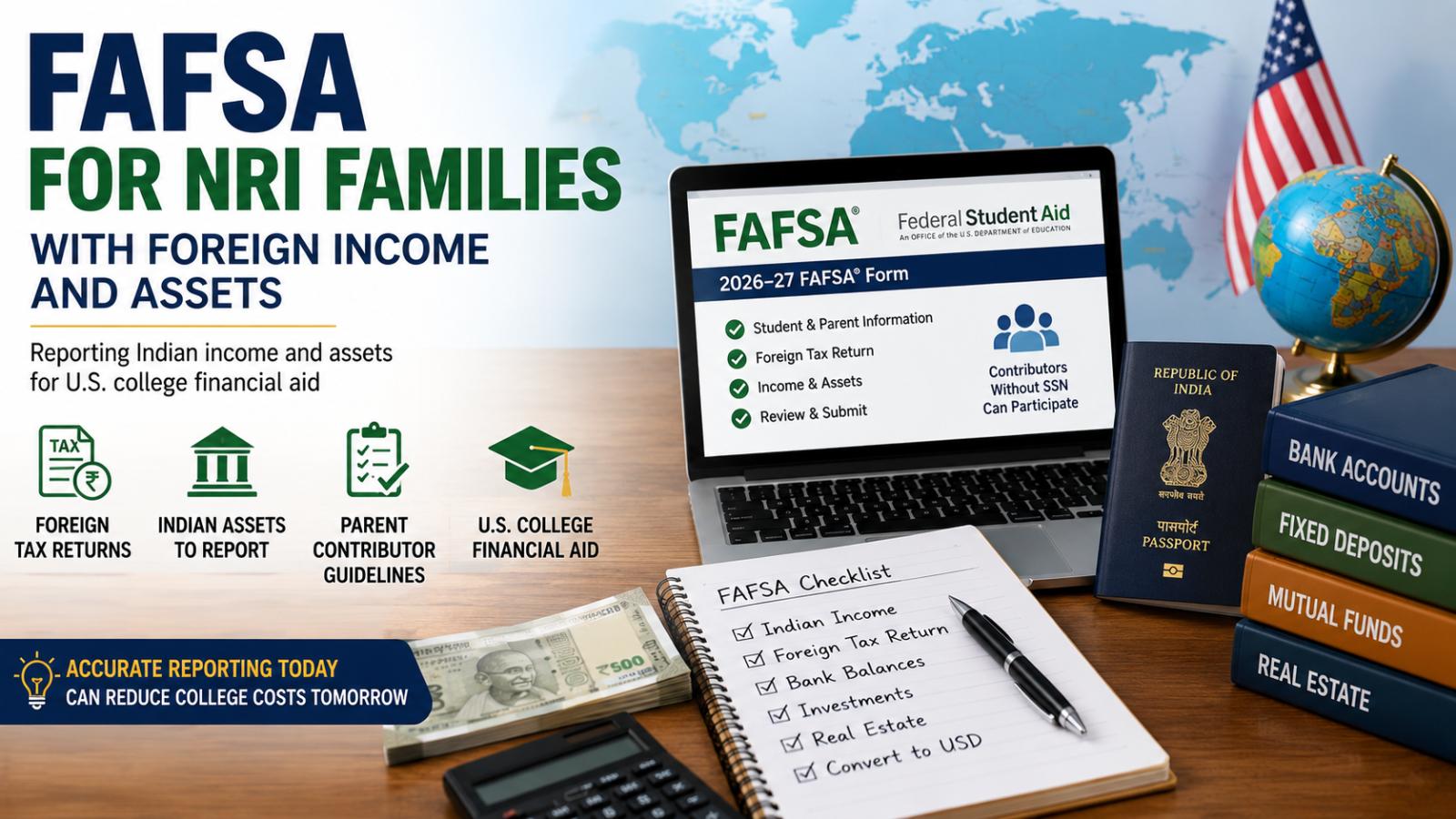
FAFSA for NRI families can involve Indian tax returns, foreign income, bank balances and investments. Parents living abroad may participate without a Social Security number, but the student’s citizenship or eligible-noncitizen status determines access to federal aid. FAFSA can be confusing for NRI families whose income, tax records and assets are divided between India and the United States. The form remains relevant when
FAFSA for NRI Families With Foreign Income and Assets
FAFSA for NRI families can involve Indian tax returns, foreign income, bank balances and investments. Parents living abroad may participate without a Social Security number, but the student’s citizenship or eligible-noncitizen status determines access to federal aid. FAFSA can be confusing for NRI families whose income, tax records and assets are divided between India and the United States. The form remains relevant when
Should NRI Parents Use Retirement Savings for College?
A $300,000 college-cost dilemma shows why NRI parents must balance a child’s U.S. education with retirement security. The decision should consider 529 savings, FAFSA foreign-income reporting, withdrawal taxes, scholarships and affordable college alternatives. A U.S. family earning about $550,000 annually is considering spending roughly $300,000 so its daughter can attend a preferred college. The parents have approximately $1.2 million across
Should NRI Parents Use Retirement Savings for College?
A $300,000 college-cost dilemma shows why NRI parents must balance a child’s U.S. education with retirement security. The decision should consider 529 savings, FAFSA foreign-income reporting, withdrawal taxes, scholarships and affordable college alternatives. A U.S. family earning about $550,000 annually is considering spending roughly $300,000 so its daughter can attend a preferred college. The parents have approximately $1.2 million across
College Financial Aid Under $250,000: FAFSA, CSS Profile and Net Cost Explained
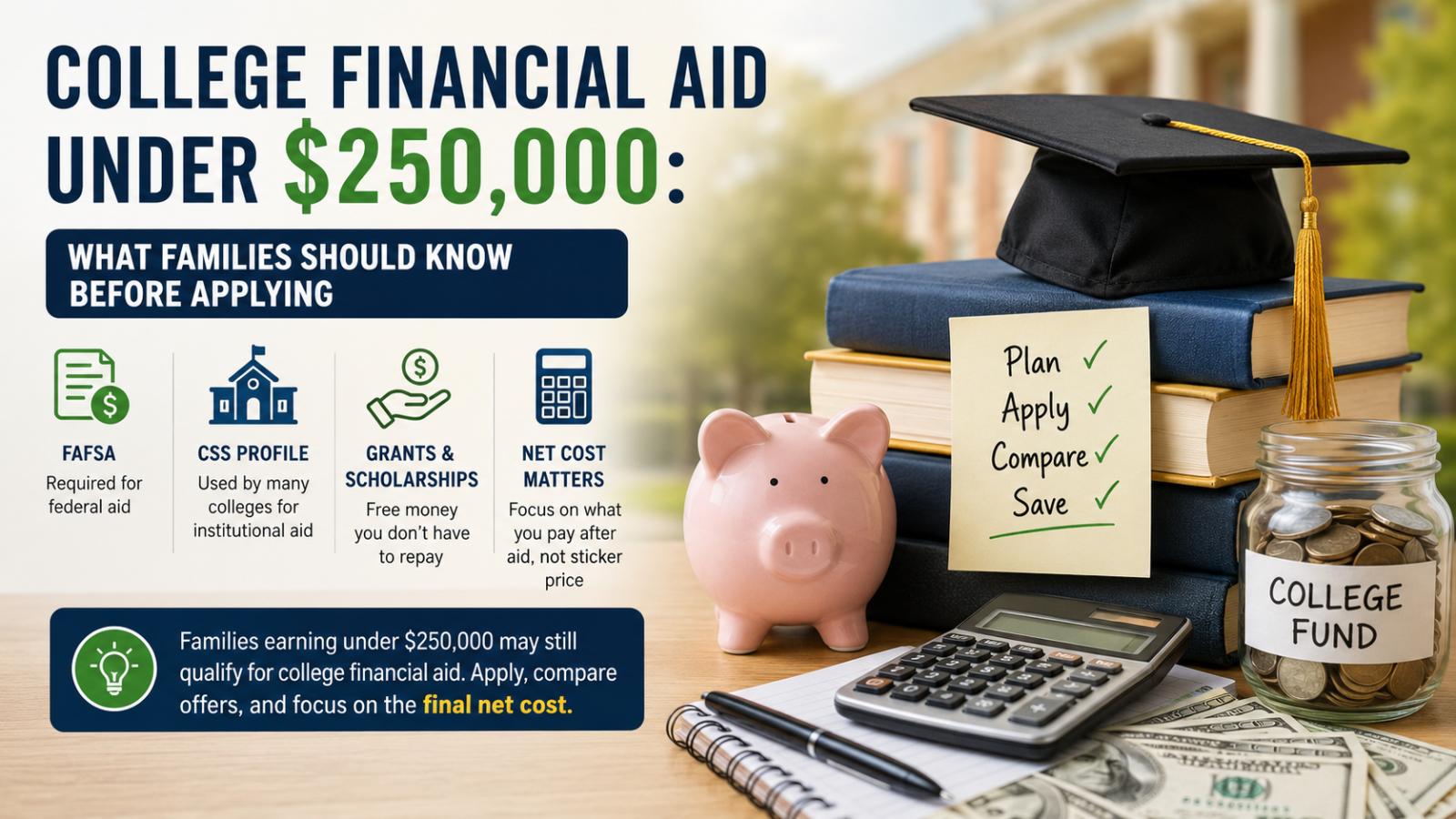
Families earning under $250,000 may still qualify for college financial aid, but the amount depends on the school, household finances, assets, application forms and the college’s total cost of attendance. There is no single U.S. rule that gives every family below $250,000 free tuition. Some selective private universities offer generous income-based grants, while public colleges and smaller institutions may use different formulas. The final amount often depends on the difference be
College Financial Aid Under $250,000: FAFSA, CSS Profile and Net Cost Explained
Families earning under $250,000 may still qualify for college financial aid, but the amount depends on the school, household finances, assets, application forms and the college’s total cost of attendance. There is no single U.S. rule that gives every family below $250,000 free tuition. Some selective private universities offer generous income-based grants, while public colleges and smaller institutions may use different formulas. The final amount often depends on the difference be


