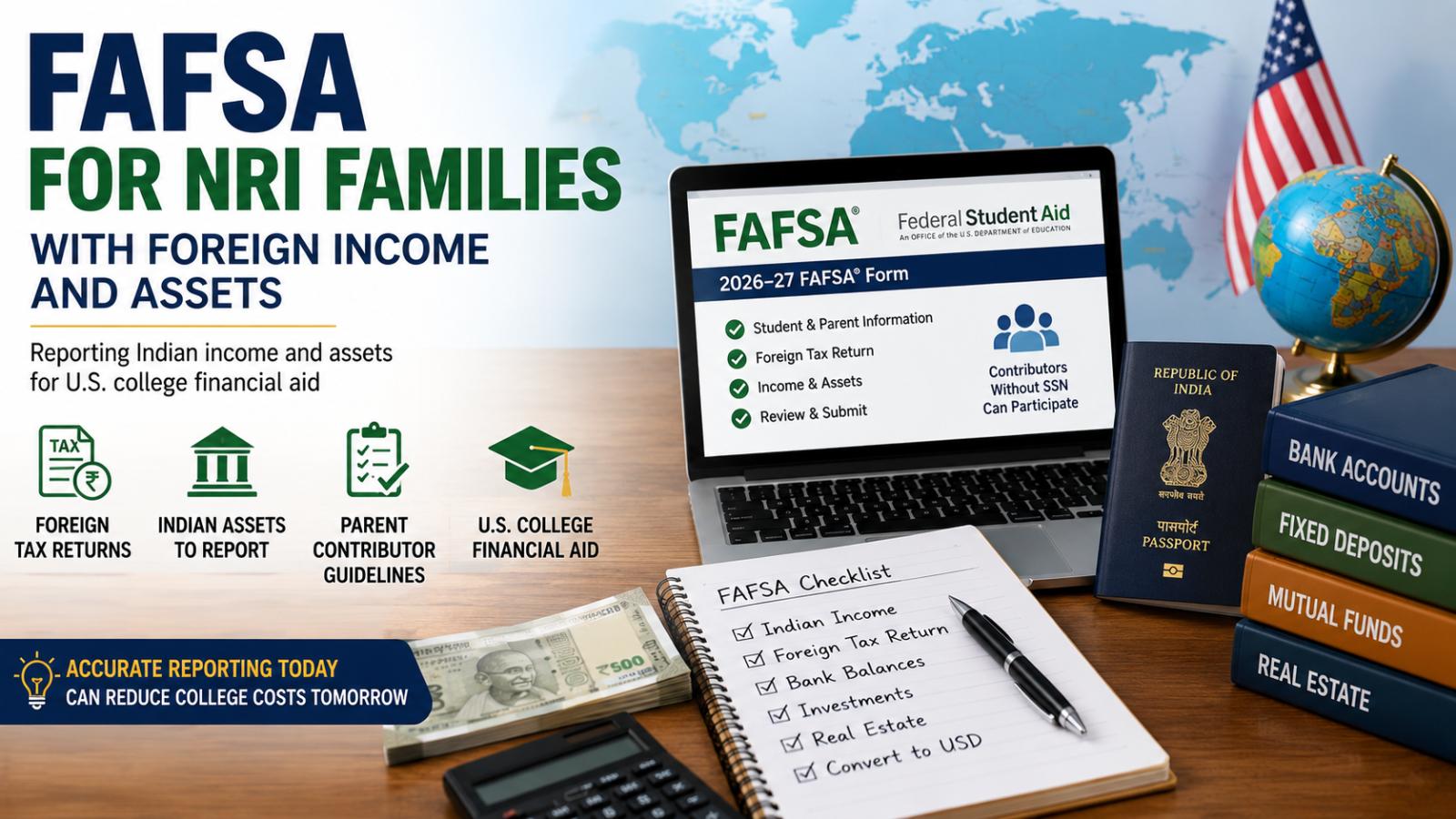
FAFSA for NRI families can involve Indian tax returns, foreign income, bank balances and investments. Parents living abroad may participate without a Social Security number, but the student’s citizenship or eligible-noncitizen status determines access to federal aid.
FAFSA can be confusing for NRI families whose income, tax records and assets are divided between India and the United States. The form remains relevant when a dependent student has parents abroad, but federal aid eligibility depends on the student’s status.
Families should also decide whether they can meet college costs without weakening retirement security. This guide on whether NRI parents should use retirement savings for college explains how to balance education expenses with long-term financial needs.
Student Eligibility Comes First
A student generally must be a U.S. citizen or eligible noncitizen to receive federal student aid. Green-card holders usually qualify as eligible noncitizens, while having NRI parents does not by itself establish eligibility.
Families with a child in dependent visa status should separately review whether H-4 students can get FAFSA or U.S. college aid, because completing the FAFSA does not automatically establish federal-aid eligibility.
Dependent students must provide required parent information. Under the 2026–27 process, a parent or spouse contributor without a Social Security number can create a StudentAid.gov account and complete the required section.
Reporting Indian Income on FAFSA
When parents living in India will also fund tuition, they should review how Indian parents can pay U.S. college fees from India, including LRS limits, TCS treatment and required bank documents.
Parents using an Indian or other foreign tax return must enter equivalent figures covering wages, dividends, capital gains, business income, retirement distributions and other income. Amounts must be converted into U.S. dollars using a published exchange rate near the FAFSA completion date.
Families should use the requested tax year and retain the foreign return and currency-conversion record in case the college seeks clarification. The 2026–27 parent guidance specifically warns families not to substitute a different year’s tax information.
Which Indian Assets May Be Reported?
Parents should understand how 529 plans work for NRI and Indian-American families, including FAFSA reporting, qualified withdrawals and the treatment of unused education funds.
FAFSA asks for current asset values on the filing date. Indian bank balances, fixed deposits, mutual funds, investment property and business interests may fall within reportable categories, depending on ownership and FAFSA definitions.
A primary residence, life insurance and qualifying retirement plans are excluded from reported investments. A 529 education account may still be reported under the applicable parent or student asset rules.
Review Before Accepting Aid
H-1B families should not assume that completing the FAFSA makes a parent eligible for federal borrowing. Before including parent debt in the college budget, review whether H-1B parents can get Parent PLUS loans for college .
Parents should identify the correct contributors, convert foreign amounts consistently and avoid excluding assets only because they are held in India. After processing, the student can review the FAFSA Submission Summary, identify problems and make permitted corrections.
Accurate reporting gives colleges a consistent financial picture. Families with trusts, companies or complicated cross-border owners