




- Home
- Articles
- NRI Updates
- 2026
- July
NRI Updates: Visa, Immigration & Indian Diaspora News | NRIPage

Can H-1B Parents Get Parent PLUS Loans for College?
H-1B parents generally cannot obtain Parent PLUS loans based on H-1B status alone, even when their child is a U.S. citizen. Families may still use FAFSA, student federal loans, institutional aid, 529 funds and other financing options. An H-1B parent may help a child complete the FAFSA, but that does not automatically make the parent eligible to borrow a federal Parent PLUS loan.
100% cool
Can H-1B Parents Get Parent PLUS Loans for College?
H-1B parents generally cannot obtain Parent PLUS loans based on H-1B status alone, even when their child is a U.S. citizen. Families may still use FAFSA, student federal loans, institutional aid, 529 funds and other financing options. An H-1B parent may help a child complete the FAFSA, but that does not automatically make the parent eligible to borrow a federal Parent PLUS loan.
How Indian Parents Can Pay U.S. College Fees From India
Indian parents can pay U.S. college fees from India through authorized banks under the Liberalised Remittance Scheme. Families should understand the $250,000 annual limit, current TCS rules, education-loan exemption, university instructions and currency costs. Parents living in India can send money for a child’s U.S. tuition, housing and other education expenses through authorized foreign-exchange chann
How Indian Parents Can Pay U.S. College Fees From India
Indian parents can pay U.S. college fees from India through authorized banks under the Liberalised Remittance Scheme. Families should understand the $250,000 annual limit, current TCS rules, education-loan exemption, university instructions and currency costs. Parents living in India can send money for a child’s U.S. tuition, housing and other education expenses through authorized foreign-exchange chann
How 529 Plans Work for NRI and Indian-American Families
A 529 plan for NRI families can provide tax-advantaged savings for U.S. education and certain eligible foreign colleges. Indian-American parents should verify qualified expenses, FAFSA treatment, state tax benefits and cross-border tax consequences. A 529 plan can help NRI and Indian-American families save for college without immediately sacrificing retirement funds. Contributions are made with after-tax
How 529 Plans Work for NRI and Indian-American Families
A 529 plan for NRI families can provide tax-advantaged savings for U.S. education and certain eligible foreign colleges. Indian-American parents should verify qualified expenses, FAFSA treatment, state tax benefits and cross-border tax consequences. A 529 plan can help NRI and Indian-American families save for college without immediately sacrificing retirement funds. Contributions are made with after-tax
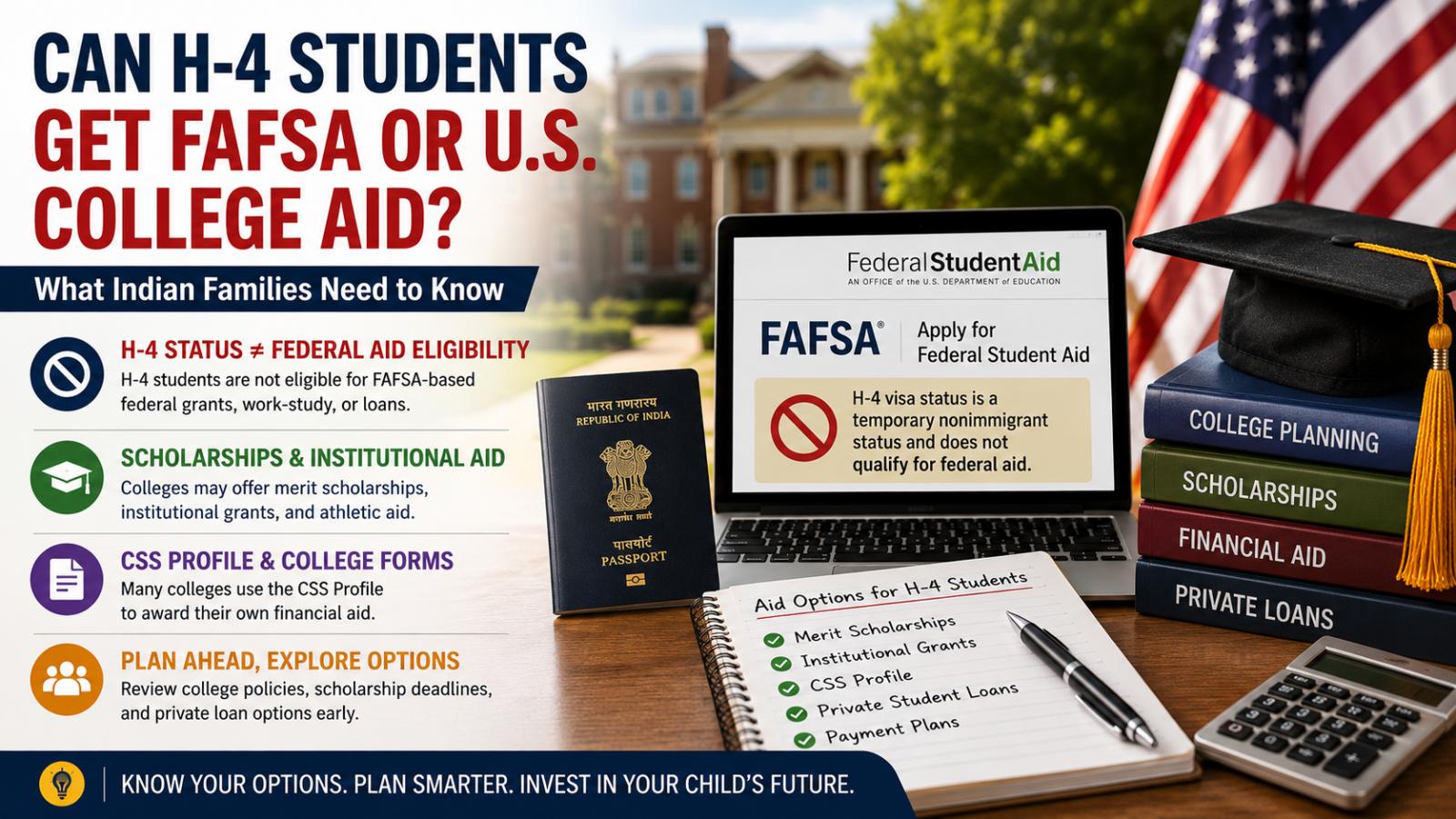
Can H-4 Students Get FAFSA or U.S. College Aid?
H-4 students can attend U.S. colleges, but H-4 status alone does not qualify them for FAFSA-based federal grants, work-study or loans. Families should explore institutional aid, merit scholarships, CSS Profile colleges and immigration-status changes. Children of H-1B workers often complete high school in the United States and apply to American colleges while remaining in H-4 dependent status. They may attend school without
Can H-4 Students Get FAFSA or U.S. College Aid?
H-4 students can attend U.S. colleges, but H-4 status alone does not qualify them for FAFSA-based federal grants, work-study or loans. Families should explore institutional aid, merit scholarships, CSS Profile colleges and immigration-status changes. Children of H-1B workers often complete high school in the United States and apply to American colleges while remaining in H-4 dependent status. They may attend school without
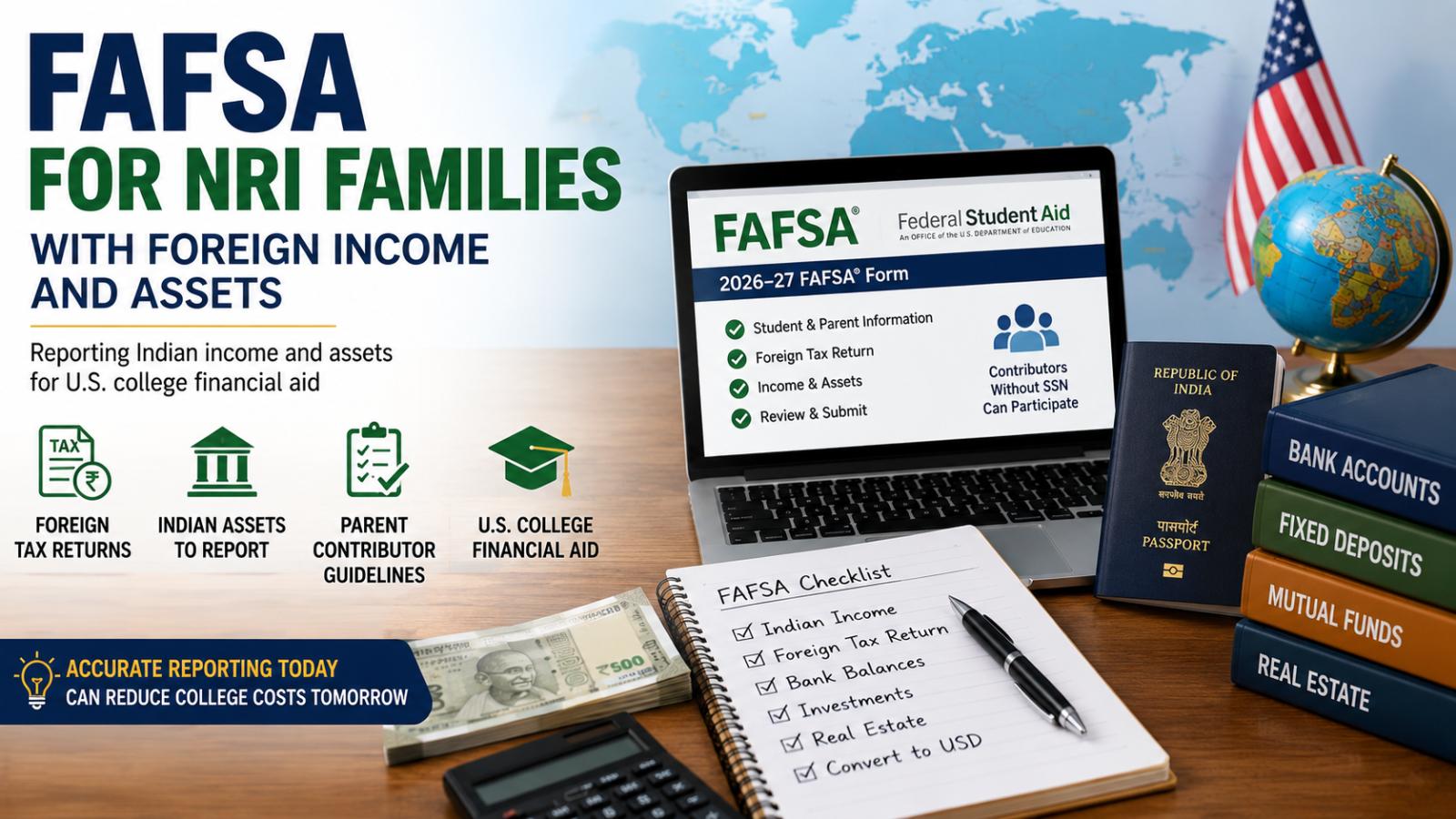
FAFSA for NRI Families With Foreign Income and Assets
FAFSA for NRI families can involve Indian tax returns, foreign income, bank balances and investments. Parents living abroad may participate without a Social Security number, but the student’s citizenship or eligible-noncitizen status determines access to federal aid. FAFSA can be confusing for NRI families whose income, tax records and assets are divided between India and the United States. The form remains relevant when
FAFSA for NRI Families With Foreign Income and Assets
FAFSA for NRI families can involve Indian tax returns, foreign income, bank balances and investments. Parents living abroad may participate without a Social Security number, but the student’s citizenship or eligible-noncitizen status determines access to federal aid. FAFSA can be confusing for NRI families whose income, tax records and assets are divided between India and the United States. The form remains relevant when