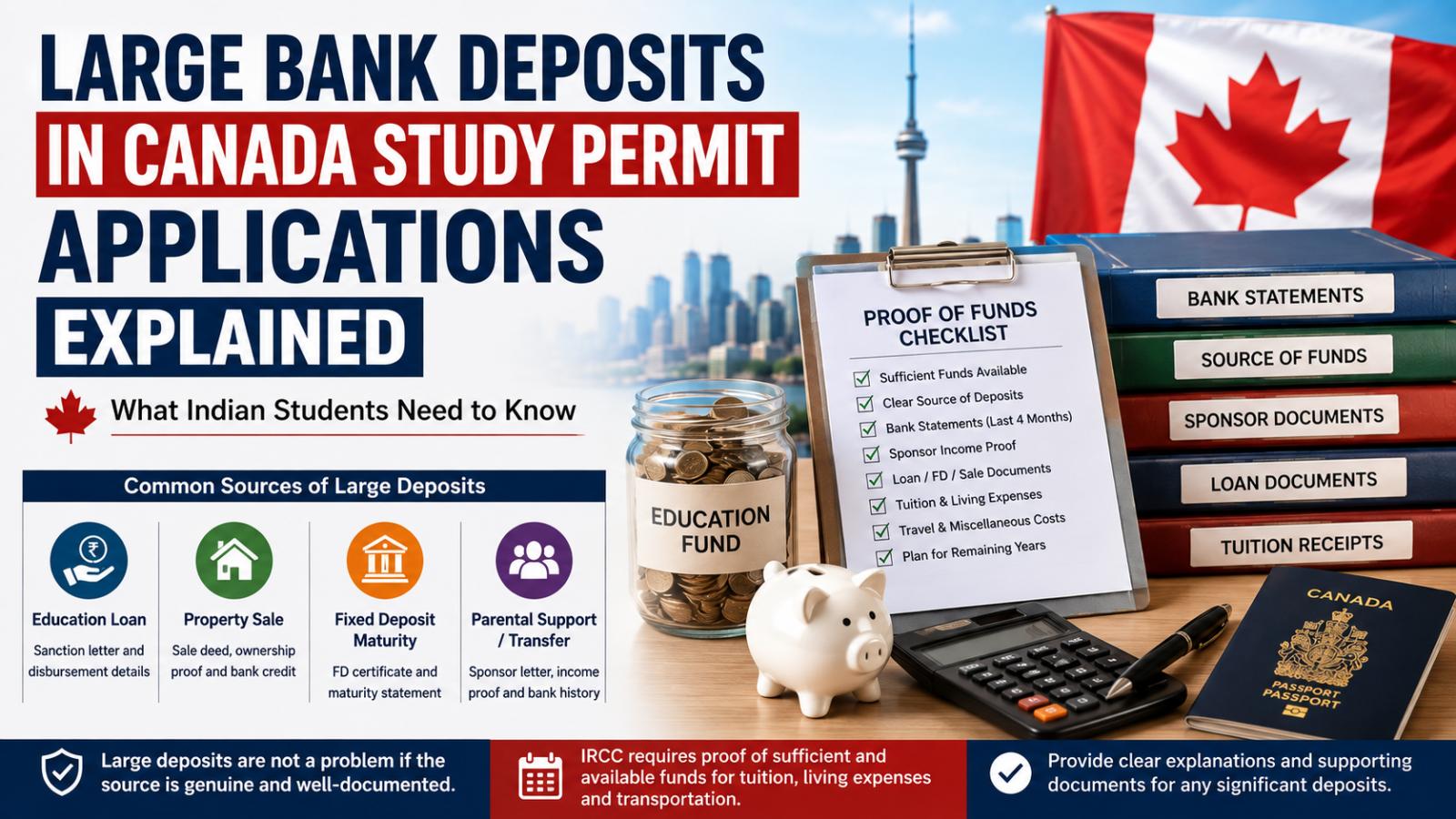
Large bank deposits in Canada study permit applications may require explanation when they do not match the account’s normal activity. Indian students should connect recent transfers to reliable records, sponsor income and a realistic plan covering tuition, living and travel costs.
Do large deposits cause study permit refusal?
A large or recent bank deposit does not automatically lead to refusal of a Canadian study permit. IRCC does not publish a universal maximum deposit or require every applicant to hold the full balance for a fixed period.
However, Canadian regulations require students to have sufficient and available funds, without working in Canada, to pay tuition, living expenses and transportation. Officers may therefore examine whether the money genuinely belongs to the applicant or sponsor and remains available for education costs.
Why bank transaction history matters
IRCC lists statements covering the previous four months as one accepted form of financial evidence. These statements show more than the closing balance; they provide a record of deposits, withdrawals and regular income.
For applications submitted on or after Monday, September 1, 2025, one student studying outside Quebec must show C$22,895 for first-year living expenses. This amount excludes tuition and transportation and is updated annually.
How applicants can explain major deposits
The correct evidence depends on the source of the money. A matured fixed deposit may be supported by the original deposit certificate, maturity statement and corresponding bank credit.
Education-loan funds can be documented through the sanction letter, disbursement records and tuition-payment receipts. Property-sale proceeds may be supported by ownership records, the sale agreement and proof that the payment entered the declared account.
Money transferred by parents may require the parents’ bank statements, income records and a financial-support letter explaining the relationship and amount provided. These are practical examples, not a universal IRCC checklist.
Present one consistent financial picture
Applicants should include a brief letter explaining significant deposits and reference the supporting documents attached to the application. The declared source should be consistent across bank records, sponsor documents, tuition receipts and the overall study budget.
Students in programs lasting longer than one year must prove first-year financial support. The application should also present a credible plan for financing the remaining study period.
A recent deposit may be accepted when its source and availability are clearly documented. Problems are more likely when the balance cannot be connected to reliable records, contradicts the sponsor’s declared income or appears unavailable for the student’s actual expenses.