Last reviewed: July 18, 2026
Moving abroad changes more than your address. Your Indian bank accounts, tax status, investments, insurance, property records, nominees and digital access may all need attention. These issues may not feel urgent when you leave, but a failed transaction, expired mobile number, tax notice or missing document can later create stress. This practical checklist explains what to update in India during the first 30 days, within 90 days and annually after moving abroad.
Understand When Your Residential Status Changes
Do not assume that boarding an international flight automatically settles your residential status. India applies residential status differently under foreign-exchange and income-tax rules. FEMA status affects banking and certain investments, while income-tax residency is calculated separately for each tax year. Record every date on which you enter or leave India. Maintain a spreadsheet showing departure and arrival dates, purpose of travel, country of employment, Indian income and foreign income received around the time of relocation.
Tasks to Complete During the First 30 Days
1. Inform Your Indian Bank
When a resident Indian becomes a person resident outside India, the existing resident savings account should ordinarily be redesignated as an NRO account.
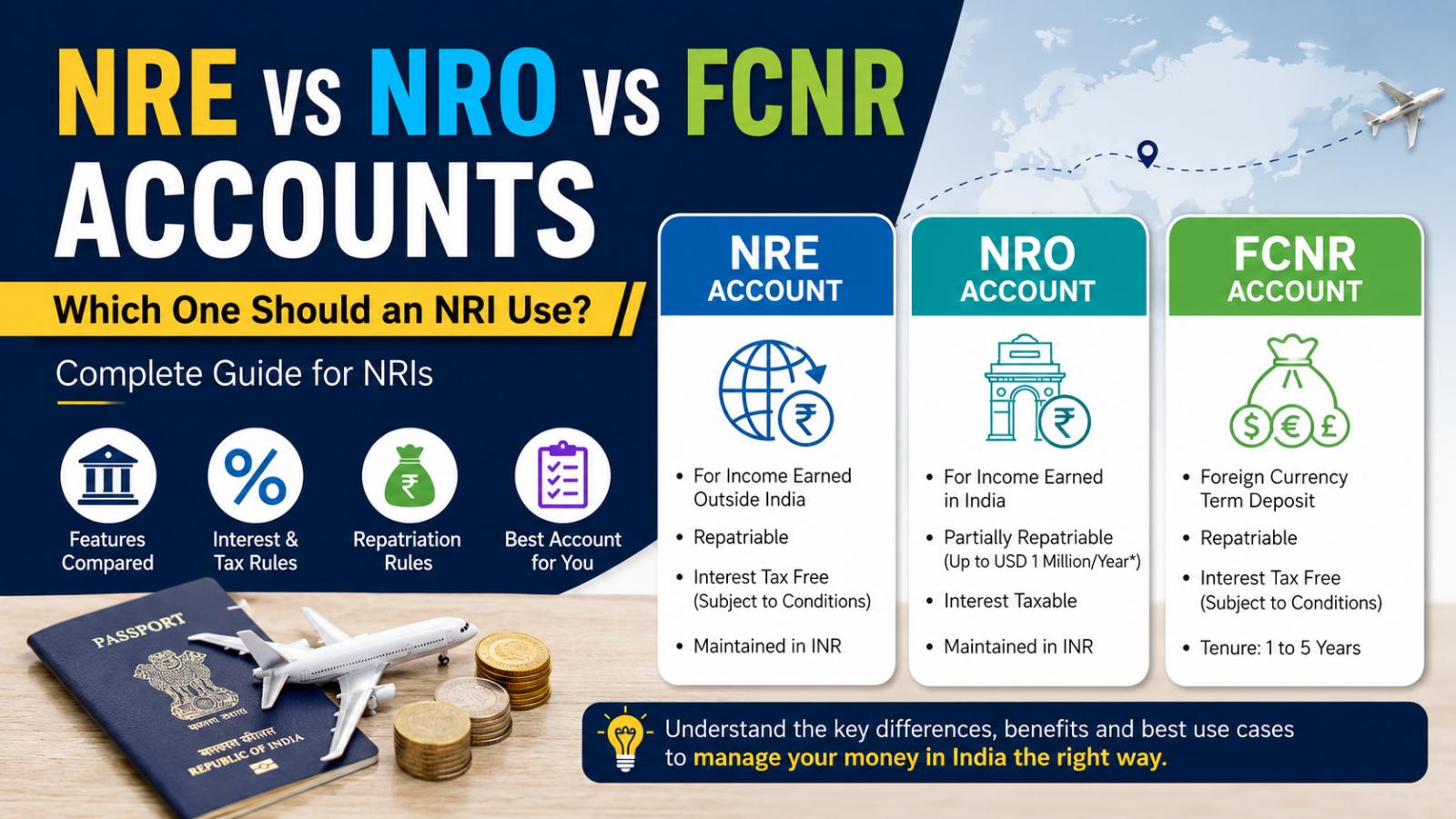
To understand which account is suitable for overseas earnings, Indian income and foreign-currency savings, read our complete guide on NRE vs NRO vs FCNR accounts.
Contact every Indian bank where you hold accounts, deposits, lockers, loans or credit cards. Banks commonly request a passport, visa or residence permit, overseas address proof, PAN and photographs.
Ask whether the account can be redesignated while preserving its transaction history.
2. Separate Foreign Earnings From Indian Income
Using one account for every transaction can make taxation and repatriation difficult to track.
A clearer structure is:
- NRE account for eligible overseas earnings remitted to India
- NRO account for rent, pension, dividends and other Indian receipts
- FCNR deposit for eligible foreign-currency term deposits
NRE and FCNR funds are generally repatriable. NRO balances have additional conditions, documentation and tax requirements.
3. Protect Your Indian Mobile Number and Email
Your Indian number may be linked to bank OTPs, UPI, Aadhaar, the income-tax portal, credit cards, demat accounts, mutual funds, insurance and property portals.
Check international roaming, recharge validity and retention requirements. Add a reliable email address and recovery options when possible.
Never allow a number linked to financial accounts to expire before replacing it.
4. Update Contact Details Everywhere
Updating one bank does not update all institutions.
Review contact details with banks, the income-tax portal, mutual funds, demat accounts, insurers, former employers, lenders, credit-card issuers, pension accounts and property associations.
Save the acknowledgement for every update. Notices may otherwise continue going to an old Indian address.
5. Build an NRI Tax Calendar
Tax residency must be reviewed every year.
Track India travel days, Indian and foreign tax deadlines, rental income, interest certificates, capital gains, tax deducted at source and Tax Residency Certificate requirements.
Tax treaties may reduce double taxation, but supporting documents may be required.
Consult a chartered accountant familiar with India and your country of residence if you hold property, shares, business interests, stock options or income in multiple countries.
Tasks to Complete Within 90 Days
6. Update Mutual Funds, Demat Accounts and Investments
Your investments can continue after you become an NRI, but the account classification and transaction process may change.
Inform asset management companies, registrar and transfer agents, stockbrokers, depository participants and other investment providers.
Ask whether you need fresh KYC, overseas tax declarations, NRE or NRO bank mapping, or additional documents.
Do not continue investing through a profile that incorrectly shows resident status merely because transactions are still accepted.
7. Review Insurance Policies
Indian insurance may not replace overseas coverage.
Review life, health, personal accident, home, vehicle and travel insurance. Confirm where each policy provides coverage, how claims can be filed from abroad and whether your residence or occupation change must be reported.
Keep scanned policies and claim-contact details accessible to your nominee.
8. Update Nominees and Emergency Contacts
Marriage, children, relocation and family changes can make old nominations outdated.
Review nominees for bank accounts, deposits, mutual funds, demat accounts, insurance, provident fund, retirement accounts and lockers.
A nominee is not always the final legal heir, but a valid nomination can simplify the institution’s claim process.
Tell one trusted family member where important records are stored.
9. Review Indian Property Records
Becoming an NRI does not require you to sell residential or commercial property already owned in India.
Verify title documents, property-tax receipts, utility and maintenance records, rental agreements, tenant details, home-loan statements, insurance and registration records.
NRIs and OCIs can generally purchase residential and commercial property in India. Agricultural land, farmhouses and plantation property are restricted under the general route, while inheritance is treated differently.
Never purchase property based only on verbal assurances, WhatsApp images or an unverified power of attorney.
10. Create a Limited Power of Attorney When Needed
A power of attorney can allow a trusted person to collect documents, manage a rental property or complete a defined banking process.
Avoid giving unnecessarily broad powers. State what the person can do, which account or property is covered, how long the authority lasts, what is prohibited and how it can be revoked.
Property-related powers should be prepared with legal advice and completed according to applicable notarisation, adjudication or registration rules.
11. Check Your Aadhaar Details
An NRI holding a valid Indian passport can apply for Aadhaar without satisfying the usual 182-day residential condition.
Check whether your name matches your passport, your email is current, your registered mobile is active and your e-Aadhaar is securely stored.
Aadhaar is not proof of citizenship, tax residency or FEMA status. Because international numbers may not receive every message, keep a working email address linked.
12. Keep PAN and Income-Tax Access Active
PAN is required for many Indian banking, investment and property transactions.
Log in to the income-tax portal and verify your personal details, contact information, linked bank accounts, pending notices and authorised representative details.
Do not ignore the portal because tax was deducted. You may need to report income, claim a refund or respond to a notice.
13. Create an NRI Document Vault
Store encrypted copies of your passport, visa or residence permit, PAN, Aadhaar, overseas address proof, employment contract, bank records, tax returns, property documents, insurance policies, investments, will, power of attorney and nomination acknowledgements.
Use multi-factor authentication and do not keep the only copy on your phone. Give one trusted person emergency access instructions without sharing every password.
Tasks to Repeat Every Year
14. Perform an Annual NRI Compliance Review
Once a year, check:
- Whether your bank status is correct
- Every day spent in India
- New Indian income or asset sales
- Nominees and emergency contacts
- Mobile-number validity
- Expiring KYC documents
- Pending tax or financial notices
- Changes in country of residence
- Plans to return to India
Residential status and tax treatment can change from one year to another. Treat this as an annual review, not a one-time exercise.
15. Prepare for a Possible Return to India
Returning to India may require changes to NRE, NRO and FCNR accounts.
NRE accounts generally need to be redesignated or transferred to eligible resident accounts when residential status changes. FCNR deposits may usually continue until maturity, subject to applicable conditions.
Keep records of overseas asset costs, foreign bank balances, employer stock grants, retirement accounts, overseas property, insurance contracts and residency-change dates.
These records may become important if you later become taxable in India on wider categories of income.
Three Common Mistakes
“My bank will automatically know.”
Banks, immigration authorities and tax systems do not automatically complete every status update for you.
“I paid tax abroad, so India does not matter.”
India may still tax or require reporting of certain Indian-source income. Treaty relief depends on the facts and documents.
“My family knows about everything.”
Your family may know that you invested, but not the broker, policy number, nominee, property file or login-recovery process.
Your 30-Minute NRI Action Plan
Start with these five steps:
- List every Indian bank and investment account.
- Contact your bank about redesignating your resident account.
- Create a travel-day tracker.
- Update your mobile number, email and address.
- Build an encrypted document folder with emergency instructions.
You do not need to complete everything in one evening. You only need to stop postponing the first step.
Moving abroad should expand your opportunities, not leave behind forgotten accounts, missing documents and preventable compliance problems.
Reader Question: Which India-related task became unexpectedly difficult after you moved abroad? Share your experience so other NRIs can prepare.
Editorial Note: Rules vary according to residential status, transaction type, destination country and personal circumstances. Consult your bank, chartered accountant or legal adviser before making tax, investment or property decisions.