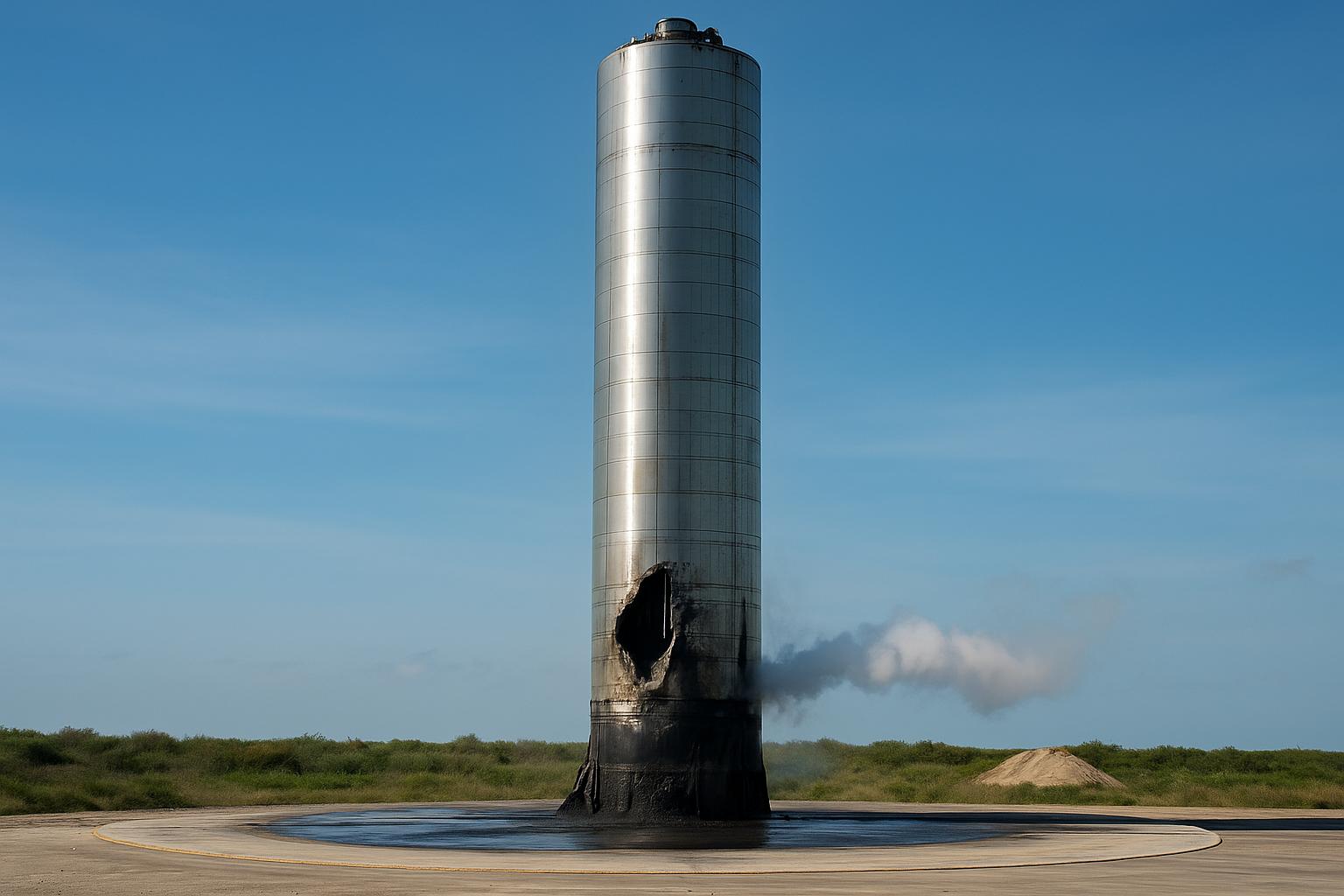
A major phase in SpaceX’s Starship test program faced an unexpected setback on Friday when Booster 18, the company’s first next-generation Block 3 Super Heavy booster, sustained significant structural damage during a ground test in South Texas. The incident occurred at SpaceX’s Massey test facility near Starbase, where the vehicle was undergoing routine gas-system pressure checks ahead of more rigorous structural proofing. Shortly after 4 a.m. local time, livestream footage captured the lower portion of the nearly 70-meter-tall booster collapsing inward as an explosion of gas and debris erupted from the test stand.
Despite the force of the event, the towering 20-story rocket remained upright. However, images taken after the anomaly showed that the liquid oxygen tank had suffered a large rupture, leaving a noticeable hole and exposing severe damage along the aft section of the booster. The visible deformation indicated that the structural integrity of the vehicle had been compromised beyond what would typically be repairable for flight.
SpaceX confirmed that Booster 18 experienced an anomaly during pressure testing of its gas systems. The company noted that no propellant had been loaded into the rocket at the time of the failure, and its Raptor engines had not yet been installed. All personnel had been cleared from the vicinity in accordance with standard safety procedures, and no injuries were reported. The controlled environment and absence of fuel likely prevented the incident from escalating into a more dangerous situation.
Preliminary assessments from the company and early evaluations by independent observers suggest that the event may have been triggered by the failure of a composite overwrapped pressure vessel, or COPV, which stores high-pressure gas. The suspected failure point appears to be located within one of the booster’s chines, where a sudden breach may have initiated the chain reaction that ultimately caused the liquid oxygen tank to rupture. COPVs have historically been a critical component in modern rocket systems, and their behavior during high-pressure testing is closely monitored.
Booster 18 held a central role in SpaceX’s upcoming plans, as it was expected to support the twelfth Starship test flight and help bring the new Pad 2 launch infrastructure at Starbase online. The loss of the vehicle represents a notable setback for the debut of the Block 3, or V3, architecture, which incorporates upgrades intended to improve performance, reliability, and reusability. With Booster 18 now unlikely to proceed toward flight, attention is shifting to the next vehicle in production, potentially Booster 19, which may become the first Block 3 booster to attempt a launch.
Although the failure is expected to affect the timing of Starship’s next major test, SpaceX emphasized that rapid development and iterative testing—successful or otherwise—remain core to its engineering approach. The company continues to pursue a fully reusable super-heavy-lift system aimed at supporting the expansion of Starlink, enabling deep-space exploration, and contributing to future Artemis lunar lander missions. The setback at Starbase serves as another reminder of the challenges inherent in developing one of the world’s most ambitious spaceflight systems, but SpaceX maintains that each test provides valuable data that will inform the next steps in the program.