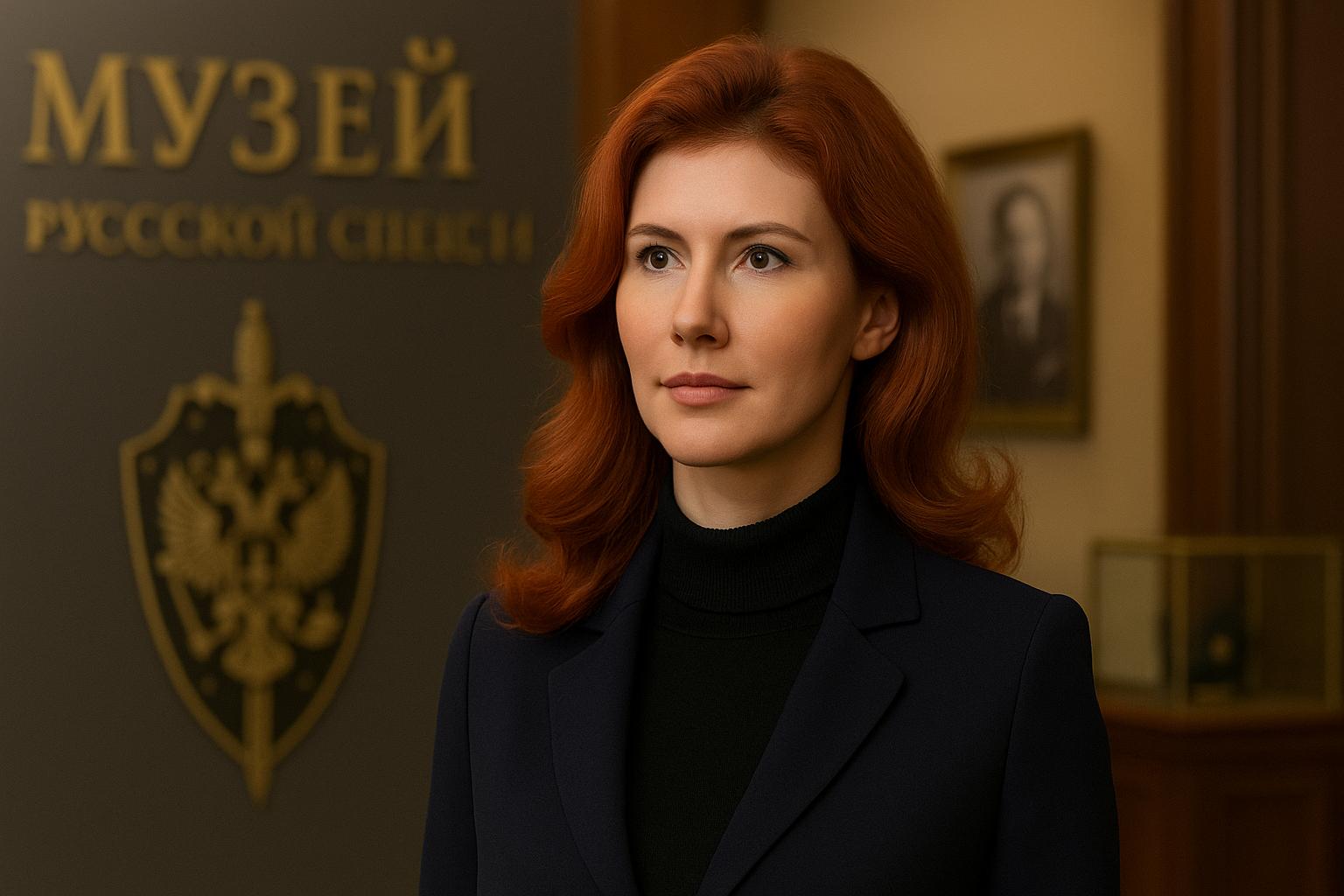
Anna Chapman, once dubbed Russia’s most glamorous secret agent, is back in the spotlight more than a decade after her dramatic exposure and expulsion from the United States in a high-profile spy swap. The former undercover operative has been appointed as the head of the newly launched Museum of Russian Intelligence, a state-linked institution associated with President Vladimir Putin’s foreign intelligence service. The move marks her return to the inner circles of Russia’s security and intelligence establishment — this time, as a public figure preserving the history of espionage.
Born as Anna Kushchenko in Volgograd, formerly known as Stalingrad, Chapman was raised in a family deeply connected to the Soviet diplomatic corps. Her father, an official in the Soviet Embassy in Kenya, exposed her early to global politics. After completing a degree in economics from the Peoples’ Friendship University in Moscow, she briefly lived in London, where she married a British psychology student named Alex Chapman in 2001. Their marriage, which lasted four years, eventually dissolved amid mutual accusations and secrecy. Chapman later claimed in her memoir Bondianna that her former husband tried to harm her — an allegation he denied.
It was during her time in London that Chapman’s transition from an ambitious entrepreneur to an intelligence operative allegedly began. According to her own account, she was recruited by an officer from Russia’s foreign intelligence service after being noticed for her sharp networking skills and access to influential business circles. After a series of psychological tests and loyalty assessments, she was drawn into a world of espionage. Chapman would later describe herself as a “female version of James Bond,” emphasizing her use of charm, confidence, and intelligence to accomplish her missions.
In 2009, Chapman relocated to New York, blending her professional ambitions with her covert activities. She established a real estate business and frequented high-profile events, gradually inserting herself into elite social networks. Investigators later revealed that she had been sending encrypted communications through specially modified laptops to her Russian handlers. Her method of operating — using charm, technology, and social media — represented a modern twist on traditional espionage tactics.
Her covert career came to an abrupt end in 2010, when the FBI arrested her as part of Operation Ghost Stories, a decade-long investigation that uncovered a deep-cover Russian spy ring in the United States. The arrest unfolded dramatically when an undercover FBI agent posing as a Russian operative handed Chapman a fake passport during a meeting in a Manhattan coffee shop. When she turned the document over to local police, federal agents moved in, capturing her and several other operatives.
The subsequent spy swap on July 8, 2010, between Russia and the United States was one of the largest since the Cold War. Ten Russian agents, including Chapman, were exchanged for four individuals imprisoned in Russia for alleged cooperation with Western intelligence services. The trade took place on the tarmac of Vienna International Airport under heavy media coverage, instantly transforming Chapman into a global sensation.
Upon her return to Russia, Chapman reinvented herself as a public personality. She hosted a television program focused on patriotism and Russian values, posed for magazine photoshoots, and became a prominent face in the youth wing of Putin’s political movement. Her social media presence, particularly on Instagram, projected a blend of glamour and nationalism — featuring her in elegant attire, fur coats, and Russian winter landscapes.
Now, under her married name Anna Romanova, she has assumed leadership of the newly established Museum of Russian Intelligence. The museum is reportedly located near Moscow’s Gorky Park and registered under the Foreign Intelligence Service (SVR), the modern successor to the KGB. The institution aims to highlight Russia’s espionage legacy, showcasing historic operations and the evolution of intelligence work through the decades.
According to Russian state sources, the museum will celebrate the achievements of the country’s intelligence officers, including those who operated abroad during the Cold War and in modern geopolitical conflicts. It is expected to feature declassified materials, artifacts, and interactive exhibits that frame espionage as a key element of national defense and pride.
While critics may view her appointment as a symbolic gesture reinforcing state narratives about loyalty and heroism, Chapman’s reemergence underscores the Kremlin’s broader strategy of merging patriotism with public fascination. For Russia, she represents both a cautionary tale and a tool of soft power — a figure who embodies the mystique of intelligence work while maintaining an aura of celebrity appeal.
Fourteen years after her arrest shook U.S.-Russia relations, Anna Chapman’s story continues to straddle the fine line between reality and myth. Her rise from disgraced spy to museum director reflects not only her personal reinvention but also the Russian state’s enduring effort to glorify its intelligence heritage. For now, the woman once accused of espionage has found her next mission — curating the history she helped shape.