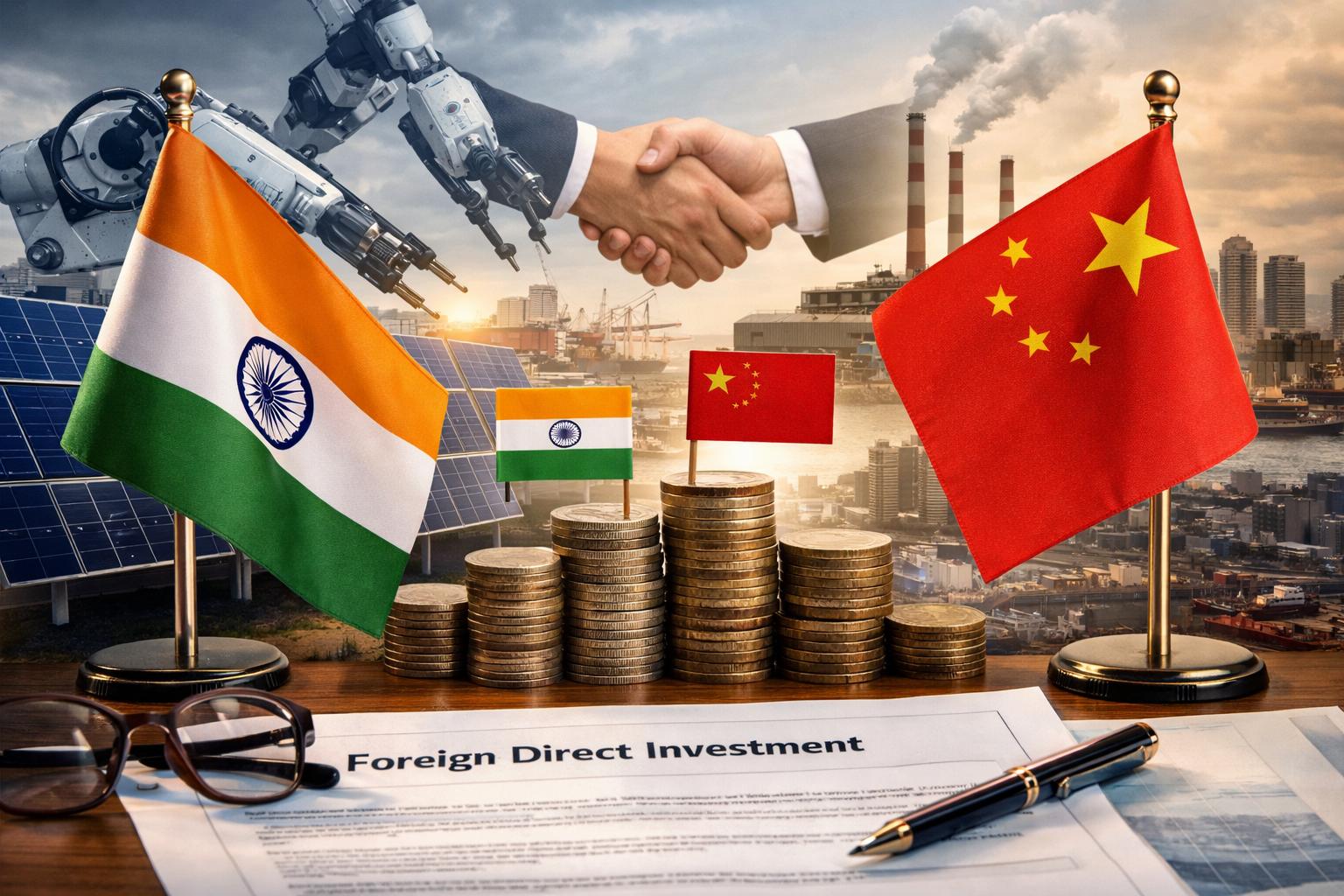
India has approved changes to its foreign direct investment policy to allow Chinese companies to invest in selected sectors, marking a cautious step toward improving economic ties between the two countries after years of strained relations. The decision was cleared by the Union Cabinet led by Prime Minister Narendra Modi and is aimed at easing investment constraints faced by certain industries while strengthening domestic manufacturing capacity.
Under the revised policy framework, Chinese firms will be permitted to invest in sectors including electronics manufacturing, capital goods and solar cell production. These sectors are considered strategically important for India’s efforts to expand industrial output and reduce dependence on imports of key components and technologies. The policy shift also reflects growing pressure from domestic industry groups that have sought easier access to foreign capital and technology.
India had imposed tighter scrutiny on investments originating from countries sharing land borders with India in 2020. The move came after violent clashes along the Himalayan frontier that significantly strained relations between the two Asian powers. As part of those restrictions, investments from Chinese entities required approval from a government review panel involving the ministries of home affairs and external affairs. The enhanced scrutiny resulted in delays and cancellations of several proposed deals involving Chinese firms and Indian companies.
One of the most prominent proposals affected by the restrictions was a plan announced in 2023 by Chinese electric vehicle manufacturer BYD to invest about $1 billion in a joint venture in India. The proposal did not move forward amid regulatory hurdles linked to the stricter FDI approval process.
Officials believe that allowing investment in specific sectors could encourage Chinese companies to establish manufacturing operations within India rather than relying solely on exports of finished goods or components. Such a shift is expected to support the government’s broader strategy to strengthen local production ecosystems while attracting advanced technology and investment capital.
The policy adjustment also comes against the backdrop of India’s widening trade deficit with China. Official data indicates that India’s trade deficit with its northern neighbor reached approximately $99 billion in the fiscal year 2025. A significant portion of these imports consists of electronics components, machinery and industrial equipment that are critical to India’s manufacturing supply chains.
Industry representatives have repeatedly argued that the earlier restrictions limited the ability of Indian manufacturers to expand production because many supply chains depend heavily on Chinese technology and investment. The easing of FDI rules is therefore expected to provide some relief to sectors seeking to scale up operations.
Policy advisers have also highlighted the potential benefits of a calibrated investment framework. India’s policy think tank, NITI Aayog, had previously recommended allowing Chinese companies to hold minority stakes in Indian firms without requiring extensive security approvals. The think tank suggested that permitting ownership of up to 24 percent could help unblock stalled deals while maintaining oversight over sensitive sectors.
The decision also reflects shifting global economic conditions. Changes in global trade patterns and the reconfiguration of supply chains have prompted several countries to reassess their investment strategies. India is seeking to position itself as an attractive manufacturing destination while balancing economic opportunities with national security considerations.
Diplomatic engagement between India and China has shown signs of cautious improvement in recent months. Prime Minister Narendra Modi visited China earlier this year, his first trip to the country in seven years, where he met President Xi Jinping to discuss steps toward stabilizing bilateral relations. Since that meeting, both countries have taken several measures aimed at facilitating economic and business engagement.
Among the recent steps are the resumption of direct commercial flights between the two countries, the easing of visa procedures for Chinese business professionals and the removal of certain restrictions on the procurement of Chinese equipment by state-run power and coal companies. These developments suggest that both governments are exploring ways to gradually rebuild economic cooperation while continuing to manage broader geopolitical differences.
While the easing of foreign investment rules does not represent a full normalization of economic ties, analysts view it as an incremental step toward a more pragmatic approach to trade and investment between Asia’s two largest economies. The coming months will likely determine how effectively the revised policy attracts investment and whether it leads to a broader revival of industrial collaboration between Indian and Chinese companies.