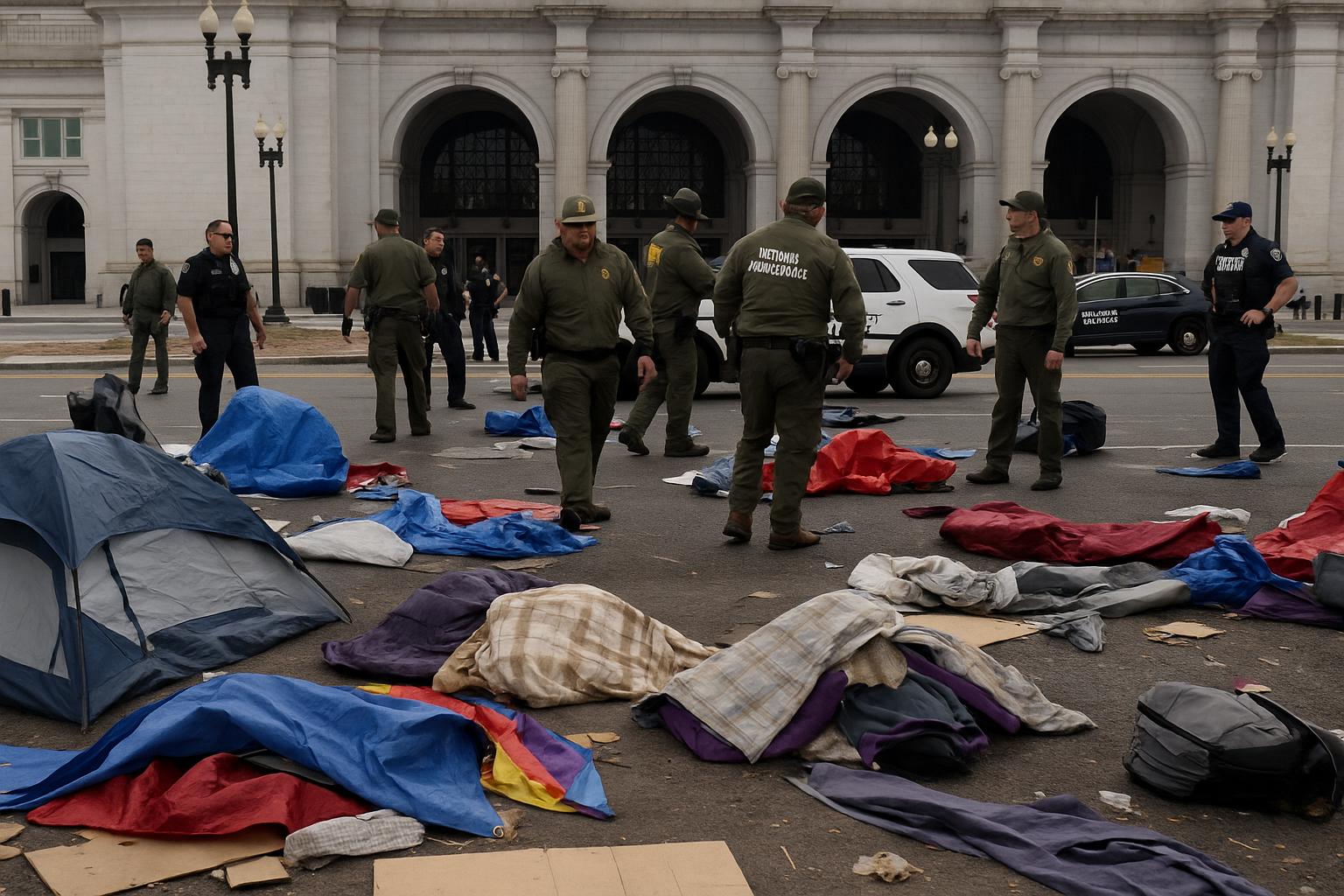
A protest encampment set up outside Washington, D.C.’s Union Station was dismantled early Friday morning by crews believed to be part of the U.S. National Park Service and United States Park Police. According to members of the activist group For Liberation and Resistance Everywhere (FLARE), the removal took place around 5 a.m., when officers arrived and began clearing tents and other property from the site. FLARE claims the action was carried out without prior notice and amounted to an unlawful seizure of their materials.
The group stated that the encampment had been authorized to remain until the end of 2025, having originally been established on May 1 of this year. Organizers insist that the sudden dismantling was not routine but politically motivated. They argue that the raid was designed to silence dissent against the administration of President Donald Trump, pointing out that much of their art and messaging was explicitly critical of the president.
Jake Adams, who oversees FLARE’s encampment, expressed frustration over the handling of the raid. According to Adams, the justification presented by officers was vague, including a claim that someone had spat on an officer—an accusation he strongly denied. Adams stressed that the group has adhered to a strict policy of nonviolence. “It’s at our core principles to be nonviolent,” he said, adding that the group has never planned or perpetrated any act of violence.
Other organizers echoed the sentiment, accusing authorities of attempting to stifle political opposition under the guise of enforcing regulations. Bailey Townley, a FLARE organizer, described the action as an assault on free speech rights. “This was a targeted attack on the First Amendment. They didn’t come to enforce rules — they came to erase dissent,” she said. Townley noted that tents, supplies, and even personal belongings were taken during the raid, which she characterized as intimidation rather than law enforcement.
The encampment had become notable for its political art opposing Trump and for confrontations with conservative counter-protesters. FLARE describes its mission as maintaining a continuous nonviolent occupation to challenge what it calls the rise of fascism in the United States. The group has stated that their ultimate goal is to see the impeachment and removal of the 47th president, and they have vowed to continue protests despite the dismantling of their Union Station site. A demonstration has already been scheduled for Friday evening in response to the clearing.
Despite the sudden raid, organizers noted that no arrests were made and no injuries reported. Adams emphasized that the group’s legal team is reviewing the matter and exploring possible challenges to the actions taken by federal authorities. He argued that the raid left “holes” that could be contested in court, though he declined to go into detail.
The controversy surrounding FLARE’s encampment ties into broader debates about free speech, public space, and the rights of protestors in the nation’s capital. Similar disputes have arisen in recent years as demonstrators test the limits of protest in highly visible and politically sensitive areas. While authorities often cite safety and neutrality in enforcing restrictions, activists argue that such justifications too often serve as cover for political suppression.
The FLARE protest camp also drew attention earlier this year when members expressed support for an Army veteran arrested after burning an American flag outside the White House. The veteran, Jay Carey, described himself as a combat veteran and asserted that flag burning was protected by the First Amendment, directly challenging an executive order by Trump banning the act. His arrest highlighted the ongoing tension between government authority and individual rights to expression.
For FLARE, the raid on their encampment underscores the stakes of their movement. Organizers have reiterated their determination to maintain visibility and to continue challenging what they see as authoritarian policies. As the political climate grows increasingly contentious, the dismantling of the Union Station protest site may fuel further activism rather than diminish it.
The events of Friday morning illustrate the fragile balance between enforcing order in public spaces and protecting the constitutional right to protest. Whether the raid will stand as a routine enforcement action or as a politically charged flashpoint remains to be seen. But for activists and observers alike, it has already reignited questions about the limits of dissent in a democracy and the responsibilities of authorities when dealing with peaceful protestors.