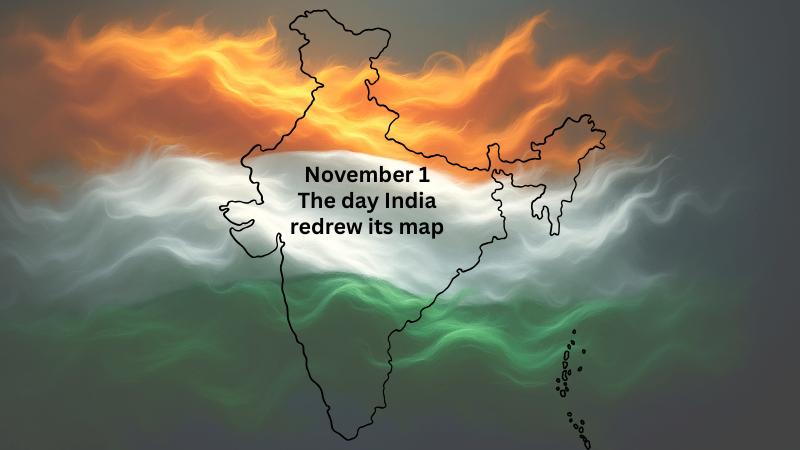
Every year on November 1, several Indian states and union territories mark their foundation day, celebrating the day they were officially reorganized or granted statehood. The date holds unique historical significance as it marks the outcome of India’s post-independence administrative restructuring — a process that reshaped the nation’s map to reflect linguistic and cultural identities. While most people associate November 1 with Kannada Rajyotsava, commemorating the birth of Karnataka, it is in fact a shared day of pride for many regions across India.
The historical context of November 1 dates back to 1956, when the States Reorganisation Act came into effect. Following independence, India inherited a complex patchwork of provinces and princely states, many of which were inconsistent with linguistic and cultural boundaries. The demand for reorganization along linguistic lines gained momentum through the 1950s, led by several regional movements. As a result, the Indian Parliament passed the landmark legislation, redrawing boundaries and creating states that better represented the predominant languages spoken in each region. The Act took effect on November 1, 1956, forever making the date a milestone in India’s federal history.
Karnataka, then known as Mysore State, was formed by merging Kannada-speaking regions from neighboring states. The renaming to Karnataka came later in 1973, and the day is now celebrated with grand cultural events, parades, and public honors across the state. Similarly, Andhra Pradesh was the first linguistic state formed in 1953 and was reorganized again in 1956 to include Telugu-speaking regions. Kerala was also born on November 1, 1956, combining Travancore, Cochin, and Malabar regions to form a unified Malayalam-speaking state.
In northern India, the reorganization had an equally significant impact. Punjab and Haryana, for instance, share the same formation date of November 1, 1966, when the former Punjab was divided based on linguistic and administrative factors. While Punjab remained Punjabi-speaking, Haryana was created for Hindi-speaking populations. Chandigarh, a planned modern city, was made a union territory and serves as the shared capital of both states.
Further central and southern India also commemorate the day. Madhya Pradesh and Chhattisgarh trace their administrative lineage to November 1, 1956, though Chhattisgarh became an independent state later on November 1, 2000, to recognize its distinct cultural and tribal identity. Tamil Nadu, another major linguistic state, also observes the day in remembrance of the 1956 reorganization that affirmed its Tamil-speaking identity.
Among the union territories, Delhi, Puducherry, Andaman and Nicobar Islands, Chandigarh, and Lakshadweep mark November 1 as their formation day as well. Each territory has its own historical background, but the shared date symbolizes their inclusion and recognition within India’s constitutional framework of governance.
While the celebrations vary from state to state, the essence remains one of unity in diversity. Cultural programs, traditional performances, and official ceremonies highlight regional languages and heritage, underscoring India’s federal philosophy. For Karnataka, the day is synonymous with red and yellow flags, vibrant processions, and tributes to eminent Kannada figures. In Kerala and Andhra Pradesh, the day is marked by public addresses and remembrance of leaders who championed statehood causes. In northern regions like Haryana and Punjab, administrative and cultural programs emphasize state achievements and development milestones.
November 1 stands as a reminder of India’s remarkable ability to preserve regional diversity within national unity. It represents not only the birth of multiple administrative entities but also the acknowledgment of linguistic pride, identity, and inclusion that continues to define India’s democratic spirit. What began as a political and administrative reform in 1956 has evolved into a day of celebration — one that unites millions of citizens in honoring the cultural essence of their home states.