Iranian authorities on Tuesday deployed plainclothes police and armed security personnel across several universities in an effort to contain a fourth consecutive day of student protests directed at Supreme Leader Ayatollah Ali Khamenei. The heightened security presence reflects growing concern within the government over expanding campus unrest and the potential for demonstrations to spread further.
Clashes were reported at multiple academic institutions, including Tehran’s University of Science and Technology, where videos circulating online appeared to show confrontations between students and members of the Basij militia, a state-backed paramilitary force often used to control public dissent. The footage suggested tense scenes on campus as authorities moved to disperse gatherings and reassert control.
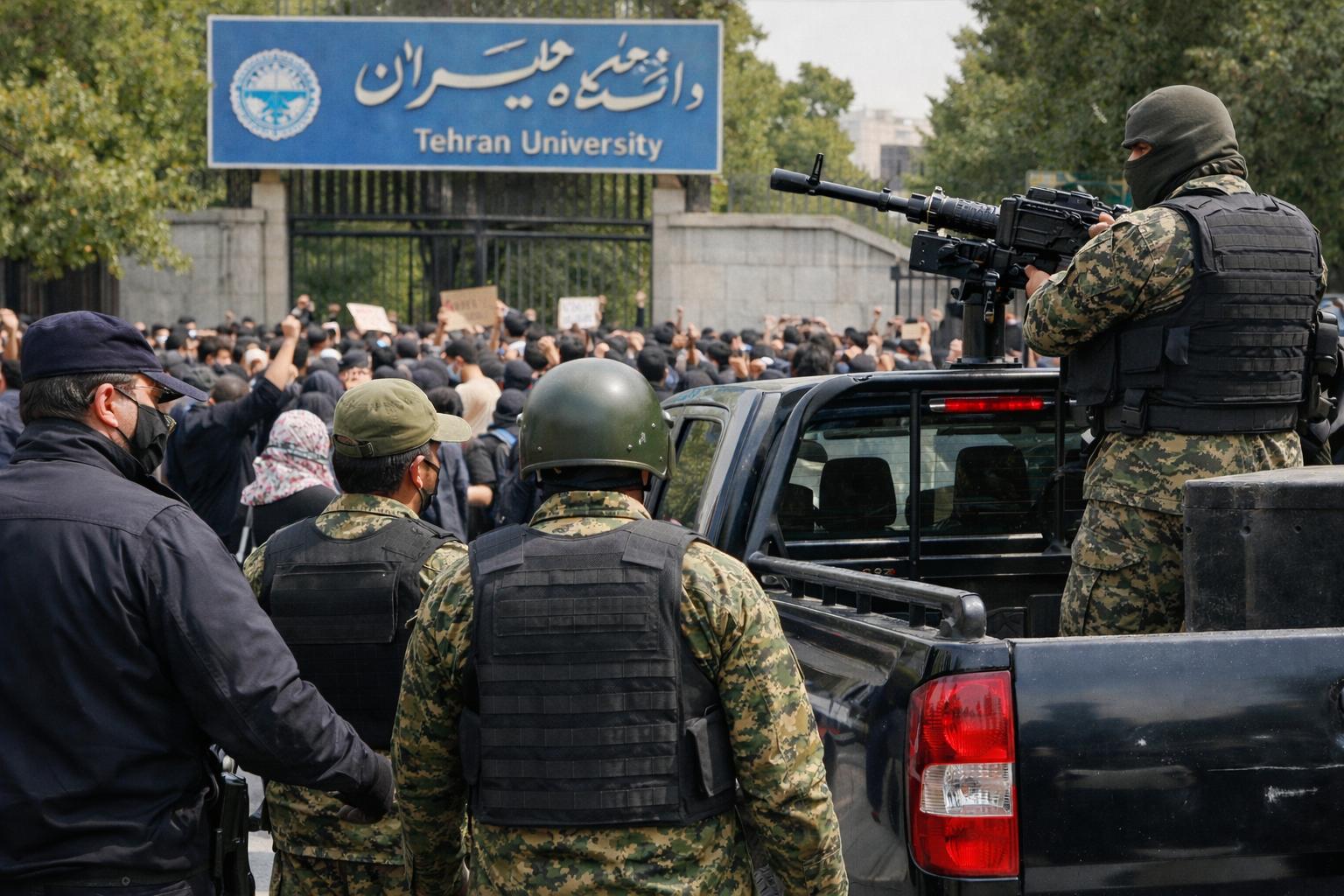
Additional images shared on social media showed pickup trucks equipped with mounted machine guns positioned outside the University of Tehran, underscoring the scale of the security response. Demonstrations were also reported in the northeastern city of Mashhad, indicating that the wave of student demonstrations is not limited to the capital.
University officials have taken administrative steps alongside the security measures. Students identified as having participated in earlier protests were reportedly barred from entering campuses, and several institutions announced the suspension of in-person classes. Authorities say the moves are intended to maintain order, but critics argue they are designed to curb dissent and prevent large student gatherings.
Data circulating among academic observers indicates that nearly 80 percent of Iran’s universities are now operating online. Analysts say the widespread shift to virtual learning may be part of a broader Iran crackdown strategy following earlier protest movements this year that challenged state authority.
Despite the tighter controls, protest activity has continued. Videos from Tehran’s University of Art showed groups of students chanting slogans such as “We fight, we die, we take back Iran” and “Political prisoners must be freed,” along with direct criticism of the country’s leadership. The chants reflect deeper frustration among segments of the student population and highlight the symbolic role universities continue to play in Iran protests.
The situation remains fluid, with security forces maintaining a visible presence across key campuses. Observers note that the coming days will be critical in determining whether the current measures succeed in containing the unrest or further inflame tensions between students and authorities.