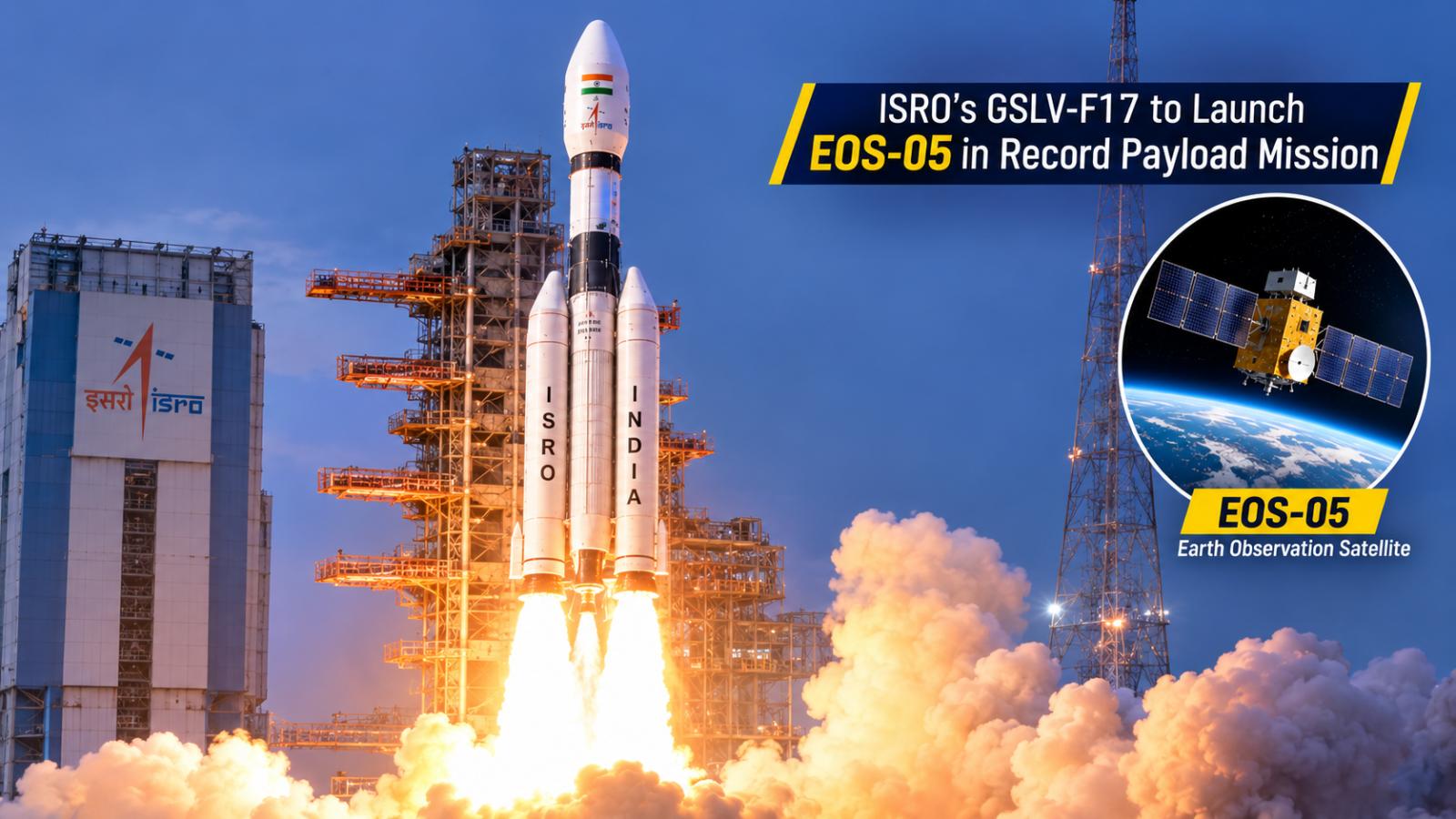
On Friday, September 4, 2026, at 2:55 AM IST, ISRO’s GSLV-F17 is scheduled to launch the 2,367-kg EOS-05 Earth observation satellite from Sriharikota.The mission will mark GSLV Mk2’s heaviest payload so far and ISRO’s return to orbital launches after a seven-month gap.
India’s GSLV rocket is scheduled to lift off from the second launch pad at the Satish Dhawan Space Centre in Sriharikota at 2:55 AM IST on Friday, September 4, 2026, carrying the 2,367-kg EOS-05 Earth observation satellite.
The mission, designated GSLV-F17/EOS-05, is significant because EOS-05 will be the heaviest payload carried by the GSLV Mk2 during its roughly 25-year operational history. The satellite, also known as GISAT-1A, is intended to replace GISAT-1, which was lost following the GSLV-F10 mission failure in August 2021.
The 27-hour and 30-minute countdown began at 11:25 PM IST on Wednesday. During the countdown, engineers conduct final health checks of the launch vehicle and spacecraft while loading the liquid-fuelled stages required for the mission.
GSLV-F17 to Carry Its Heaviest-Ever Satellite
The GSLV is a three-stage launch vehicle. Its first stage combines a solid-fuel core motor with four liquid-fuel strap-on boosters. The second stage uses a liquid-fuel engine, while the final stage is powered by a cryogenic engine using super-cooled liquid hydrogen and liquid oxygen.
EOS-05 weighs 2,367 kg, putting it above the weight of most satellites previously carried by the GSLV to a transfer orbit.
The satellite is designed to eventually operate from geostationary orbit at an altitude of about 36,000 km above Earth. This is particularly significant for an imaging spacecraft because most Earth observation satellites operate much closer to the planet, typically in low-Earth orbit.
From its high orbital position, EOS-05 is expected to repeatedly observe large areas and provide frequent imagery of regions of interest.
EOS-05 to Support Disaster and Weather Monitoring
EOS-05 is an agile Earth observation satellite designed to provide near-real-time imaging at frequent intervals.
Its applications are expected to include monitoring natural disasters and rapidly developing events, along with observing agriculture, forests and water bodies. The satellite could also support cyclone tracking, thunderstorm and cloudburst monitoring and disaster-warning activities.
Frequent observation from geostationary orbit would allow the spacecraft to repeatedly monitor the same broad region without waiting for another orbital pass, which is one of the major advantages of placing an imaging satellite at such a high altitude.
The mission therefore has importance for both Earth observation and strategic monitoring capabilities.
Why GSLV Will Place EOS-05 in a Sub-GTO
One of the most unusual aspects of the GSLV-F17 mission is its planned sub-Geosynchronous Transfer Orbit, or sub-GTO, insertion.
Communication satellites are usually launched into a Geosynchronous Transfer Orbit before using their onboard engines to gradually reach their final geostationary position.
A typical GTO may have a perigee of roughly 170 to 200 km and an apogee of around 36,000 km. EOS-05, however, is expected to initially enter an orbit with a perigee of approximately 170 km and an apogee of about 28,934 km.
The reason is the satellite’s weight. Instead of requiring the GSLV to take the 2,367-kg spacecraft all the way to a standard GTO, the rocket will release EOS-05 into the lower sub-GTO. The spacecraft will then use its own propulsion system to raise its orbit and ultimately reach its intended operational position.
The strategy effectively distributes the energy required to reach geostationary orbit between the launch vehicle and the satellite.
GSLV missions have generally carried payloads weighing below 2,300 kg to GTO. An earlier attempt to launch the 2,310-kg GSAT-5P aboard GSLV-F06 in December 2010 ended in a mission failure following an in-flight anomaly.
Launch Marks ISRO’s Return After Seven-Month Gap
The September 4 mission will also mark an important return to flight for India’s space programme after a gap of about seven months.
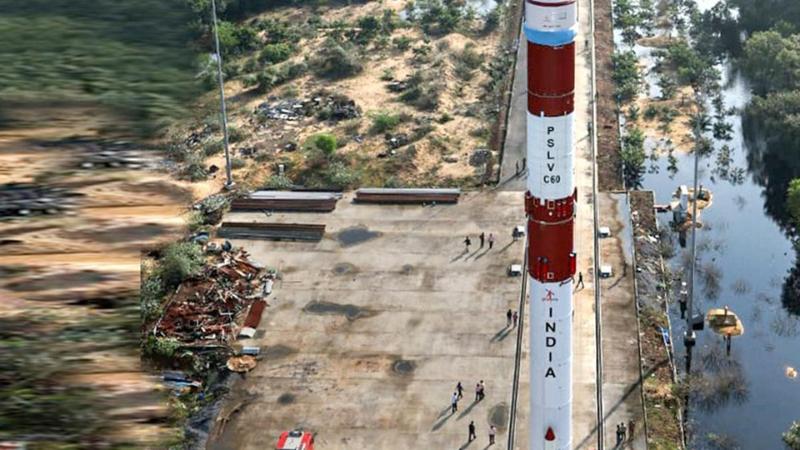
ISRO has not conducted an orbital rocket launch since the PSLV-C62 mission in January 2026, which ended in failure during flight. That mission followed the PSLV-C61 failure in May 2025, marking an unusual sequence of setbacks for a launch vehicle with a long record of reliability.
PSLV-C61 had been carrying the EOS-09 Earth observation satellite, while PSLV-C62 carried EOS-N1 along with more than a dozen customer satellites.
Against that backdrop, the GSLV-F17/EOS-05 mission will be closely watched. A successful launch would not only place an important Earth observation satellite on its journey toward geostationary orbit but also mark ISRO’s return to launch operations after months without an orbital mission.