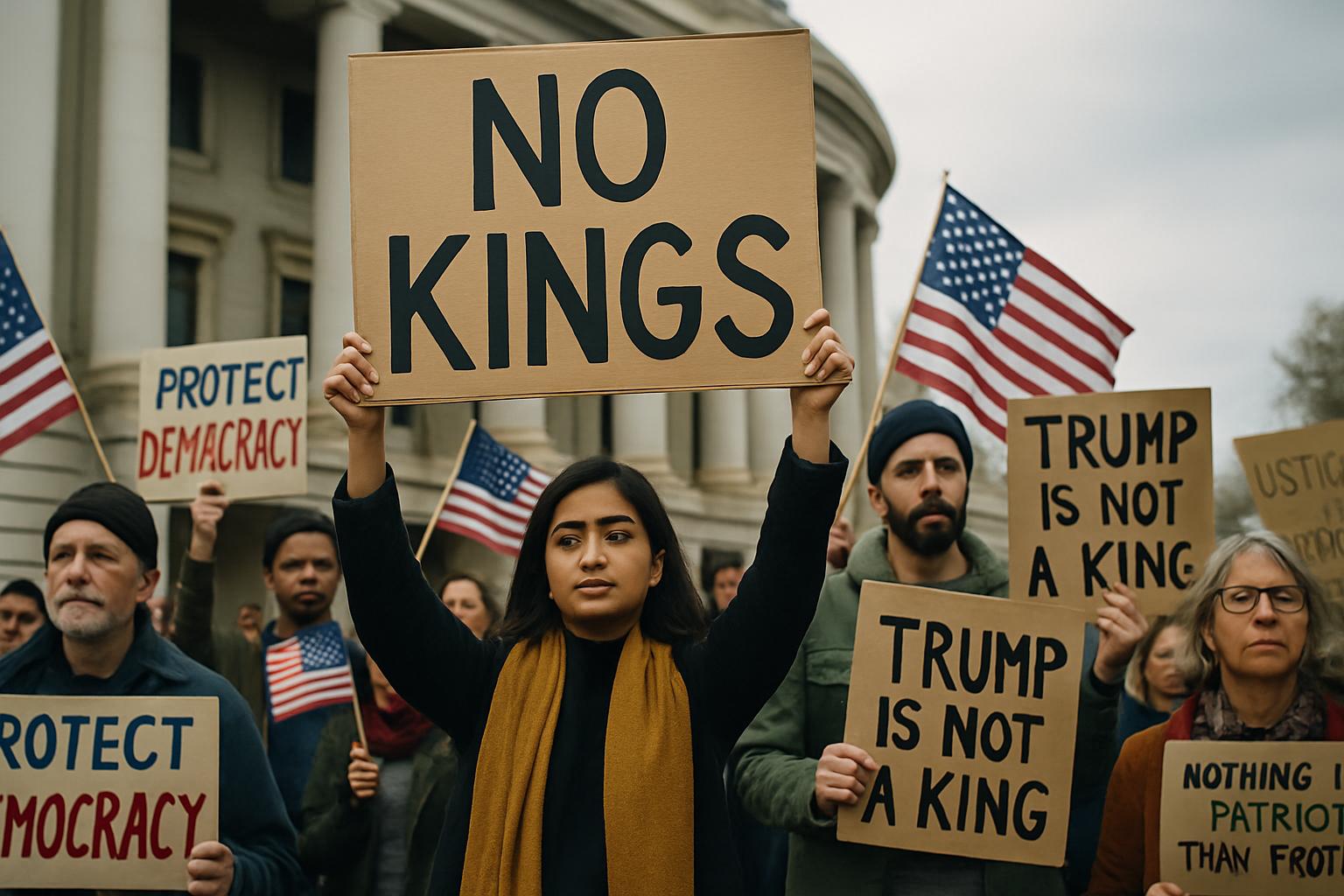
Thousands of Americans gathered across the country on Saturday as part of the expanding “No Kings” protests, a growing grassroots movement challenging the leadership and policies of President Donald Trump. From major metropolitan centers to smaller towns, citizens voiced their concerns over what they describe as an erosion of democratic principles, rising authoritarianism, and government overreach. The movement’s slogan, “No Kings,” symbolizes a call to uphold the constitutional balance of power and to reaffirm the idea that elected leaders must remain accountable to the people.
The demonstrations, organized by a network of civic groups and local communities, were particularly visible in New Jersey, where at least five towns hosted peaceful rallies throughout the day. Marchers carried American flags, placards advocating democracy and freedom, and banners bearing the phrase “No Kings, Only the People.” The protests have drawn participants from diverse backgrounds—students, workers, families, and retirees—all united by a shared concern for the future of American governance.
Crowds filled public parks and city squares in places such as Newark, Trenton, Princeton, and Jersey City. Speakers addressed the importance of checks and balances, urging citizens to remain active and informed in the democratic process. Organizers said the purpose of the rallies was not only to express discontent with the administration’s actions but also to reignite civic engagement and participation in local and national politics. The gatherings were largely peaceful, with participants emphasizing nonviolent expression and unity.
In interviews, several protesters said the ongoing government shutdown and increasing political polarization had motivated them to join the movement. Many accused the administration of prioritizing political interests over the welfare of ordinary Americans. “This isn’t about party politics,” one demonstrator in Princeton said. “It’s about reminding our leaders that they serve the people, not themselves. That’s what democracy is all about.” Others described the protests as a wake-up call to prevent the concentration of power within the executive branch and to defend the independence of institutions.
Despite its growing scale, the “No Kings” movement has faced criticism from supporters of the president, who argue that the rallies misrepresent his leadership style and achievements. Some have dismissed the gatherings as partisan attempts to discredit the administration. Protesters, however, insist that their movement transcends political lines, emphasizing that their message is rooted in preserving the values of democracy and accountability. They stress that peaceful protest is a cornerstone of American freedom, not an act of defiance against the nation.
Observers note that the rise of the “No Kings” demonstrations reflects a broader surge in civic activism across the United States. Over the past year, protests, petitions, and grassroots campaigns have become increasingly common as citizens seek to influence public policy and hold leaders responsible. The “No Kings” movement, in particular, has struck a chord with Americans who feel excluded from political decision-making or concerned about diminishing trust in institutions.
As the day progressed, demonstrators across the nation continued their rallies, waving flags and chanting slogans calling for unity, transparency, and fairness in governance. Organizers expressed optimism that their message would inspire more Americans to engage constructively with their communities and representatives. “Our strength lies in our collective voice,” a speaker in Newark told the crowd. “We may not have power in office, but we have the power to stand together and demand integrity from those who do.”
The nationwide protests are expected to continue throughout the coming weeks, with additional rallies planned in major U.S. cities, including Washington, D.C., Chicago, and Los Angeles. While the long-term impact of the movement remains to be seen, its organizers believe that consistent civic participation can help preserve democratic values and foster accountability.
As night fell, candles illuminated public spaces where citizens stood side by side, singing patriotic songs and reaffirming their faith in the principles upon which the nation was founded. The “No Kings” movement, they said, is not just a protest against one administration—it is a reminder that democracy thrives only when people remain vigilant, engaged, and united in their pursuit of justice and equality.