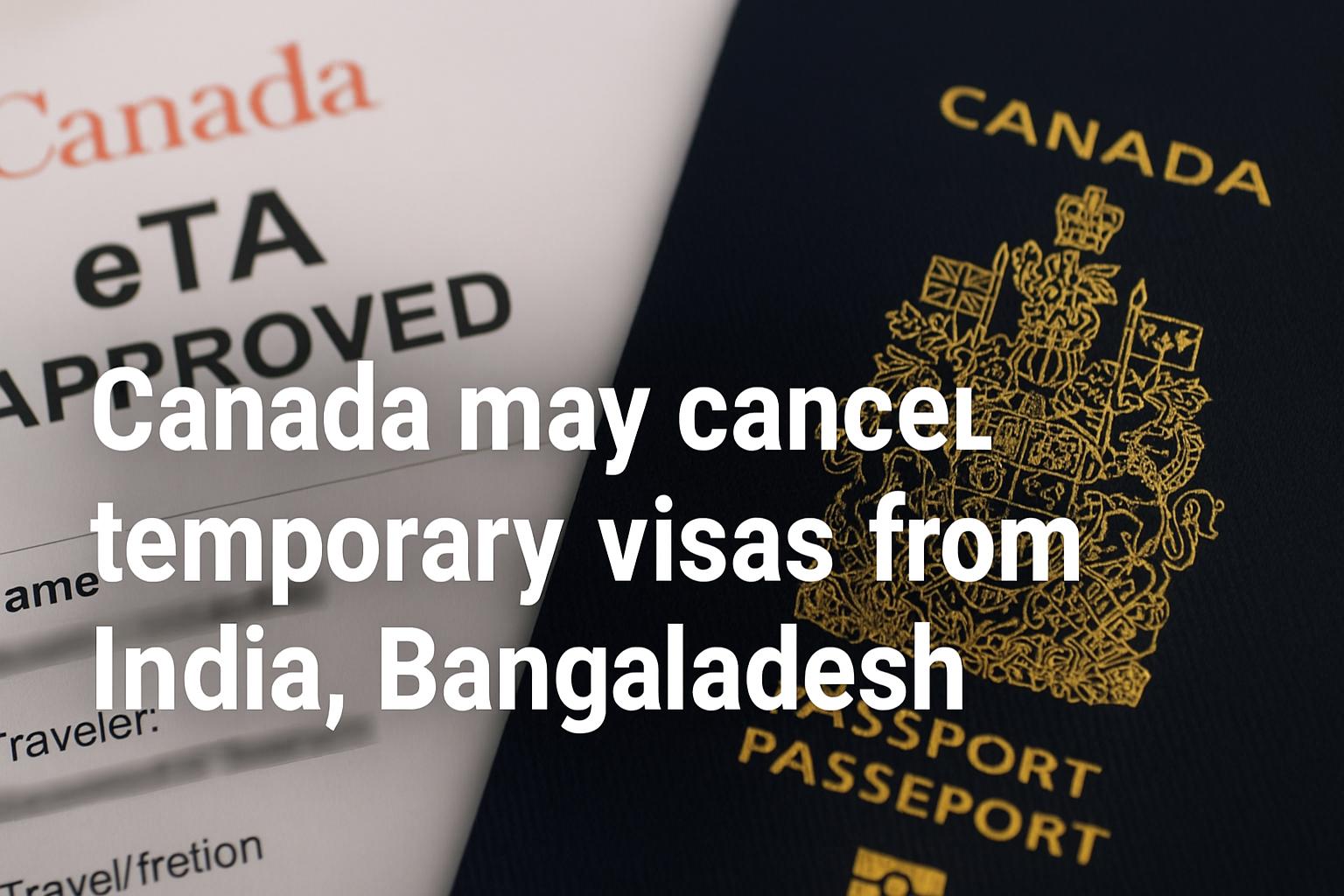
Canada’s immigration authorities are reportedly moving toward adopting new powers that could allow them to cancel temporary visas on a large scale — a policy shift that may disproportionately affect applicants from India and Bangladesh. According to internal government documents, the initiative is part of a broader partnership between Canadian agencies and their U.S. counterparts to strengthen border controls and address rising concerns over fraudulent applications.
The documents indicate that Canada’s Immigration, Refugees and Citizenship Canada (IRCC) and the Canada Border Services Agency (CBSA), in collaboration with U.S. agencies, have formed a working group to draft provisions under Bill C-12. This bill, now before the Canadian Parliament, proposes to authorize the government to revoke entire classes of temporary visas under “exceptional circumstances” such as pandemics, wars, or identified security risks from specific countries.
Sources suggest that the legislation’s development was influenced by a sharp rise in asylum claims from Indian nationals. Reports show that the number of Indian asylum seekers in Canada grew from fewer than 500 per month in May 2023 to over 2,000 by July 2024. The increase has strained the immigration system, lengthening processing times and prompting calls for greater scrutiny.
The IRCC’s October 2024 memorandum to then–Immigration Minister Marc Miller highlighted that visa cancellations would help “reduce security risks and limit potential misuse.” However, the documents also reveal that Indian applicants have been singled out due to a surge in allegedly fraudulent or incomplete applications. As of mid-2024, nearly 1,900 passengers were flagged for additional verification and sent procedural fairness letters detailing their legal rights and recourse.
Processing delays have worsened, rising from 30 days on average in mid-2023 to 54 days by July 2024. Approvals have also dropped — from 63,000 in January 2024 to 48,000 in June — as authorities divert more staff toward background verification. Officials attribute the backlog partly to high application volumes from India and Bangladesh.
Government representatives have defended the proposal, saying it aims to ensure border integrity. The Immigration Department said it has taken “concrete steps to minimize unnecessary border volumes, increase information sharing, and reduce non-genuine visitors.” The agency claims that tougher screening for temporary resident visas from “countries with the highest abuse rates” has reduced illegal U.S.–Canada crossings by 97 percent since their peak in mid-2024.
Still, the proposed mass visa cancellation authority has triggered significant backlash. More than 300 civil society groups and immigration lawyers have voiced concern that such powers could pave the way for arbitrary mass deportations or politically motivated visa denials. Critics also argue that Canada’s immigration challenges stem from structural inefficiencies rather than applicant misconduct, warning that collective penalties could erode trust with key partner nations.
For Indian applicants, the developments come amid another blow — soaring student visa rejection rates. Data from August 2025 shows that nearly three out of every four Indian students seeking to study in Canada were denied permits, up from 32 percent a year earlier. In comparison, global rejection rates have remained around 40 percent. Canadian authorities have said they uncovered over 1,500 fraudulent student applications from India in 2023, prompting heightened vigilance.
The number of Indian students applying for Canadian study permits dropped sharply, from about 20,900 in August 2023 to just 4,515 two years later. The Indian Embassy in Ottawa has acknowledged the issue, emphasizing that Indian students have long contributed to Canadian academia and innovation. It urged Canada to maintain fair and transparent evaluation systems that continue to attract “the best quality students from India.”
The visa debate also coincides with a cautious thaw in India–Canada relations. Bilateral ties reached a historic low in 2023 following accusations by former Prime Minister Justin Trudeau that Indian agents were involved in the killing of a Sikh separatist leader in British Columbia — a claim New Delhi strongly denied. Relations began to improve after Mark Carney assumed office as Canada’s new Prime Minister, extending an invitation to Indian Prime Minister Narendra Modi for the G7 Summit and restoring high-level diplomatic exchanges.
In October 2025, Canadian Foreign Minister Anita Anand visited New Delhi for discussions with External Affairs Minister S. Jaishankar and Commerce Minister Piyush Goyal. The talks produced a joint roadmap for cooperation in trade, critical minerals, and renewable energy — signaling renewed efforts to rebuild trust.
While the Canadian government maintains that the visa-cancellation proposal is intended for “exceptional use,” its timing and focus have sparked anxiety across South Asian communities. For many aspiring students and professionals, the new policy threatens to close doors that once symbolized opportunity and upward mobility.
As the bill moves through Parliament, immigration observers warn that its impact could extend beyond border management, influencing Canada’s reputation as an open, multicultural society. For now, thousands of hopeful applicants from India and Bangladesh wait anxiously — uncertain whether their dream of studying or working in Canada will remain within reach or fade into the distance.