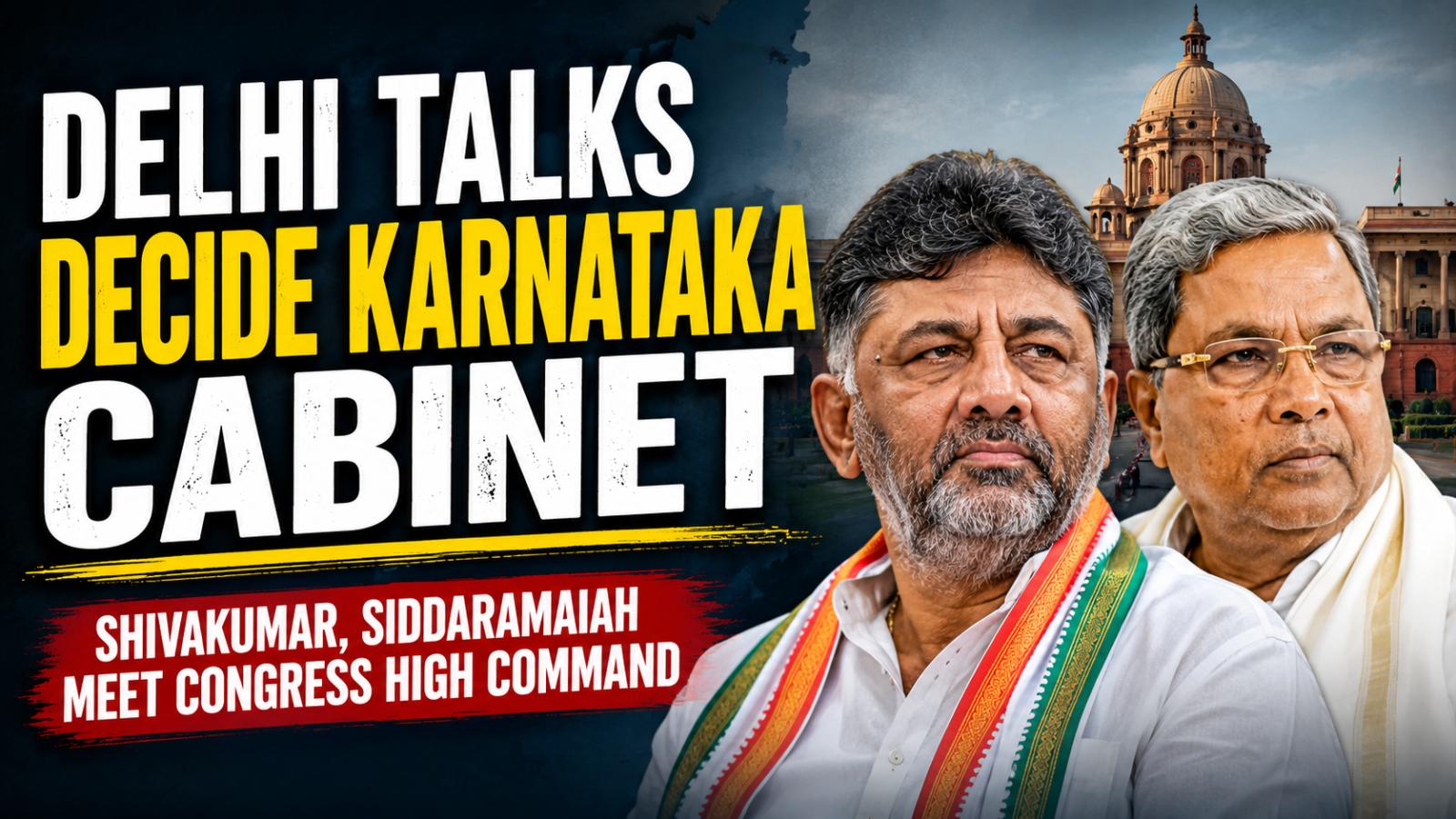
D K Shivakumar and Siddaramaiah will travel to Delhi to meet the Congress high command and finalise Karnataka’s new cabinet. Purpose: The meeting aims to decide ministerial berths, balance caste and regional representation, manage loyalist groups, and prepare for the June 3 swearing-in.
Karnataka Cabinet Talks Move To Delhi
Karnataka Chief Minister-designate D K Shivakumar and outgoing Chief Minister Siddaramaiah are set to travel to New Delhi for crucial discussions with the Congress high command as the party prepares to finalise the next state cabinet. The meeting comes ahead of Shivakumar’s scheduled swearing-in as Chief Minister on June 3 at Lok Bhavan, where he is expected to take oath along with some members of the Council of Ministers.
The cabinet formation exercise is expected to be politically sensitive because Karnataka has a sanctioned strength of 34 ministers, including the Chief Minister. With many aspirants and limited positions available, the Congress leadership will have to balance experience, caste equations, regional representation, loyalty groups and internal expectations. This is not a simple cabinet expansion; it is a test of how smoothly the party can manage transition after Siddaramaiah’s tenure and Shivakumar’s elevation.
According to party sources, both Shivakumar and Siddaramaiah are scheduled to land in Delhi on Monday afternoon, while their return plans have been left open-ended. That detail itself signals that the discussions may not be quick. Cabinet decisions in Karnataka are rarely just about names; they are about control, future influence and keeping different power centres from feeling ignored.
Shivakumar, who is also the Karnataka Congress President, was officially elected leader of the Congress Legislature Party on Saturday. His elevation comes after prolonged speculation around leadership change in the state. However, the bigger challenge now is not just taking oath as Chief Minister, but building a cabinet that does not trigger resentment among senior leaders, former ministers and legislators expecting rewards.
When asked about how many ministers would take oath with him, Shivakumar avoided giving a number and said the party high command would decide. His cautious response shows that the final list is still being worked out and that Congress does not want to expose internal disagreements before the swearing-in. AICC President Mallikarjun Kharge has also said that no proposal had yet been received regarding the composition of the new ministry.
Lobbying has already intensified, with several ministerial aspirants reportedly travelling to Delhi to present their case before the leadership. Former ministers from Siddaramaiah’s dissolved council are trying to retain their positions, while legislators who missed out earlier are pushing for a chance in the new government. This creates a difficult situation for Shivakumar because including too many old faces may disappoint fresh claimants, while dropping too many seniors may create avoidable friction.
The Cabinet Balancing Challenge
The new cabinet is expected to include a mix of old and new faces, according to indications from party circles. The Congress leadership is likely to weigh caste representation, regional balance and the presence of Siddaramaiah loyalists while finalising the list. This is where the cabinet exercise becomes delicate. Shivakumar needs a team that reflects his authority as the incoming Chief Minister, but he cannot afford to alienate Siddaramaiah’s camp too aggressively.
Speculation is also growing over the possibility of multiple Deputy Chief Ministers. If Congress chooses that route, it may be aimed at balancing communities and factions, but it could also dilute the perception of one clear power centre. Multiple Deputy CM posts may help manage short-term resentment, but they also risk creating parallel influence groups inside the government.
There is also talk that several ministers from Siddaramaiah’s cabinet may not be retained. That would give Shivakumar room to bring in new supporters and regional representatives, but it may upset those who expect continuity. The opportunity cost is obvious: every new face added means one experienced leader is left disappointed, and every senior leader retained reduces space for generational change.
Siddaramaiah’s son and Congress MLC Yathindra has also expressed hope of getting a place in the next cabinet after meeting Shivakumar. His statement adds another layer to the political calculations because the inclusion of leaders linked to senior power centres can affect perceptions of balance within the party.
Talks are also expected on the next Karnataka Pradesh Congress Committee President, a post currently held by Shivakumar. Senior MLA and former minister Satish Jarkiholi is being seen as a frontrunner for the role. However, reports suggest he may seek both a cabinet berth and the KPCC chief post. Giving both to one leader could strengthen organisational control in one camp, but it may also create dissatisfaction among others seeking either position.
Another important agenda item is the upcoming Rajya Sabha and Legislative Council polls scheduled for June 18. With its current Assembly strength, Congress is expected to win three of the four Rajya Sabha seats and five of the seven MLC seats. That makes candidate selection another high-stakes decision, especially because these positions are often used to accommodate leaders who miss out on cabinet berths.
Why This Delhi Meeting Matters
The Delhi meeting will decide more than just who becomes minister. It will shape the early image of the Shivakumar government and indicate how much space Siddaramaiah’s loyalists retain in the new setup. The Congress high command has to avoid a messy beginning because disgruntlement after cabinet formation can weaken governance and give the opposition an easy opening.
For Shivakumar, the first cabinet list will be read as a signal of his political style. A heavily loyalist cabinet may strengthen his control but risk internal pushback. A compromise cabinet may keep peace but limit his freedom. A balanced cabinet may be the safest option, but that is also the hardest to execute when the number of aspirants is high.
For Siddaramaiah, the talks are equally important because his influence in the new government will depend on how many of his loyalists are accommodated. As outgoing Chief Minister, he remains one of the Congress party’s strongest mass leaders in Karnataka. Ignoring his camp would be politically risky, especially when the party needs unity ahead of future elections.
The Congress high command now has to manage three priorities at once: ensuring a smooth swearing-in on June 3, preventing rebellion among disappointed aspirants, and preparing for the June 18 Rajya Sabha and Legislative Council polls. The real test will not be the oath ceremony itself, but whether the party can contain internal pressure after the cabinet list is announced. The cabinet discussions in Delhi will therefore be watched closely across Karnataka political circles. Shivakumar’s rise to the Chief Minister’s chair marks a major moment in state politics, but the success of his government may depend on how carefully Congress handles the first major power-sharing exercise of his term.