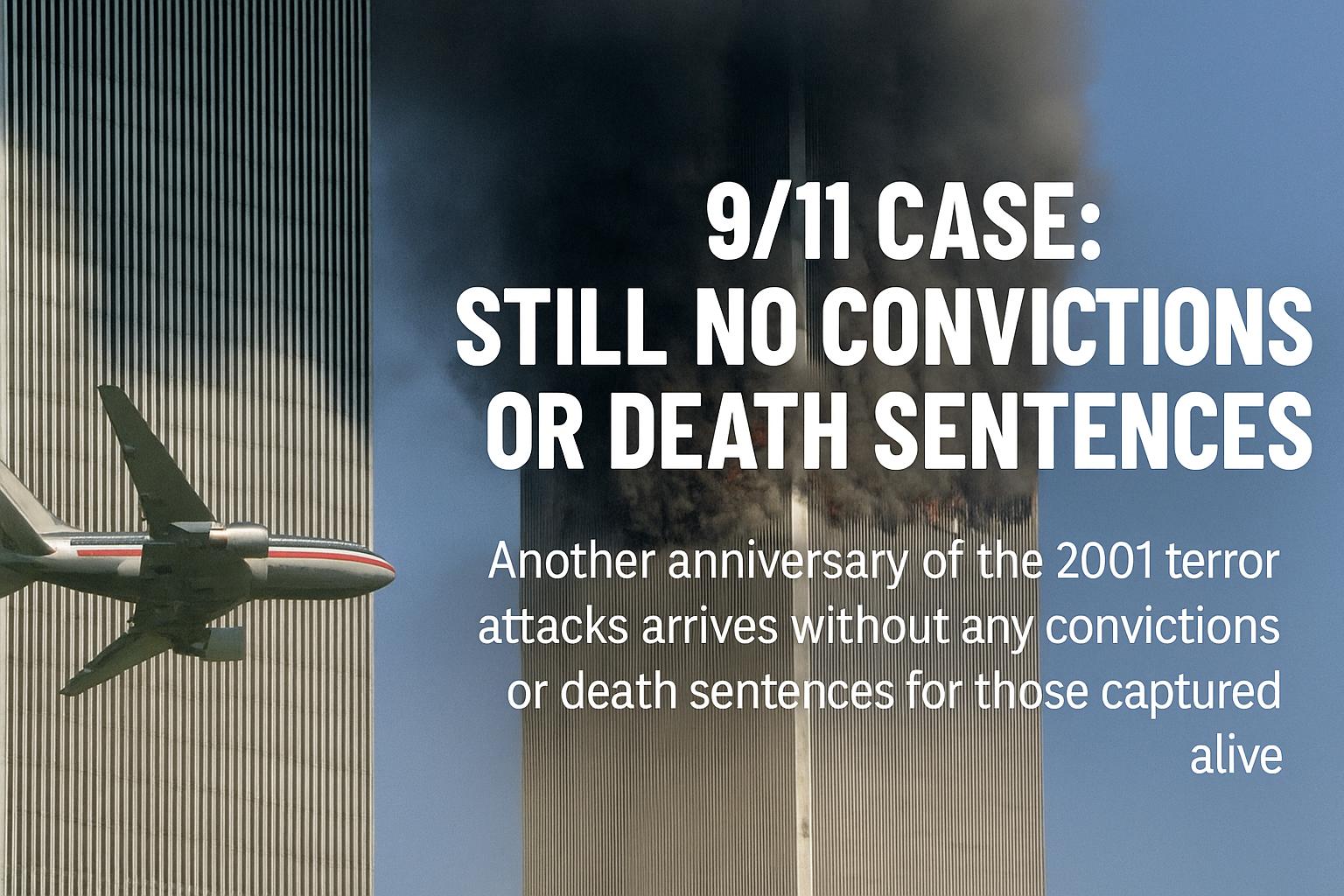
Another anniversary of the September 11, 2001 terror attacks is here, but the United States still has not convicted or sentenced any of the men arrested alive for their alleged roles in the planning and facilitation of the tragedy. The 9/11 attacks remain etched in the memory of millions across the world, having killed nearly 3,000 people in one morning of unparalleled destruction. Of the 2,996 estimated victims, 2,977 were civilians, first responders, and passengers on board the hijacked aircraft. The 19 terrorists who hijacked the planes perished during the attacks, leaving investigations to focus on co-conspirators and facilitators who survived.
The attacks unfolded with devastating speed and precision. American Airlines Flight 11 struck the North Tower of the World Trade Center, followed shortly by United Airlines Flight 175 slamming into the South Tower. Another plane, American Airlines Flight 77, crashed into the Pentagon, targeting the very heart of America’s defense establishment. The fourth, United Airlines Flight 93, never reached its intended target after brave passengers fought back against the hijackers. That plane ultimately crashed into a field in Shanksville, Pennsylvania. Investigators later concluded the hijackers were aiming either for the White House or the Capitol, a plan disrupted by the courage of ordinary citizens.
The official investigation quickly turned to al-Qaeda, the terror group led by Osama bin Laden. While bin Laden was killed by U.S. forces in 2011 in Pakistan, several suspected masterminds and planners were captured alive and transferred to Guantanamo Bay. Chief among them is Khalid Sheikh Mohammed, identified as the principal architect of the operation. Arrested in 2003 and held at Guantanamo since 2006, Mohammed has been in pre-trial proceedings for over a decade. Despite numerous hearings and legal arguments, he has never been convicted, nor sentenced. Alongside him stand four other men charged with orchestrating various elements of the plot: Walid bin Attash, accused of training the hijackers; Mustafa al-Hawsawi, accused of financing the operation; Ali Abdul Aziz Ali, also known as Ammar al-Baluchi, accused of facilitating money transfers and logistics; and Ramzi bin al-Shibh, alleged to have acted as a key liaison between the hijackers and al-Qaeda leadership. All five continue to face charges in the special military commission system, but none have seen their trials completed.
The lack of verdicts after 24 years highlights one of the most controversial chapters in American legal and counterterrorism history. The trials have faced countless delays, with disputes over evidence, including material obtained through torture, contributing to the prolonged proceedings. Questions about the human rights record of Guantanamo Bay, combined with frequent changes in legal teams, issues of competency among the accused, and disputes over classified intelligence, have combined to drag the trials into a seemingly endless cycle of postponements.
In July 2024, controversy erupted over a proposed plea agreement that would have allowed Mohammed, bin Attash, and al-Hawsawi to plead guilty in exchange for life sentences without parole, effectively removing the death penalty from the table. Families of victims, politicians, and large sections of the public reacted with outrage, arguing that such a deal would deny justice to the thousands killed in the attacks. Following the backlash, then U.S. Defense Secretary Lloyd Austin rescinded the deal. However, legal debates continued until a federal appeals court ruled in July 2025 that the plea agreements were not binding, reinstating the possibility of death penalty trials.
Despite this development, the reality remains that no one has been convicted for the deadliest terror attack in U.S. history. For many families of victims, this represents a profound failure of the justice system. The phrase “justice delayed is justice denied” has been repeatedly invoked by those who have spent more than two decades waiting for closure. The inability of the U.S. government to bring these cases to conclusion stands in stark contrast to other post-9/11 actions. Iraq’s Saddam Hussein, falsely linked to weapons of mass destruction, was captured, tried, and executed by 2006. The Taliban regime, originally toppled in 2001, returned to power in 2021 after the U.S. withdrawal from Afghanistan. Yet the central figures accused of direct involvement in 9/11 remain unconvicted.
The prolonged trials represent both a stain on America’s legal history and a symbol of its struggle to reconcile justice with due process in the post-9/11 era. Nearly a quarter of a century later, the world has changed dramatically, but for many of the families left behind by the attacks, time has not healed the wound. The absence of definitive legal outcomes continues to fuel frustration, skepticism, and disillusionment. Until verdicts are delivered, the story of 9/11 will remain not only a tale of tragedy but also one of unfinished justice.