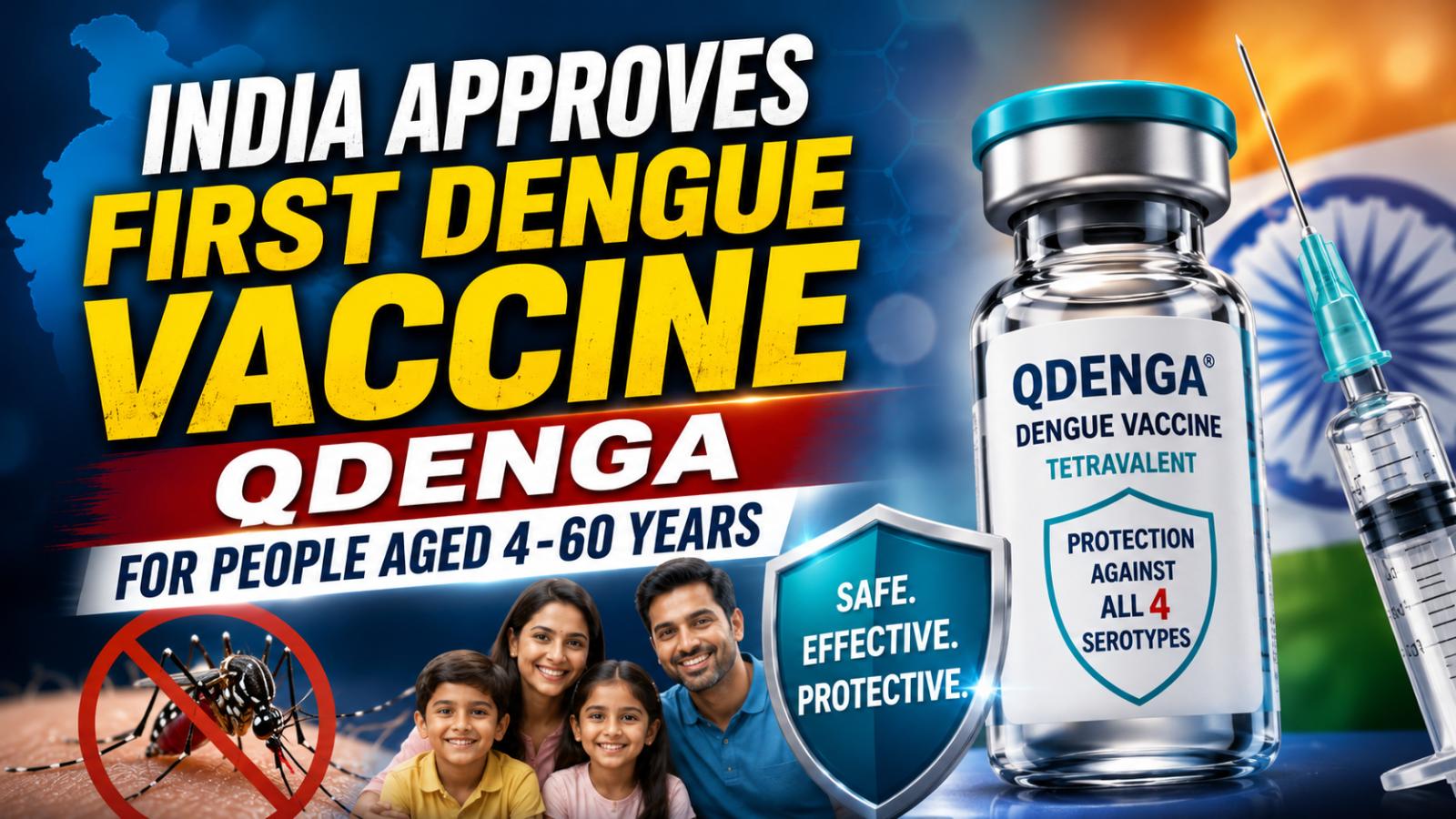
India approves QDENGA for dengue prevention in people aged 4–60, making it the country’s first authorised dengue vaccine. The two-dose shot targets all four serotypes and is given three months apart, while rollout, pricing and access details are still awaited.
QDENGA Approval Marks a First for India
India’s drug regulator has approved Takeda’s QDENGA for preventing dengue in people aged four to 60 years, making it the first dengue vaccine authorised in the country.
The Drug Controller General of India granted market authorisation to the tetravalent live-attenuated vaccine under the New Drugs and Clinical Trials Rules. The clearance is considered an important development for India, where dengue remains a persistent mosquito-borne public health threat.
QDENGA is designed to generate protection against all four dengue virus serotypes. It may be administered regardless of whether a person has previously contracted dengue, and the approved use does not require routine pre-vaccination testing for earlier exposure.
However, regulatory approval does not mean that everyone aged four to 60 should immediately receive the vaccine. Vaccination decisions should follow Indian health-authority recommendations and advice from a qualified healthcare professional.
QDENGA Two-Dose Schedule Requires Three-Month Gap
QDENGA is administered through a 0.5 mL subcutaneous injection. The complete vaccination course consists of two doses, with the second dose given three months after the first.
The vaccine contains weakened forms of the four dengue virus serotypes. These weakened viruses are intended to stimulate an immune response without causing dengue disease in healthy eligible recipients.
Its ability to be used without confirming a previous dengue infection distinguishes QDENGA from Dengvaxia, an older vaccine that has specific restrictions linked to prior dengue exposure and is not approved in India.
As QDENGA is a live-attenuated vaccine, eligibility may depend on factors such as health condition, immune status, pregnancy and current medication. People should not treat the age range alone as confirmation that the vaccine is suitable for them.
QDENGA Trial Results Show Lower Hospitalisation Risk
India’s approval is supported by Takeda’s clinical-development programme, which included 19 Phase 1, Phase 2 and Phase 3 studies involving more than 28,000 participants.
The pivotal TIDES trial involved more than 20,000 children and adolescents in dengue-endemic countries. One year after the second dose, the study reported 80.2% efficacy against virologically confirmed dengue. At 18 months, efficacy against dengue-related hospitalisation was reported at 90.4%.
Extended follow-up showed 61.2% overall efficacy against confirmed dengue and 84.1% efficacy against dengue-related hospitalisation over four-and-a-half years. Effectiveness can differ according to virus serotype, age and whether a person had previously been infected.
Takeda has also completed seven years of follow-up from the Phase 3 programme, reporting continued protection and a sustained long-term safety profile. India-specific research examined safety and immune response among participants aged four to 60.
WHO Guidance Is Narrower Than India’s Approval
The World Health Organization prequalified QDENGA in May 2024, allowing agencies such as UNICEF and the Pan American Health Organization to procure it for eligible vaccination programmes.
WHO currently recommends programmatic use primarily for children aged six to 16 years in locations with high dengue transmission. It does not presently recommend routine programme use in children below six because of lower observed efficacy in that age group.
India’s regulatory approval for ages four to 60 is therefore broader than WHO’s current public-immunisation recommendation. Decisions about including QDENGA in national or state vaccination programmes, priority groups, pricing and public availability will require separate policy announcements.
Vaccination will also not replace mosquito-control measures. Removing stagnant water, preventing mosquito breeding, using repellents and seeking early medical care for suspected dengue will remain essential even after the vaccine becomes available.