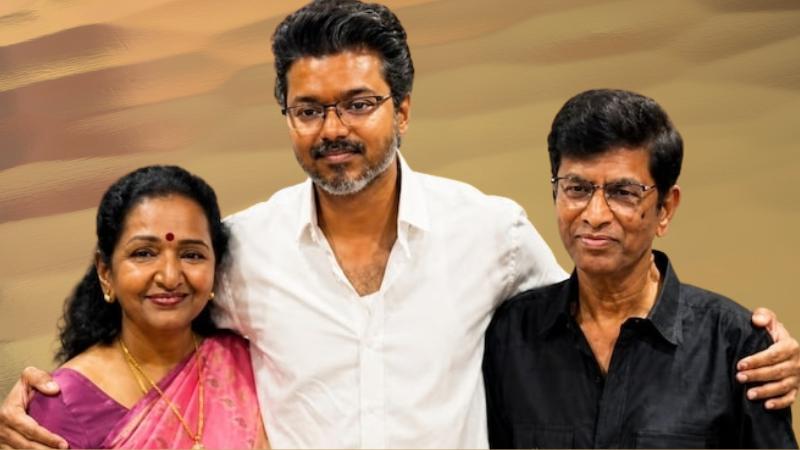
Chennai, May 6, 2026 – The story of SA Chandrasekhar (SAC) and his son Vijay is a tale marked by mentorship, tension, estrangement, and eventual reconciliation, ultimately culminating in Vijay’s political success with his party, Tamilaga Vettri Kazhagam (TVK). Their complex and emotional journey mirrors both the struggles and victories that come with fame, family, and politics.
A Cinematic Beginning: Father and Son on the Silver Screen
SA Chandrasekhar, a director known for his socially charged narratives in Tamil cinema, was not born into filmmaking privilege but rather earned his place through sheer persistence. His directorial debut, Aval Oru Pachai Kuzhanthai (1978), set the tone for his career: films centered around ordinary people's struggles, often told through the lens of mainstream Tamil entertainment. This approach made SAC a household name, especially after his 1981 vigilante film Sattam Oru Iruttarai, which solidified his reputation in Tamil cinema.
SAC’s early success was intertwined with the rise of actor Vijayakanth, whom he directed in several hit films. SAC’s meticulous crafting of Vijayakanth’s screen identity is one of the most significant chapters in 1980s Tamil cinema. Their collaborations cemented SAC’s reputation as a filmmaker who could successfully tell the stories of the underdog.
In the early 1990s, SAC took on the challenge of shaping his son’s career in the same mold. Joseph Vijay, as he was known then, had already appeared as a child artist in several of SAC’s films. When the time came to launch Vijay as a lead actor, SAC directed Naalaiya Theerpu (1992), marking Vijay’s debut as a hero. Unfortunately, the film did not do well at the box office, a devastating setback for any new star. However, SAC did not give up on his son. He cast Vijay again and again in several films, including Senthoorapandi (1993), Rasigan (1994), Vishnu (1995), and Deva (1995). SAC’s patience paid off. By the mid-1990s, Vijay was becoming a household name, and SAC was behind the scenes, guiding his son’s rise to stardom.
A Diverging Path: From Film to Politics
As Vijay’s fame grew, so did his desire to break free from his father’s shadow. In 2009, Vijay took his fan base to the next level by turning his fan club, Makkal Iyakkam, into a charitable organization focused on social welfare activities. By 2011, the organization had extended its support to the AIADMK party in Tamil Nadu’s Assembly elections. SAC clarified at the time that Makkal Iyakkam was not a political entity but hoped for change in Tamil Nadu. The AIADMK’s victory marked a significant shift in the state’s political landscape, and SAC’s presence was largely a background figure.
However, in 2020, SAC made an audacious move: he attempted to convert Makkal Iyakkam into a political party, All India Thalapathy Vijay Makkal Iyakkam. SAC appointed himself as the general secretary, his wife Shoba as the treasurer, and another relative as president, all without informing Vijay. This move caused an immediate rift between father and son. Vijay, rejecting his father’s political ambition, publicly distanced himself from the party, stating that he had no connection to its political statements or aspirations. The conflict deepened when Vijay filed a civil lawsuit against his parents and others, seeking a legal injunction to prevent them from using his name or image for any political activities. This was an unprecedented public rupture, marking a significant break in their personal and professional relationship.
The Public Estrangement and Its Aftermath
The lawsuit was not just a legal matter; it represented a painful rupture in their bond. SAC, once a mentor and guiding force in Vijay’s career, now became the subject of legal action from his own son. Tamil Nadu, along with the entire film industry, watched in disbelief as the man who had launched Vijay’s career became the target of his own son’s legal actions. SAC attempted to explain the estrangement in interviews, suggesting that outside influences were the main cause of the rift, but the public perception was clear: the father and son were now at odds.
SAC’s political ambition, while briefly dashed, was never entirely extinguished. His attempts to register a political party for Vijay had failed, but his passion for Tamil Nadu’s political future remained alive. Despite the legal fallout, SAC continued to speak highly of his son, even if they were not speaking to each other personally.
Reconciliation and a Shared Triumph
By early 2023, SAC began to publicly soften his tone. He admitted that their relationship had been strained for over a year but downplayed the severity of the separation. “Like everyone’s life, our father-son relationship has had many ups and downs, but despite that, we both remain reconciled,” SAC remarked in an interview. His acknowledgment that they had watched Vijay’s film Varisu together signified a public step toward healing.
Fast forward to May 2026, and Vijay’s political journey took an unexpected but triumphant turn. His party, Tamilaga Vettri Kazhagam (TVK), won 108 seats in the Tamil Nadu Assembly, a monumental achievement for the fledgling political group. SAC, now speaking with pride, called it a “historic victory.” He praised his son for his confidence in contesting the elections alone, a decision that many had considered risky at the time.
A Full-Circle Moment for Father and Son
What began as a father’s ambition to shape his son’s career in cinema transformed into a complicated dance of influence, estrangement, and personal growth. SAC, who once tried to steer Vijay’s political future, now watched with admiration as his son stood on his own, leading TVK to victory. The full-circle moment, from SAC’s direction of Vijay’s first film to his own support of his son’s political rise, is a testament to the complexities of family, ambition, and legacy.
In the end, SAC’s decision to publicly praise his son’s political success speaks to a reconciled bond. Vijay’s success was not just his own — it was built on a foundation laid by SAC’s unwavering belief in him, both on and off the screen. The father who once shaped his son’s cinematic journey now stands as a proud onlooker, watching his son chart a political course independent of his own. This, in itself, marks the most profound success of their shared journey: a story of mentorship, estrangement, and eventual reconciliation.