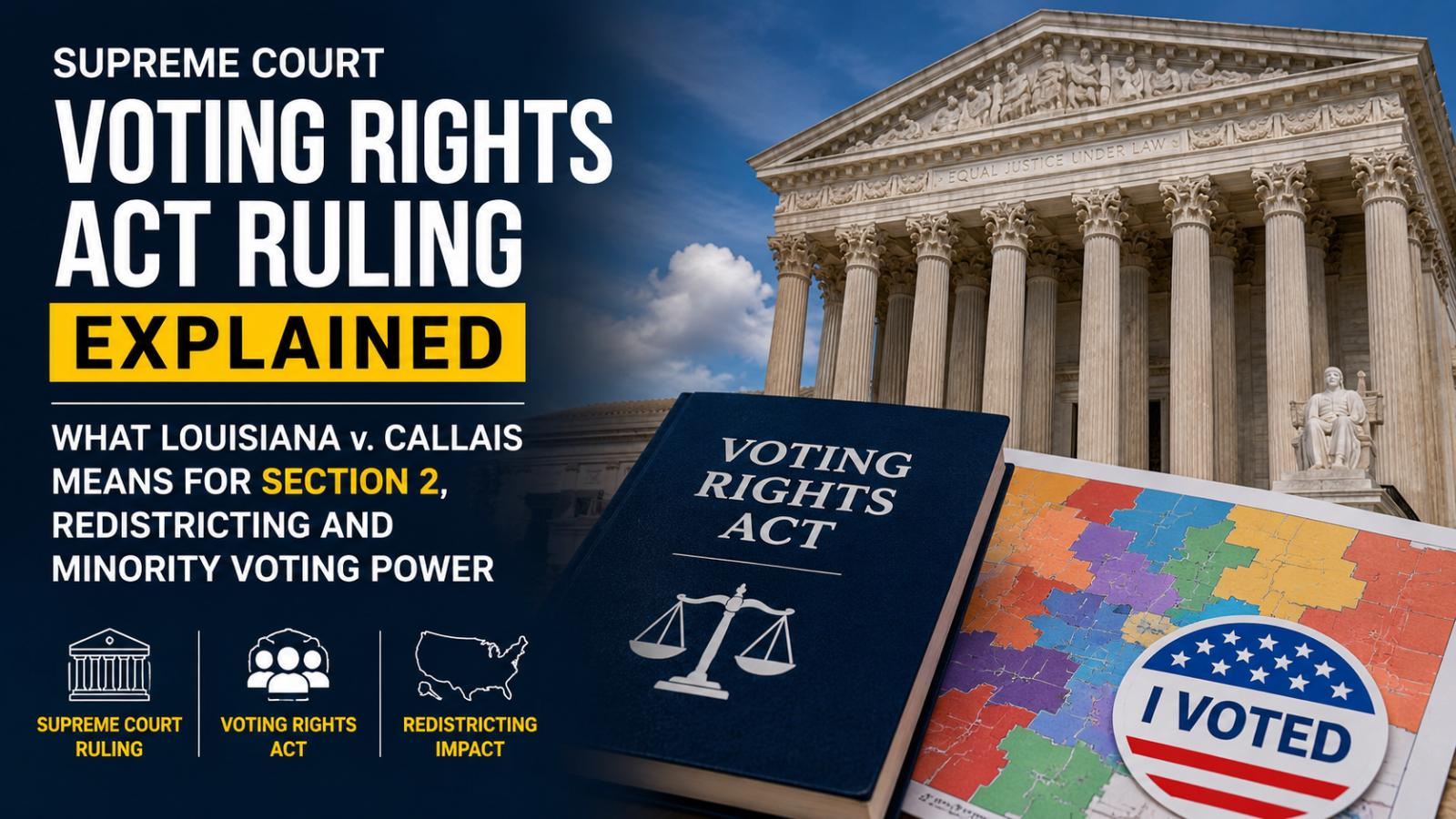
The Supreme Court’s Voting Rights Act ruling in Louisiana v. Callais did not strike down Section 2, but it sharply narrowed how the law can be used in redistricting cases.
In a decision issued on Wednesday, April 29, 2026, the Court ruled that Louisiana’s SB8 congressional map was an unconstitutional racial gerrymander because the Voting Rights Act did not require the state to create an additional majority-Black district.
What Did the Supreme Court Rule?
The Court said Section 2 of the Voting Rights Act can justify race-conscious redistricting only when properly applied. But in Louisiana’s case, the majority found that the state had not shown a strong enough legal basis for using race to draw the second majority-minority district.
The ruling makes future Section 2 lawsuits harder by requiring stronger evidence that a state intentionally drew districts to give minority voters less opportunity because of race. The Court also said plaintiffs must better separate race-based voting patterns from partisan voting patterns.
Why Section 2 Matters
Section 2 of the Voting Rights Act prohibits voting practices that discriminate based on race, color or membership in certain language minority groups. It has long been one of the main legal tools used to challenge election maps that dilute minority voting power.
Before this ruling, many redistricting challenges focused on whether minority voters had less opportunity to elect candidates of their choice under the “totality of circumstances.” The new decision shifts more weight toward intentional discrimination and race-versus-party analysis.
Why Louisiana’s Map Was Challenged
After the 2020 census, Louisiana first adopted a congressional map with one majority-Black district. A federal court later found that map likely violated Section 2 and pushed the state to create a second majority-Black district.
Louisiana then adopted SB8, but that map was challenged as a racial gerrymander. The Supreme Court agreed that race played too large a role in drawing District 6.
What Happens Next?
For more on how Democrats are preparing for the 2026 elections, read our report on Kamala Harris urging Democrats to expand their 2026 strategy.

he ruling is already affecting redistricting fights. On Thursday, May 14, 2026, Louisiana state senators passed a new U.S. House map that would eliminate one majority-Black district, though the plan still required House approval, according to AP.