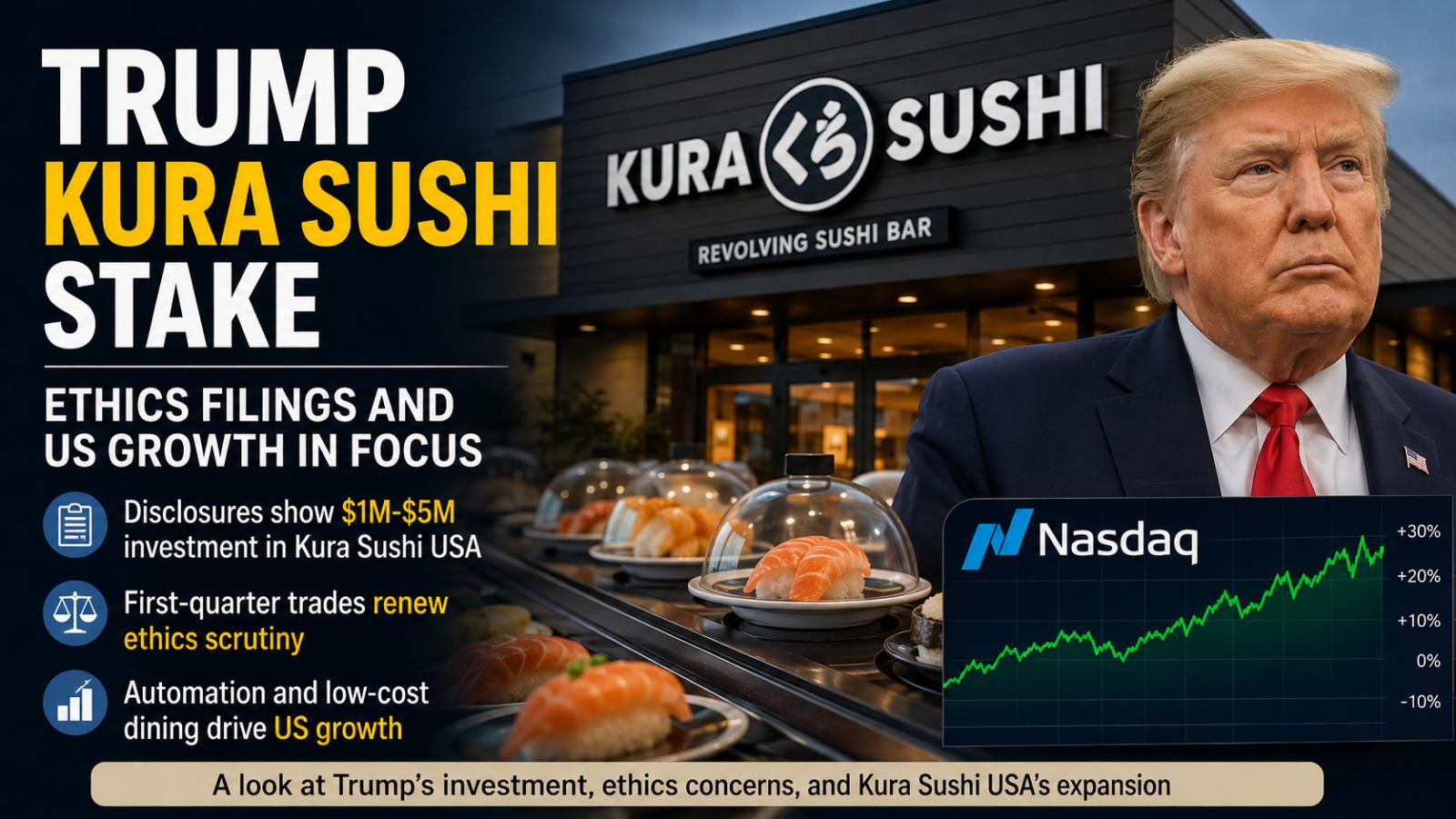
President Donald Trump’s Kura Sushi USA stake is drawing attention after federal ethics filings showed a February 2, 2026 purchase valued between $1 million and $5 million, linking the president’s portfolio to a fast-growing US conveyor-belt sushi chain.
The filing has renewed questions over Trump’s stock trading because it came alongside thousands of first-quarter transactions involving major companies, including Nvidia, Apple, Amazon, Microsoft and Boeing. Reuters reported that Trump disclosed at least $220 million in financial transactions involving US corporate securities during the first quarter of 2026, with the total potentially reaching about $750 million.
Why Trump’s Kura Sushi Stake Is Getting Attention
Kura Sushi USA, the Nasdaq-listed American arm of Japan’s Kura Sushi, has grown in the United States by combining affordable dining with tablet ordering, robotic delivery lanes and conveyor-belt service.
The investment drew surprise in Japan, where Kura Sushi is already a familiar restaurant brand. But the US business offers a clearer growth story as restaurant chains look for ways to manage labor costs, inflation pressure and cautious consumer spending.
Ethics Filings Renew Conflict Questions
The disclosures said Trump, or advisers managing his assets, made more than 3,700 first-quarter trades. Some holdings involved companies whose business interests may be affected by federal policy, renewing conflict-of-interest concerns.
A Trump Organization spokesperson said the president’s assets are managed independently by third-party financial institutions and that Trump, his family and the company are not involved in individual trading decisions. Vice President JD Vance has also said Trump does not personally pick stocks.
Kura Sushi USA’s Growth Case
Kura Sushi USA launched in the United States in 2009 and has expanded into Texas, Florida and other Sun Belt markets. The supplied article says revenue rose about 25% in fiscal 2025, though higher wages and softer spending have pressured margins.
Management has leaned on plate-counting systems, kitchen robotics and reservation tools, making automation central to the company’s investment appeal.
The stake matters because it connects three reader-friendly angles: Trump’s financial disclosures, renewed ethics scrutiny and the growth of automation-driven restaurant chains in the United States. For readers, the key question is not only why Kura Sushi attracted investment attention, but also how presidential financial disclosures are judged when assets are not placed in a blind trust.