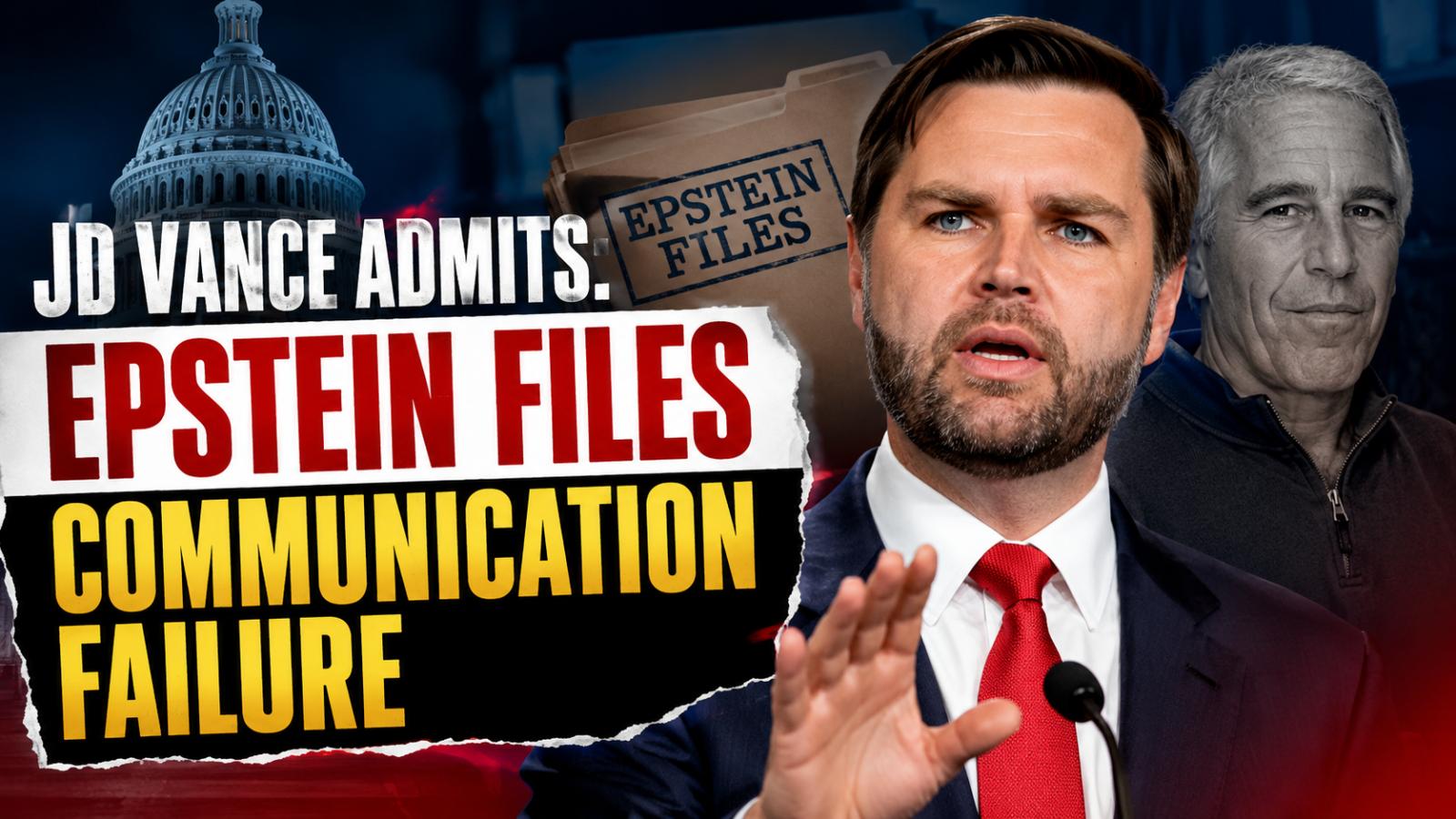
US Vice President JD Vance has admitted that the Trump administration mishandled communication surrounding the Jeffrey Epstein files. During an appearance on The Joe Rogan Experience, Vance said officials created unnecessary confusion but rejected accusations of a deliberate cover-up.
Epstein release should have started earlier
Vance said the administration should have released the available Epstein material more directly instead of allowing uncertainty and speculation to dominate the public discussion.
“We absolutely screwed up the comms of the Epstein files,” Vance told Rogan. However, he argued that communication failures did not prove that officials were trying to conceal evidence or protect influential people. The remarks marked one of the administration’s clearest acknowledgements that its Epstein file rollout damaged public confidence.
Vance said releasing the records earlier, with legally required protections for victims, could have prevented much of the mistrust. His comments also highlighted the difference between withholding evidence and applying redactions intended to protect survivors, witnesses and sensitive personal information.
Bondi claim raised expectations
Vance defended former Attorney General Pam Bondi while acknowledging that she overstated what the government possessed. Bondi faced criticism after saying an alleged Epstein “client list” was on her desk, creating expectations that the Justice Department was preparing to reveal previously unknown names.
“I know Pam. I like Pam. I don’t think there was anything malicious going on,” Vance said. He argued that Bondi was responding to political pressure but exaggerated what officials had and what the records could establish.
The criticism intensified after the Justice Department distributed binders labelled as the first phase of the Epstein files. The department later confirmed that much of the initial material had previously circulated publicly, although it had not all been formally released by the federal government.
Trump view challenged by public mistrust
The Epstein controversy became a persistent political problem for President Donald Trump’s administration because expectations of major revelations were followed by delays, redactions and conflicting statements.
The dispute also demonstrated the risk of presenting document releases as dramatic political events. When officials promote records before explaining their evidentiary value, routine disclosures can create unrealistic expectations and fuel unsupported theories.
Vance rejected claims that communication errors proved a wider conspiracy. However, his admission showed that the administration recognised how its messaging contributed to public mistrust.
DOJ docs released under federal law
Congress approved the Epstein Files Transparency Act in 2025, requiring the Justice Department to disclose a broader collection of records related to federal investigations into Epstein. President Trump signed the legislation on November 19, 2025.
The Justice Department began releasing records in December and announced on January 30, 2026, that it had published more than three million additional pages. The material included photographs, communications, interview records and other investigative documents.
DOJ officials said redactions were primarily intended to protect victims and their families. The department also warned that the archive contained unverified submissions, false allegations and sensitive information that should not automatically be treated as established fact.
Public trust remains the central issue
Vance’s remarks may reduce some uncertainty about the administration’s internal view, but they do not end the transparency debate. Questions remain about redaction decisions, withheld records and whether government agencies have fully supported related investigations.
The larger lesson is straightforward: releasing millions of pages does not automatically create transparency. Officials must clearly explain what the documents contain, what remains protected and which claims are supported by verified evidence.
Relevant internal links can connect this report to the US News category, Donald Trump policy coverage, Justice Department investigations, government transparency articles and previous Jeffrey Epstein file updates.