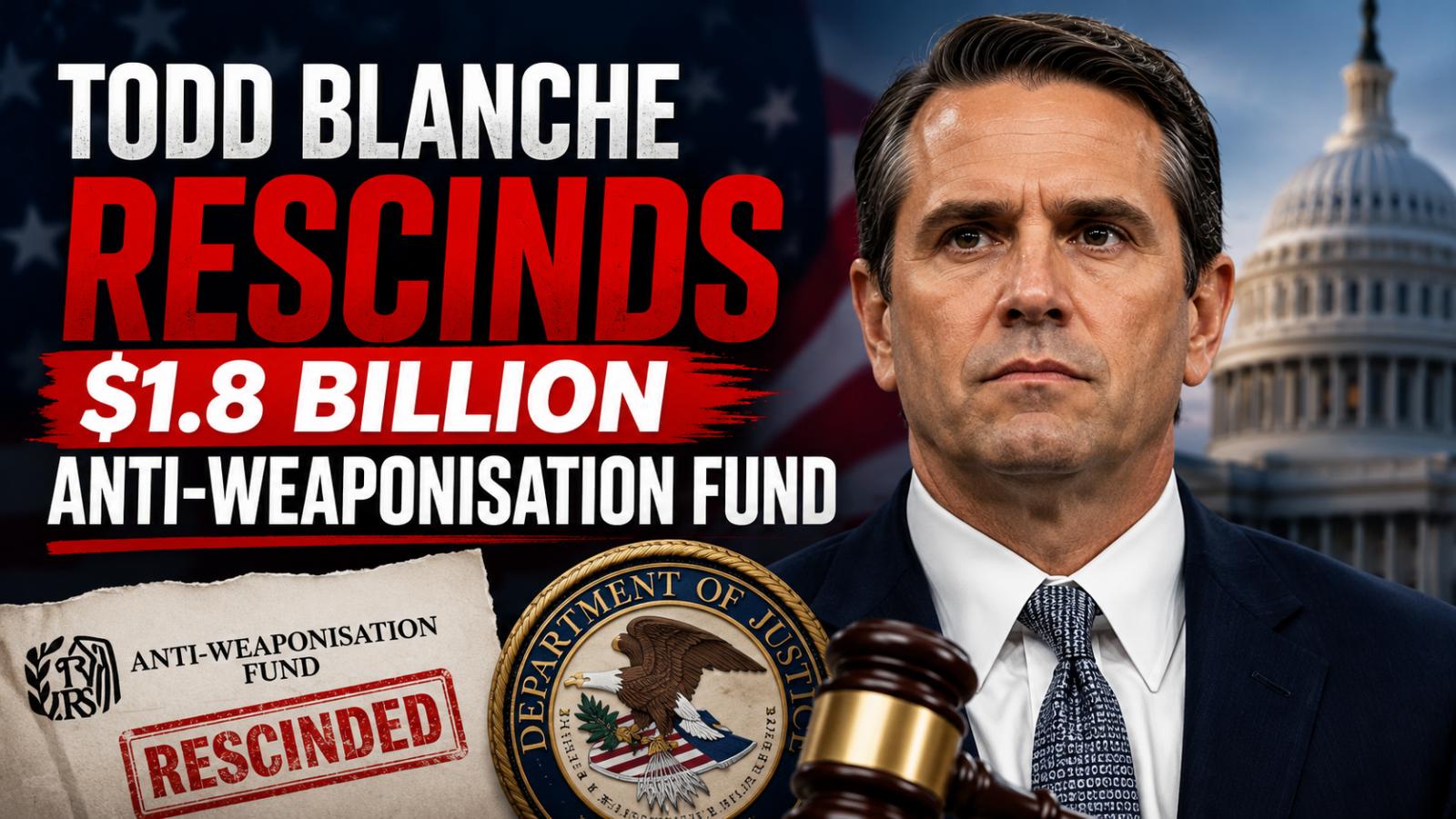
Acting US Attorney General Todd Blanche has formally rescinded the controversial $1.8 billion anti-weaponisation fund as he seeks to overcome Republican opposition to his permanent confirmation. The decision also limits tax protections included in a settlement involving President Donald Trump and the Internal Revenue Service.
Senate vote approaches
Blanche announced the reversal in a post on X on Sunday, August 2, following several weeks of discussions with senators and members of the Senate Judiciary Committee. He said the talks addressed outstanding questions surrounding the programme and the related IRS settlement.
An order attached to his announcement rescinded the May 18 directive that created the Anti-Weaponisation Fund. The document stated that the earlier order would have no further force or effect. The formal action came before a crucial Senate Judiciary Committee vote on Blanche’s nomination to become the 88th attorney general of the United States. Senate records confirm that President Trump nominated Blanche and that the committee held confirmation hearings on July 15 and 16.
IRS deal created the fund
The Justice Department established the fund in May as part of a settlement linked to Trump’s legal dispute with the IRS. According to the department’s original announcement, the programme would have received approximately $1.776 billion from the federal Judgment Fund.
The proposed system could have issued monetary relief, formal apologies and other remedies to people who claimed the federal government had politically targeted them. The Justice Department said the programme would submit quarterly reports to the attorney general and stop processing claims by December 2028.
The proposal quickly became one of the most controversial parts of Blanche’s nomination. Critics argued that the broad eligibility rules could allow people connected to the January 6, 2021, Capitol attack or other Trump allies to seek taxpayer-funded compensation.
GOP split threatened confirmation
Republican Senators John Cornyn of Texas and Thom Tillis of North Carolina raised concerns about both the fund and the scope of the IRS settlement. Their opposition became significant because Democratic members of the Judiciary Committee were already expected to oppose Blanche.
The senators sought a formal written guarantee that the programme would not move forward. Blanche had previously described the fund as effectively dead, while the Justice Department told courts that it had abandoned the plan. However, no formal rescission order had been issued until Sunday.
The Justice Department said the fund never became operational. No members were appointed, no claims were processed and no money was transferred before Blanche formally cancelled it.
DOJ order limits tax shield
Blanche also narrowed an addendum to the IRS settlement that had raised questions about future tax investigations involving Trump, his relatives and associated entities. The updated language states that the protection applies retrospectively and only to parties named in the original lawsuit.
That clarification means the settlement does not provide blanket protection from audits or investigations involving future tax filings. The change directly addresses concerns that the earlier language could have prevented the IRS from reviewing later filings by Trump or members of his family.
By withdrawing the fund and limiting the tax provision, Blanche has removed the two biggest Republican objections to his nomination. The decision may improve his chances of advancing through the Judiciary Committee, although his confirmation will still depend on maintaining sufficient Republican support in the full Senate.