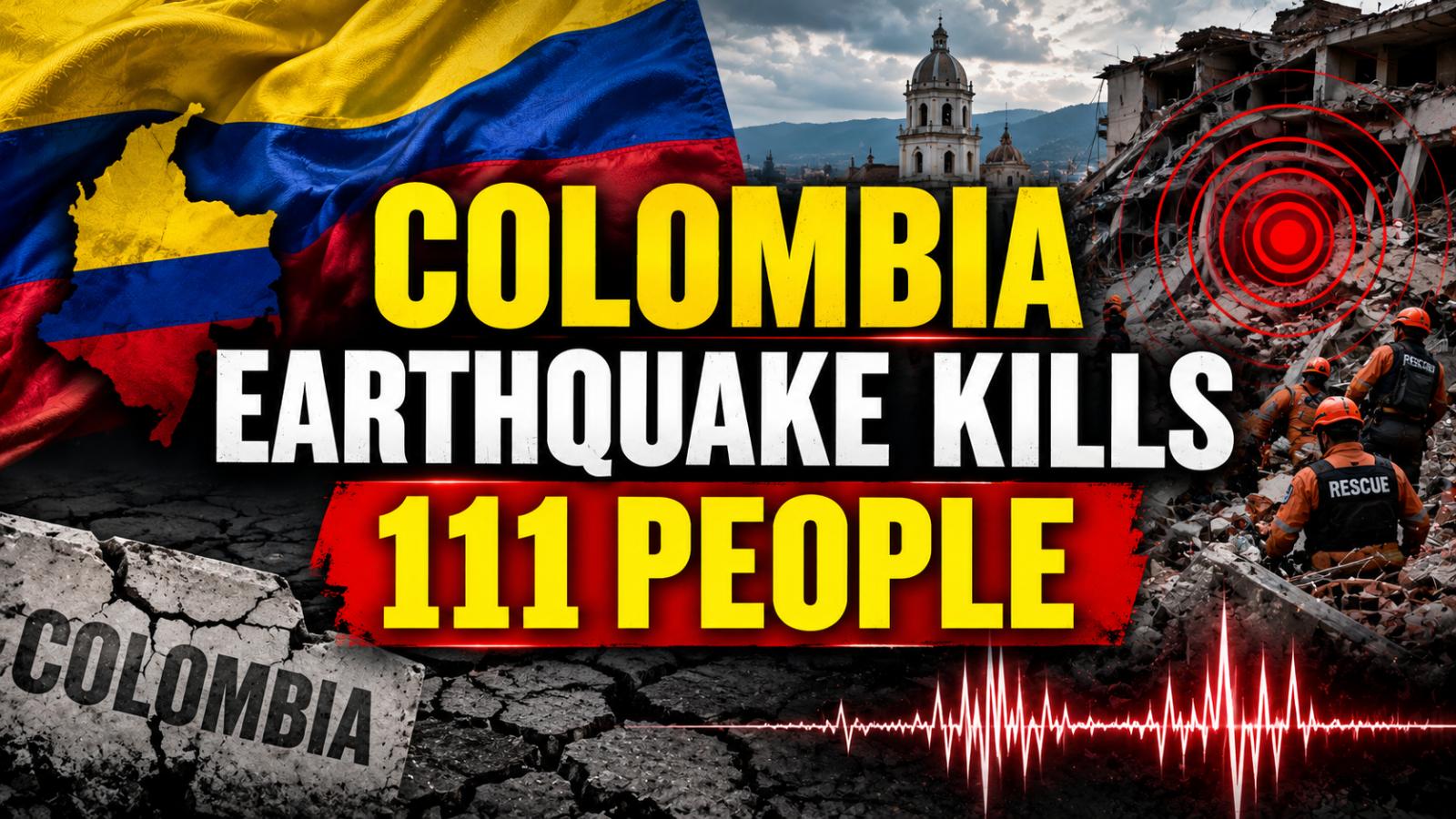
Colombia earthquake 2026 has left at least 111 people dead and dozens injured after a powerful magnitude 7.4 quake struck western Colombia on Monday. Buildings collapsed across several cities as emergency crews searched rubble for survivors, while shaking was felt hundreds of kilometres from the epicentre.
Colombia quake leaves 111 dead and dozens injured
The earthquake struck western Colombia on August 10, triggering widespread damage and prompting a major emergency response. President Abelardo de la Espriella said at least 111 people had been killed and 87 injured as authorities continued assessing affected communities. The government declared a national disaster, and officials warned that casualty figures could change as rescue operations continued.
Cali was among the cities reporting severe structural damage, with buildings collapsing and people becoming trapped beneath debris. Emergency teams from other major cities were called in to reinforce local rescue operations. Pereira, Manizales and communities in Chocó were also among the areas reporting deaths, injuries or significant damage.
Choco quake centred near San José del Palmar
The Colombian Geological Service has now confirmed the earthquake at magnitude 7.4, with its epicentre near San José del Palmar in Chocó and a depth of about 103 kilometres. This supersedes earlier preliminary measurements that gave different magnitudes and depths.
The agency described it as the largest earthquake recorded in Colombia since the country's modern national seismic monitoring network began operating. Strong shaking was reported across a wide area, including Bogotá, despite the capital being far from the epicentre.
Cali damage complicates rescue operations
Collapsed structures have created the most urgent challenge for rescue teams. Authorities are searching damaged buildings while assessing whether additional structures remain unsafe.
Transportation infrastructure was also disrupted. Damage assessments were reported at airports in several western Colombian cities, adding logistical pressure to an emergency response already spread across multiple departments.
The depth of the earthquake helped explain why it was felt across such a broad area. Colombian Geological Service experts said the quake originated within the Nazca Plate beneath the region rather than from a shallow surface fault.
Quake rescue continues amid aftershock concerns
Emergency officials remain focused on locating survivors and evaluating buildings before residents return. Authorities have also urged communities to remain alert for aftershocks and to follow official guidance rather than unverified information circulating online.
President de la Espriella said rescue operations were the immediate priority as the scale of the disaster became clearer. With damaged buildings across several cities and search operations continuing, the final human impact may not yet be known.
Colombia seismic activity remains a major risk
Colombia has significant earthquake exposure because of the complex interaction of tectonic plates beneath and around the country. The Pacific and Andean regions are particularly active, making seismic preparedness an important national concern.
Monday's disaster demonstrates how a deep earthquake can still produce destructive shaking over an extensive area. The immediate priority is finding survivors, treating the injured and determining which buildings and infrastructure remain safe.
One important correction from your source copy: do not retain the preliminary 6.7 figure as though it conflicts with the 7.4 report. Colombia's Geological Service has updated its official measurement to magnitude 7.4 at 103 km depth.