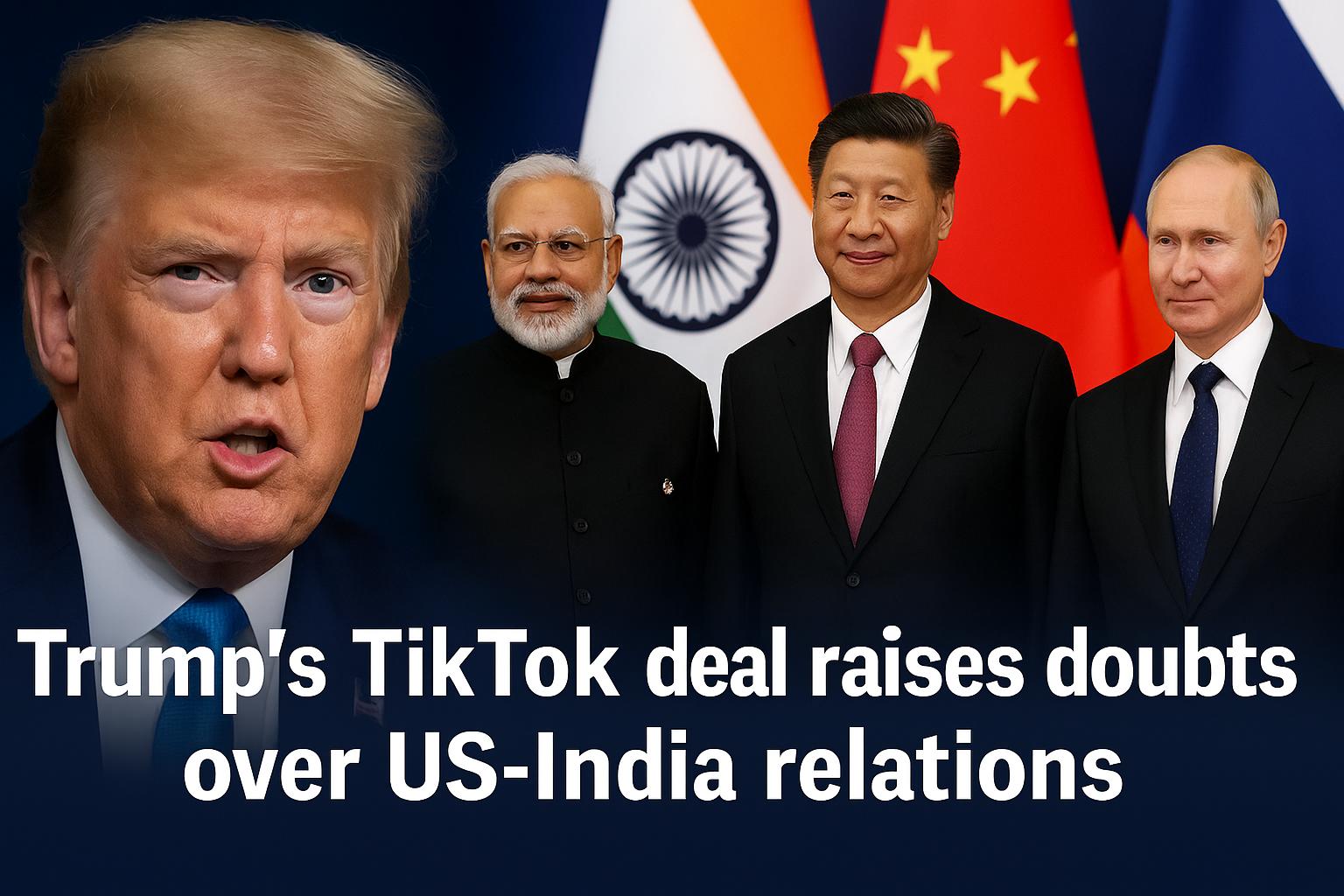
US President Donald Trump on Monday (September 15) announced that his administration had reached a preliminary agreement with a “certain company,” which he described as the one “young people” in the US “very much wanted to save.” While he did not directly name TikTok, it was evident from the context of his comments. The US Treasury later confirmed that Washington and Beijing had agreed on a framework deal regarding TikTok. Trump also revealed that he would be speaking with Chinese Premier Xi Jinping on September 19, stressing that ongoing trade discussions in Europe, which involve the EU as well, were making progress.
The announcement marks another chapter in Trump’s complex approach to international negotiations, particularly with China. His statements suggest that while TikTok has been a point of contention between the two countries, his administration now sees an opportunity to strike a deal that balances both domestic political pressure and international trade relations. Yet the development comes at a moment when India is questioning the reliability of its partnership with Washington.
The photograph of Prime Minister Narendra Modi with Russian President Vladimir Putin and Chinese President Xi Jinping quickly circulated in Washington, causing concern across the political spectrum. Many American observers noted that while India continues to demonstrate strategic independence, Trump’s moves may be undermining decades of careful US-India diplomacy. India, surrounded by difficult neighbors and increasingly central to Indo-Pacific security, now finds itself weighing Washington’s long-term intentions.
The controversy over Trump’s policies has revived memories of previous moments when US political figures acted independently of presidential directives. At various times, prominent members of Congress have chosen to visit leaders in Syria, Taiwan, or Ukraine, even when the White House preferred isolation or conciliation. These moves were often framed as part of Congress’s role as a co-equal branch of government. Figures such as Nancy Pelosi and Mike Pompeo once made high-profile visits abroad to signal positions different from sitting presidents.
For India, the frustration lies not only with Trump’s transactional policies but also with the silence from Capitol Hill. If bipartisan leaders in the Senate Foreign Relations Committee or the Senate Armed Services Committee recognize India’s importance, why have they not taken steps to travel to New Delhi and reassure its leadership? Many argue that the US-India relationship in the Indian Ocean basin could prove decisive in the 21st century, making the current hesitation deeply concerning.
The absence of proactive congressional diplomacy stands in stark contrast to past instances where lawmakers or retired officials used their freedom to engage foreign leaders. Critics argue that if former presidents like George W Bush, Barack Obama, or Joe Biden genuinely valued the India relationship, they could demonstrate it through symbolic visits or public statements. Instead, there is an apparent reluctance to challenge Trump’s approach, leaving India questioning Washington’s true commitment.
India is not Syria or Taiwan, and Modi is not an authoritarian leader shunned by the West. Rather, India is a democracy whose cooperation is vital to counter regional instability and global security threats. Yet the lack of visible support from American leaders risks sending a damaging message. Indians may reasonably ask why they should continue to trust Washington if its commitment can shift so dramatically with a single administration.
Ultimately, the broader tragedy may not be Trump’s unpredictable behavior, but the unwillingness of American political elites to rise above it. The silence and inaction of hundreds of officials across Washington send a louder signal than Trump’s speeches or posts on social media. For India, the message is clear: unless the United States can demonstrate continuity and seriousness in its partnership, the foundation of the relationship risks erosion.
India’s annoyance with Trump’s policy shifts and his willingness to prioritize short-term deals over long-standing diplomatic commitments is not simply about one leader’s personality. It reflects a deeper unease with the United States’ ability to maintain consistent foreign policy in an era of growing geopolitical uncertainty. Whether through Congress, former presidents, or future administrations, Washington must decide if its words about valuing India truly translate into action.
At this moment, with Trump focused on striking deals with Beijing and even courting Pakistan in ways that unsettle New Delhi, the need for reassurance could not be greater. If India is indeed one of America’s most important strategic partners, then it deserves more than silence. The responsibility lies not only with Trump but also with the many voices in Washington who have so far failed to speak up.