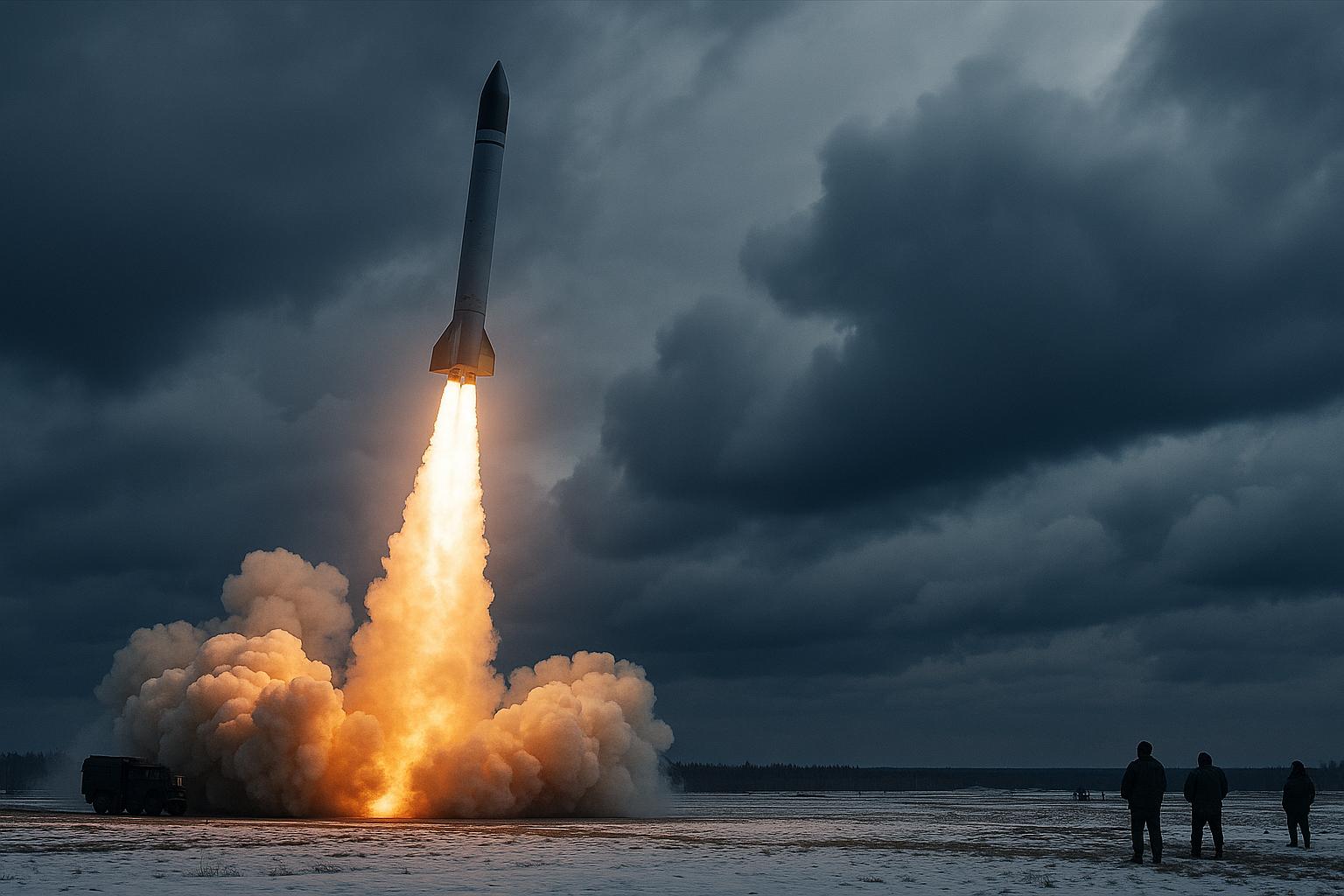
Russian President Vladimir Putin announced on Sunday, October 26, that Russia had successfully completed the final test of its Burevestnik nuclear-powered cruise missile, a weapon Moscow describes as having an “unlimited range.” The missile, often referred to as the “Flying Chernobyl” due to its nuclear propulsion system, has been a subject of intense global scrutiny since its development was first disclosed in 2018.
Putin called the weapon a “unique creation that no other country in the world possesses,” asserting that it represents a major leap in Russia’s long-range defense capabilities. The Burevestnik, officially designated 9M730, and known to NATO as SSC-X-9 Skyfall, is part of Moscow’s advanced strategic weapons program designed to strengthen deterrence and bypass modern missile defense systems.
The Russian leader’s announcement follows years of speculation surrounding the missile’s safety, performance, and potential environmental risks. Its nuclear propulsion technology theoretically enables it to fly indefinitely, changing course mid-flight and striking targets anywhere in the world without the limitations of traditional fuel-based missiles. This capability, if proven operational, could significantly alter the global balance of strategic power.
According to General Valery Gerasimov, Russia’s Chief of General Staff, the missile’s most recent test took place on October 21 and lasted 15 hours. He emphasized that the flight demonstrated both reliability and precision, though he suggested that the missile’s endurance extends well beyond that timeframe. “The technical characteristics of the Burevestnik allow it to hit highly protected targets at any distance with guaranteed precision,” Gerasimov said, highlighting the weapon’s ability to evade all existing missile defense systems.
The International Institute for Strategic Studies has previously estimated the missile’s notional range at up to 20,000 kilometers (12,400 miles), theoretically granting it the ability to reach targets anywhere across the planet. The Burevestnik’s nuclear-powered engine eliminates the need for conventional fuel, enabling sustained flight over extended periods and unpredictable routes.
However, the missile’s development has not been without controversy. Western analysts have expressed concern over potential radioactive contamination risks during testing and operation. The weapon’s nickname, “Flying Chernobyl,” underscores fears of an accident that could disperse nuclear material into the atmosphere. Despite these concerns, Russian officials have maintained that the missile meets all safety and environmental standards.
Putin’s announcement comes amid renewed tensions between Moscow and Western nations, particularly over global security frameworks and the arms control treaties that once limited nuclear development. The Kremlin continues to assert that the Burevestnik program is part of Russia’s sovereign right to defend itself and ensure strategic parity with other nuclear powers.
With the final test reportedly complete, analysts suggest the missile could move toward limited deployment, though details remain classified. If operationalized, the Burevestnik would join other advanced Russian weapons systems such as the Avangard hypersonic glide vehicle and the Poseidon underwater drone, both designed to reinforce Russia’s deterrence strategy.
As Moscow celebrates what it calls a landmark achievement, global observers remain divided—some view it as a demonstration of technological innovation, while others warn it represents a dangerous escalation in nuclear armament. The full implications of the Burevestnik’s success, both strategic and environmental, may take years to fully understand.