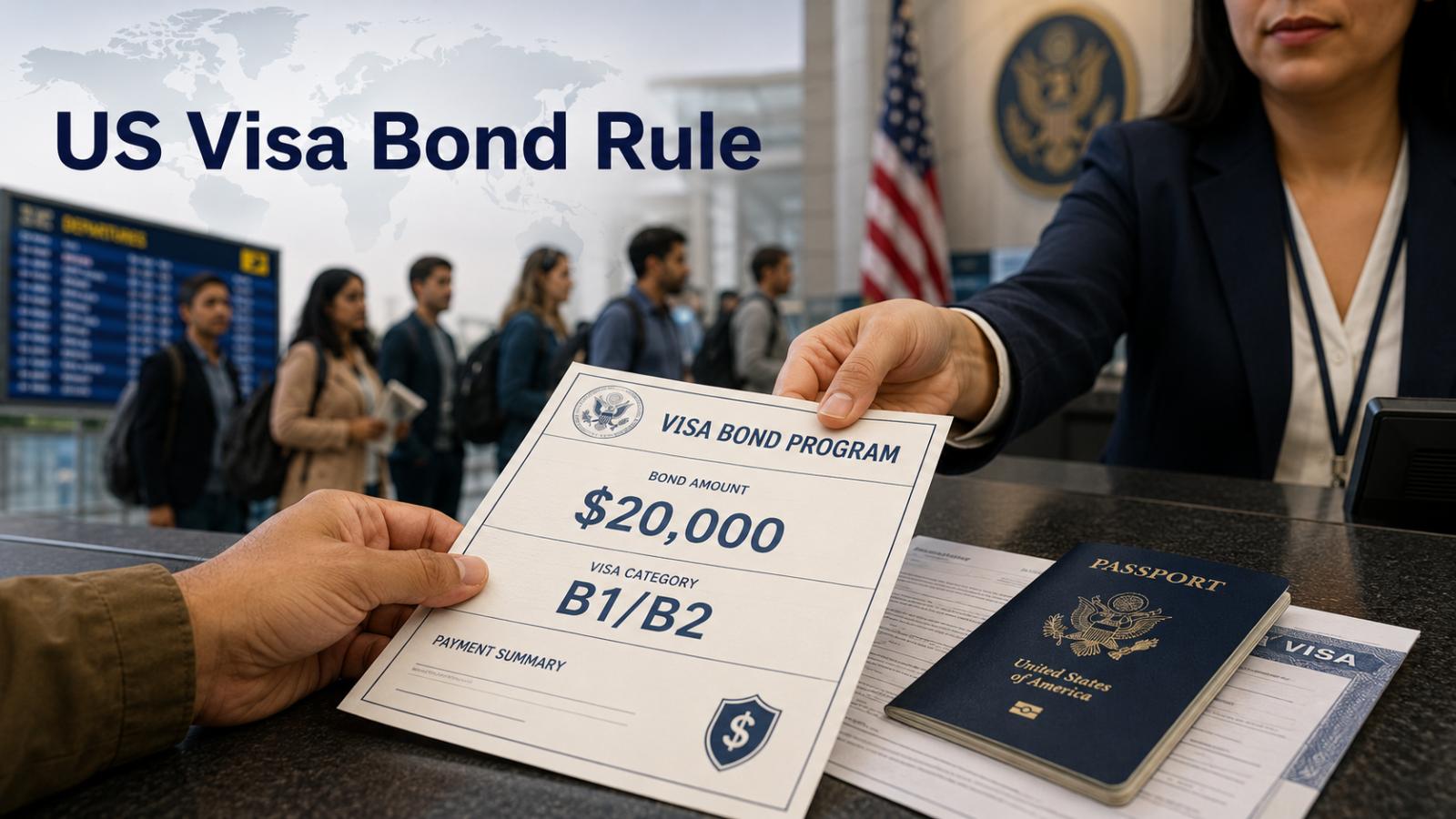
The US visa bond program became permanent on August 3, 2026, allowing consular officers to require $10,000, $15,000 or $20,000 bonds from certain B1/B2 applicants. The rule covers 50 countries, targets overstays and does not currently include Indian nationals.
The U.S. State Department made its visa bond program permanent on Monday, August 3, 2026, allowing consular officers to require certain B-1, B-2 or combined B-1/B-2 visa applicants to post bonds of $10,000, $15,000 or $20,000 before a visa is issued. The program currently covers nationals of 50 countries selected using criteria such as overstay rates, information-sharing gaps and document security.
How the B1/B2 visa bond works
A covered applicant attends the consular interview first. If an officer requires a bond, the applicant receives instructions to pay electronically through a U.S. Treasury platform. If the applicant is later found ineligible, the visa is denied and the bond is canceled.
Approved travelers must follow the bond conditions, including entering and leaving through approved commercial airports and departing within the authorized stay. The money is refunded after government systems confirm compliance. A substantial violation can result in forfeiture.
Permanent rule raises bond amounts
The 2025 pilot used bonds of $5,000, $10,000 and $15,000. The permanent program removes the $5,000 tier and sets amounts at $10,000, $15,000 or $20,000. Consular officers choose the level based on the applicant’s circumstances, unless a national-interest or humanitarian waiver is granted.
Pilot reduced overstays and visa issuance
The State Department said the 50 participating countries recorded 45,488 overstays in fiscal 2024. During the pilot’s first 10 months, fewer than 50 overstays were recorded among bonded travelers. About 20,000 applications required a bond, nearly half did not result in payment, and B-1/B-2 visa issuance for covered countries fell 83% from the same period a year earlier.
India not on current country list
India is not on the State Department’s current list of 50 covered countries, so Indian B-1/B-2 applicants are not presently subject to the bond. The list can change on a rolling basis, with additions generally announced at least 15 days before implementation.
The permanent rule gives the U.S. government a continuing financial tool to discourage overstays while creating a substantial upfront cost for affected travelers. Its wider impact will depend on future country additions, removals and compliance data.