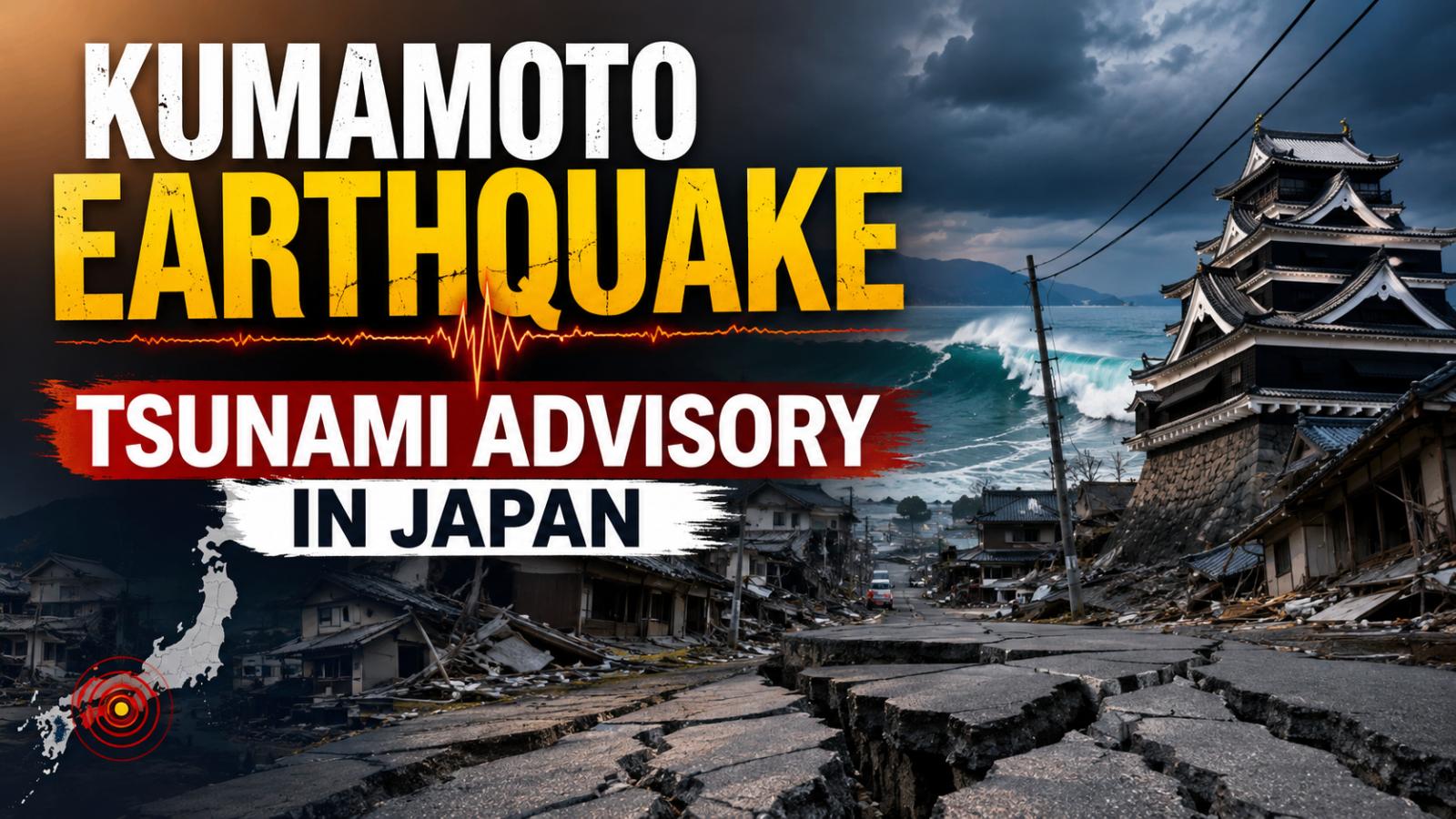
A powerful Kumamoto earthquake measuring magnitude 7.1 struck Japan’s southern Kyushu region on Tuesday, July 28, prompting a tsunami advisory and emergency alerts across several prefectures. Authorities urged coastal residents to move away from the sea while officials assessed possible damage and aftershock risks.
Kumamoto earthquake shakes southern Japan
The Japan Meteorological Agency said the earthquake struck Kumamoto Prefecture and caused intense shaking across parts of the region. Strong tremors were reported in the Amakusa and Ashikita areas, while residents across Kyushu received emergency earthquake notifications on mobile phones and public warning systems.
Initial assessments placed the earthquake at magnitude 7.1. Japan’s seismic intensity scale measures how strongly the ground shakes in specific locations, rather than only measuring the energy released at the source. Officials continued reviewing seismic data as emergency teams gathered reports from affected communities.
Tsunami alert issued for coastal areas
Following the Kyushu quake, the JMA issued a tsunami advisory for Ariake Bay and warned that waves could reach approximately one metre, or about 3.28 feet. Residents near the coast were instructed to leave beaches, ports and low-lying shoreline areas and remain in safer locations until authorities cancelled the advisory.
Some early reports referred to the notice as a tsunami warning. However, the official alert level reported for Ariake Bay was a tsunami advisory. This distinction is important, but even a one-metre tsunami can create dangerous currents capable of sweeping away people, boats and vehicles near the shoreline.
JMA warning reaches seven prefectures
Emergency earthquake alerts were issued for Kumamoto, Nagasaki, Kagoshima, Fukuoka, Saga, Oita and Miyazaki prefectures. These areas are located on or near Kyushu, where residents were advised to watch for falling objects, damaged buildings, landslides and interruptions to transport and utility services.
The Japanese government established an emergency response structure to collect damage reports and coordinate with local authorities. Officials said protecting lives remained the immediate priority and warned residents not to return to coastal areas simply because no large wave was immediately visible.
Aftershock warning and damage checks
Authorities began inspecting roads, railways, public buildings and critical infrastructure after the Kumamoto earthquake. Japan’s nuclear regulator reported no immediate abnormalities at three nearby nuclear power facilities, although safety checks continued as a precaution. Transport operators also reviewed services in areas affected by strong shaking.
People in the region were advised to prepare for aftershocks, avoid visibly damaged structures and rely on official JMA and local government updates. Damage and casualty information remained limited during the initial response, meaning early figures could change as emergency teams reached affected communities.