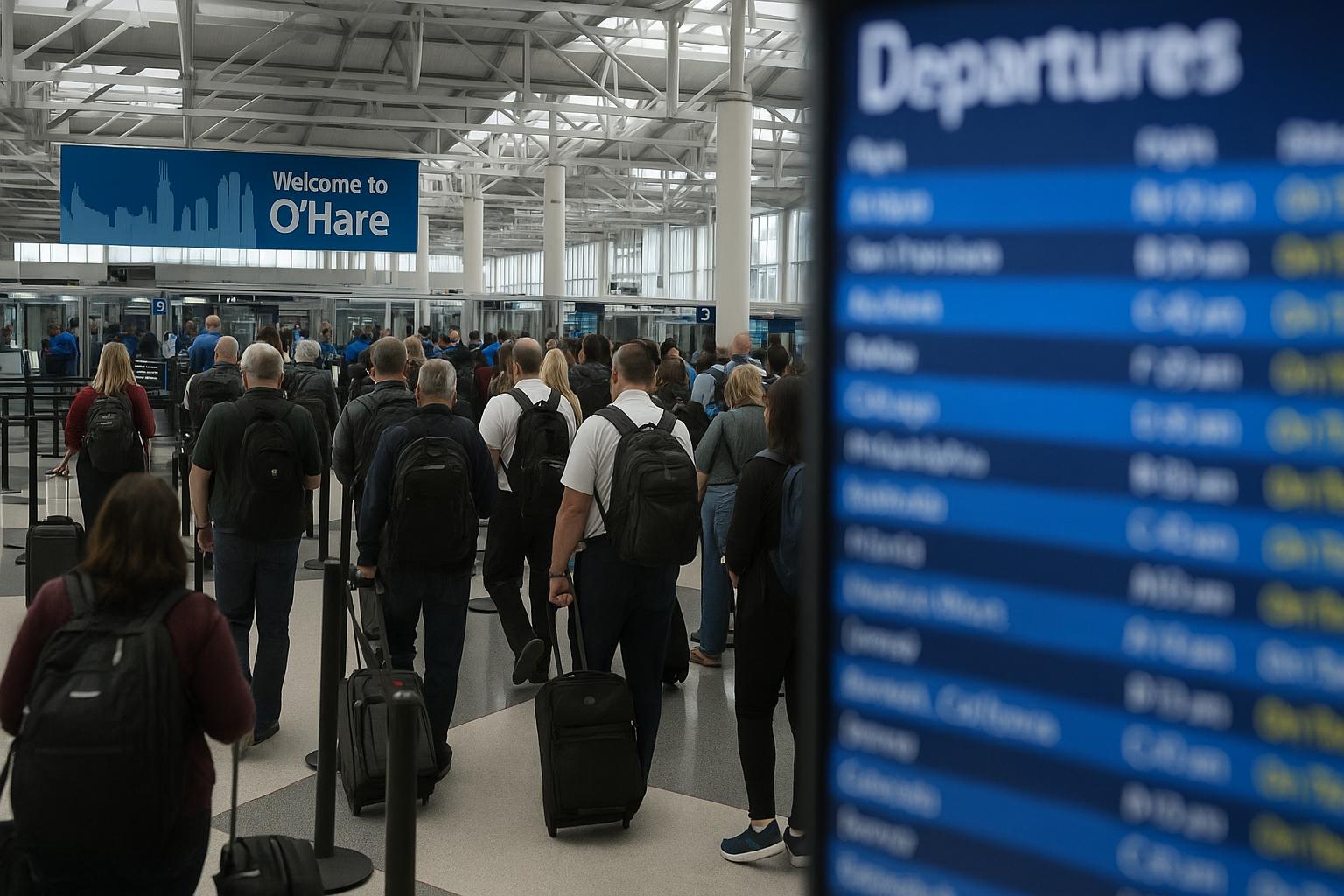
More than 250 flights were delayed Thursday across Chicago’s O’Hare and Midway International Airports as the ongoing federal government shutdown continued to affect staffing levels nationwide. According to data from the Chicago Department of Aviation’s flight-tracking portal, FlyChicago, delays began mounting early in the morning and grew steadily through the day, causing widespread frustration among passengers and airlines.
As of 11:30 a.m., O’Hare International Airport had already reported 210 flight delays within a 24-hour window, while Midway logged 23. By noon, the total number of delayed flights across both airports had surpassed 250, making Thursday one of the most disrupted travel days since the start of the shutdown. Officials did not immediately specify the causes of the delays, though industry sources have pointed to reduced staffing at key federal aviation agencies as the primary factor.
The timing could hardly be worse. Thousands of visitors from across the country and around the world are arriving in Chicago for the 2025 Bank of America Chicago Marathon this weekend, one of the city’s largest annual events. The surge in passenger traffic has placed added pressure on airport operations already strained by limited personnel.
In a recent statement, the Chicago Department of Aviation reaffirmed that safety and security remain its “highest priorities.” The department noted that it is closely monitoring potential effects of the federal shutdown and coordinating with federal partners such as the Federal Aviation Administration (FAA), the Transportation Security Administration (TSA), and U.S. Customs and Border Protection (CBP). Officials pledged to assist travelers and maintain smooth airport operations where possible, though they warned that disruptions could continue if staffing shortages persist.
Across the country, the FAA has acknowledged similar challenges at multiple airports, including those in Boston, Dallas, Philadelphia, and Nashville, as well as at air traffic control centers in Houston, Atlanta, and the Dallas–Fort Worth area. The ripple effects have been felt as far away as Burbank, Newark, and Denver, where flight schedules have also been impacted by insufficient staffing.
Local transportation officials say air traffic controllers remain on duty despite not receiving paychecks since the shutdown began. Transportation Secretary Sean Duffy described growing anxiety among controllers who are now struggling to cover household expenses while maintaining their demanding work schedules. “They’re worried not only about the safety of our skies but also about how to feed their families,” Duffy said. “Many are working six days a week under enormous pressure.”
As the shutdown enters its ninth day, aviation experts warn that the longer it continues, the greater the risk of widespread disruption to the U.S. air travel network. Travel industry analysts have expressed concern that the crisis could stretch into the holiday season, potentially affecting millions of Americans’ Thanksgiving travel plans. “If the government remains shut down, it could seriously disrupt holiday travel and cause chaos across the system,” one analyst said.
For travelers already facing delays, experts advise checking flight status before heading to the airport using airline apps or official flight-tracking websites. The FAA’s own site offers updates on nationwide airport conditions, helping passengers determine whether delays are localized or part of broader systemwide issues.
If a flight is canceled, passengers are urged to immediately contact airline representatives at the airport, call customer service hotlines, or reach out via social media for faster responses. Airlines are required to rebook passengers at no additional cost and must provide refunds if travelers choose not to fly. Those affected by cancellations are also entitled to refunds for any unused services such as seat upgrades or baggage fees.
While some travelers may consider alternate modes of transportation, analysts caution that systemic issues affecting air traffic control centers mean that disruptions are likely to continue across the aviation network rather than being limited to individual carriers. “This isn’t just one airline’s problem,” said Kyle Potter, a travel industry expert. “It’s a systemwide challenge that could impact nearly every airport as long as the shutdown persists.”
Although U.S. airlines are not legally obligated to provide additional compensation for delays or cancellations caused by government-related staffing shortages, the Department of Transportation offers an online resource where passengers can check what commitments individual carriers make regarding refunds, rebookings, and customer assistance.
Travelers are also encouraged to remain patient with airport staff. Frontline agents are dealing with high volumes of frustrated passengers, and maintaining civility can often lead to faster and more effective service. “Remember that these agents didn’t cause the shutdown,” Potter said. “A little patience can go a long way during a crisis like this.”
As federal negotiations continue in Washington, passengers across the country are bracing for continued turbulence in the nation’s aviation system. For now, Chicago remains one of the hardest-hit cities, with O’Hare and Midway serving as high-traffic test cases for how long America’s skies can operate under reduced staffing and mounting political uncertainty.