Sai Pallavi’s sword-and-shield scene in the Ramayana trailer has renewed debate over Sita’s portrayal as a strong and independent heroine.
Ramayana Trailer Shows A Fearless Side Of Sita
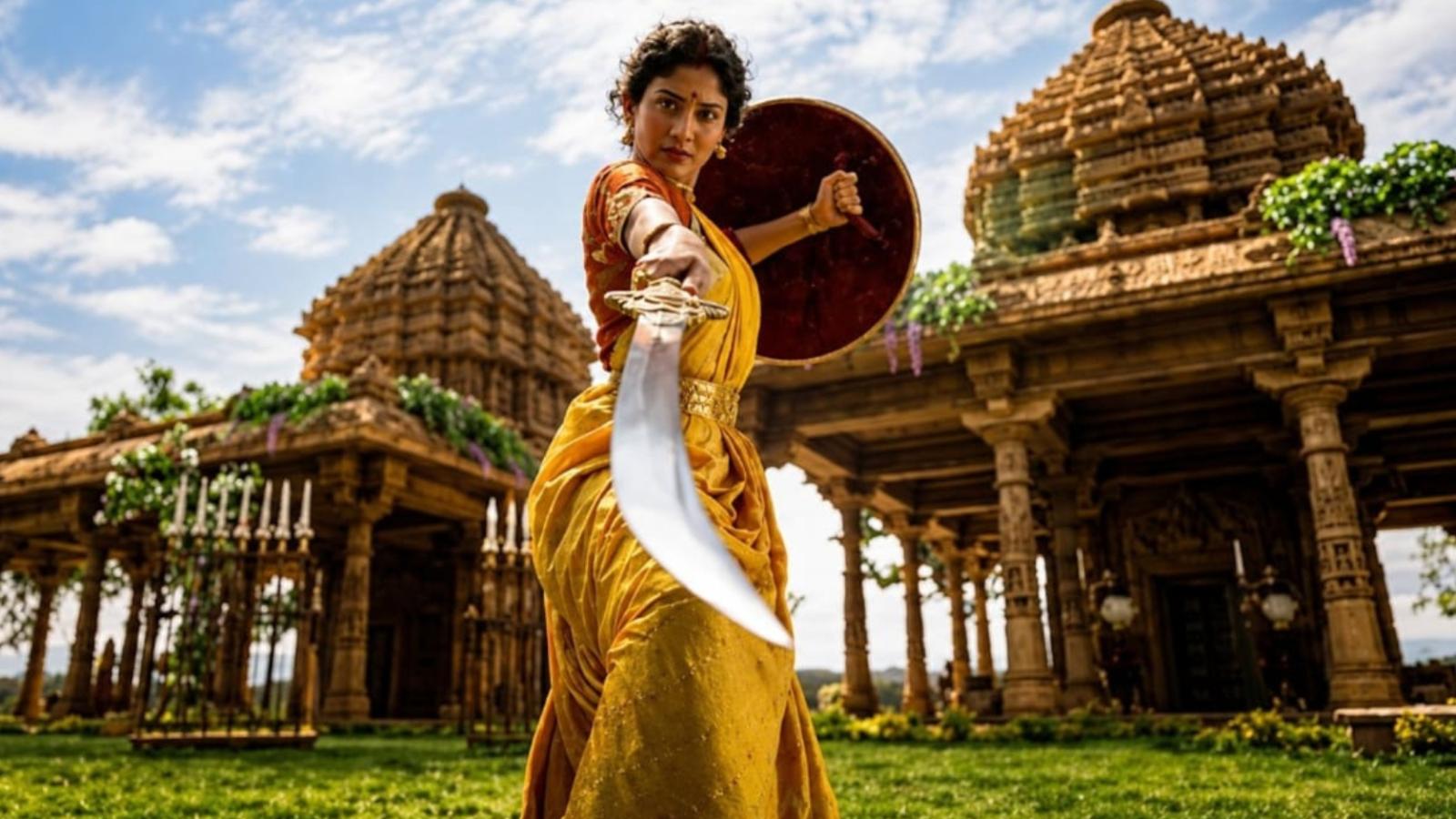
Nitesh Tiwari’s Ramayana trailer contains several grand moments featuring Ranbir Kapoor as Rama and Yash as Ravana, but a brief shot of Sai Pallavi as Sita has emerged as one of its most discussed scenes.
Dressed in a yellow saree, Sita is seen holding a curved sword in one hand and a round shield in the other. The visual lasts only a few seconds, yet it has encouraged viewers to examine whether the film will present Sita as more than a silent or passive character waiting to be rescued.
Popular screen adaptations have often remembered Sita primarily as the ideal wife who followed Rama into exile, endured captivity in Lanka and remained committed to dharma despite repeated suffering. Her strength has generally been portrayed through patience, sacrifice and emotional endurance.
However, literary traditions and regional retellings have also described Sita as intelligent, courageous, physically capable and willing to challenge decisions with which she disagreed. The trailer’s warrior-like image may therefore be drawing from a much broader understanding of her personality.
Ramayana Trailer Revives Sita’s Warrior Traditions
Sita is introduced in Valmiki’s Ramayana as the daughter of King Janaka, who discovers her while ploughing the earth. She is respected for her wisdom, compassion, moral conviction and extraordinary resilience.
Some folk traditions connected to Sita’s swayamvar describe her as possessing unusual physical strength from childhood. According to these retellings, she was able to move or lift Shiva’s powerful bow, leading Janaka to decide that only a man capable of stringing it would be worthy of marrying her.
This interpretation changes the meaning of Rama’s achievement at the swayamvar. Rather than being only a test of male strength, it becomes an attempt to find a partner capable of matching Sita’s exceptional qualities.
Her warrior identity is explored more dramatically in the Adbhuta Ramayana. In that retelling, Sita assumes the form of Mahakali and defeats Sahasra Ravana after Rama is rendered unconscious. The episode presents her not as someone waiting for protection but as the ultimate force capable of protecting others.
Modern literary works have also explored this lesser-seen dimension. Chitra Banerjee Divakaruni’s The Forest of Enchantments presents the epic through Sita’s perspective and portrays her as a healer, strategist and woman with a deep knowledge of nature.
Ramayana Trailer Highlights Strength Beyond Weapons
Sita’s courage cannot be measured only by whether she carried a sword or entered a battlefield. Her most important displays of strength came through the decisions she made during moments of extreme personal difficulty.
She chose to accompany Rama during his exile despite his initial objections. She spoke openly when she disagreed with him and defended her dignity when her character was questioned after her captivity in Lanka.
Her time in Ashok Vatika also demonstrated extraordinary emotional resilience. Isolated from her family and surrounded by Ravana’s guards, Sita resisted pressure and refused to surrender her convictions.
Her survival became even more significant after her later exile. Pregnant and separated from Ayodhya, she found shelter at sage Valmiki’s ashram and raised her sons, Luv and Kush, away from the royal court.
When asked to prove her purity once again, Sita rejected another public trial and appealed to the earth to receive her. That final choice has frequently been interpreted as an act of agency, dignity and resistance rather than defeat.
Ramayana Trailer Could Present A More Layered Heroine
It is not yet clear whether Sai Pallavi’s sword scene represents a major action sequence, a training moment or a symbolic visual created for the film. A few seconds from the trailer are not enough to determine how Nitesh Tiwari will interpret the character throughout the story.
However, the scene has already reopened an important conversation about Sita’s identity. She was not only Rama’s wife or a captive waiting in Ashok Vatika. She was also a princess, a decision-maker, a mother, a survivor and, in several respected retellings, a warrior.
Sai Pallavi’s casting has attracted attention because of her ability to portray emotional strength without relying on exaggerated expressions. The film now has an opportunity to present Sita’s compassion, intelligence and endurance alongside her courage and independence.
Should Ramayana explore these dimensions sincerely, it would not necessarily be creating a modern version of Sita. Instead, it would be drawing attention to qualities that have appeared across the epic’s literary, folk and regional traditions for generations. The trailer’s brief sword-and-shield shot may ultimately prove to be only a small part of the film. Yet it has already reminded audiences that Sita’s story is far more complex than the image of an ideal wife defined only by sacrifice.