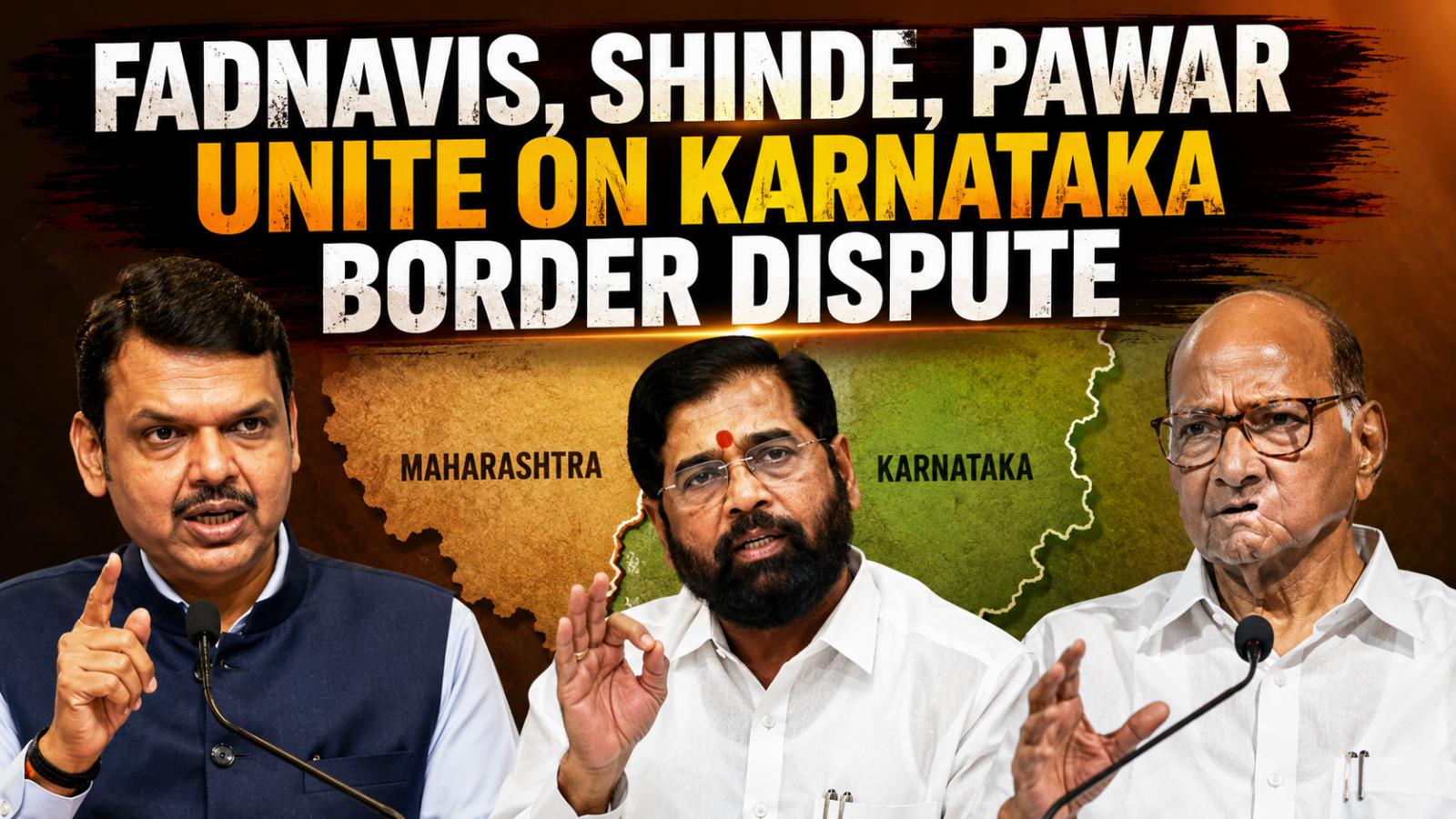
Maharashtra leaders Devendra Fadnavis, Eknath Shinde and Sharad Pawar have renewed efforts over the Karnataka border dispute, promising faster Supreme Court hearings, senior legal support and financial assistance for Marathi-speaking residents facing cases in border areas.
Fadnavis, Shinde and Pawar unite over Karnataka border dispute
Maharashtra’s government and senior political leaders have renewed their push on the long-running Maharashtra-Karnataka border dispute, with Chief Minister Devendra Fadnavis announcing stronger legal efforts to expedite the case pending before the Supreme Court.
The issue brought together leaders from different political camps at a High-Power Committee meeting held at Vidhan Bhavan in Mumbai. Deputy Chief Minister Eknath Shinde, NCP (SP) chief Sharad Pawar and other senior political leaders attended the discussions, which focused on legal strategy and support for Marathi-speaking people living in the disputed border region.
Fadnavis said the Maharashtra government would continue to stand behind Marathi-speaking residents in the border areas and make efforts to protect what the state considers their legitimate linguistic and cultural rights. He also said senior legal experts would be appointed as part of an attempt to move the Supreme Court case forward more quickly.
Maharashtra plans stronger Supreme Court legal strategy
The Maharashtra government has decided to intensify its legal approach to the border dispute, which has remained unresolved for decades. Fadnavis said the state would file necessary applications seeking an early hearing in the Supreme Court and involve experienced legal experts in preparing and presenting its case. The government also plans to compile information concerning the Linguistic Minorities Commission and share it with Maharashtra MPs so that issues affecting Marathi-speaking residents in border areas can be raised in Parliament.
Another major proposal discussed at the meeting was legal assistance for Marathi-speaking residents in Karnataka who are facing court cases. Fadnavis said the Maharashtra government would appoint lawyers where required and bear legal expenses, while a coordination mechanism would be established through the ministerial committee. The meeting reflected a rare show of unity between ruling and opposition leaders on an issue that has remained politically and emotionally significant in Maharashtra for decades.
Shinde promises continued support for Marathi-speaking residents
Eknath Shinde said the Maharashtra government was sensitive to the problems faced by Marathi-speaking people in the Maharashtra-Karnataka border region and would continue making efforts to address their concerns. He also referred to government schemes extended to eligible residents of the border areas, including opportunities connected with IAS pre-examination training and admissions to professional courses such as engineering and medicine, according to the report.
The broader dispute traces its roots to the linguistic reorganisation of states in 1956. Maharashtra has long claimed Marathi-speaking areas that are currently part of Karnataka, including Belagavi, formerly known as Belgaum, and other border regions. Karnataka has consistently rejected Maharashtra’s claims and maintained that the existing boundary should remain unchanged. The exact number of villages cited has varied across political resolutions and reports over time. The Deccan Chronicle report refers to Maharashtra’s claim involving 814 villages, while other historical accounts and later political resolutions have referred to 865 villages.
Border dispute returns to political focus
The renewed push places the Maharashtra-Karnataka border dispute back at the centre of political attention. Maharashtra’s priority is now to accelerate proceedings before the Supreme Court while strengthening legal and administrative support for Marathi-speaking communities in Karnataka. Fadnavis said the entire state stands behind the Marathi-speaking population in the disputed areas and that the government is prepared to act on pending suggestions raised by the High-Power Committee. Shinde also assured continued government support and coordination on issues affecting border residents.
The dispute remains legally unresolved and politically sensitive. Maharashtra continues to press its claim on several Marathi-speaking border areas, while Karnataka maintains its opposition to any territorial change. With the Maharashtra government now promising senior legal representation, applications for an early Supreme Court hearing and financial support for residents facing legal cases, the latest meeting signals a coordinated effort to revive momentum around the decades-old dispute. The presence of leaders from both the ruling alliance and the opposition has also given the renewed campaign broader political significance. While differences remain on many other issues, the border question has once again created a common platform for Maharashtra leaders seeking a faster legal resolution and stronger protection for Marathi-speaking residents in the disputed region.