In a statement issued following the strikes, Venezuelan President Nicolás Maduro condemned what he described as an act of imperial aggression and urged the people and governments of Latin America, the Caribbean, and the wider international community to mobilise against the action. The appeal framed the attacks as a violation of national sovereignty and warned of broader consequences for regional stability if hostilities were to intensify.
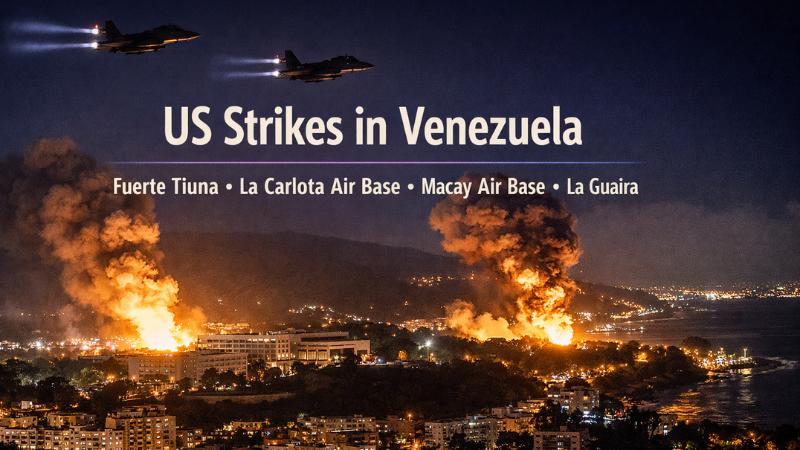
Venezuelan officials said multiple areas were affected, with the most significant incidents reported in the capital, Caracas, and in the neighbouring states of Miranda, Aragua, and La Guaira. These regions are home to several critical military and logistical facilities that play a central role in the country’s defence infrastructure.
Among the locations identified was Fuerte Tiuna, the largest military complex in Venezuela and the headquarters of the Ministry of Popular Power for Defence and the armed forces. Authorities also reported damage at La Carlota Air Base, formally known as the Generalissimo Francisco de Miranda Airbase, situated in eastern Caracas and used for both military aviation and security operations. In Aragua state, local sources and social media footage pointed to strikes at the Macay Air Base, a major Venezuelan Air Force installation in Maracay that has long been regarded as central to the country’s aviation history.
In La Guaira, a coastal state known primarily for its port facilities, officials said sites linked to naval operations and air defence logistics were also affected. The state’s strategic importance lies in its role as a gateway for maritime supply lines and military coordination along the Caribbean coast.
The attacks occurred amid heightened diplomatic activity, including a recent meeting between Venezuelan officials and Chinese envoys led by Qui Xiaoqi, underscoring the broader international context in which the crisis is unfolding. While details of the damage and any casualties remain limited, the developments have intensified concerns over the risk of further confrontation and the potential impact on regional security and global diplomatic relations.