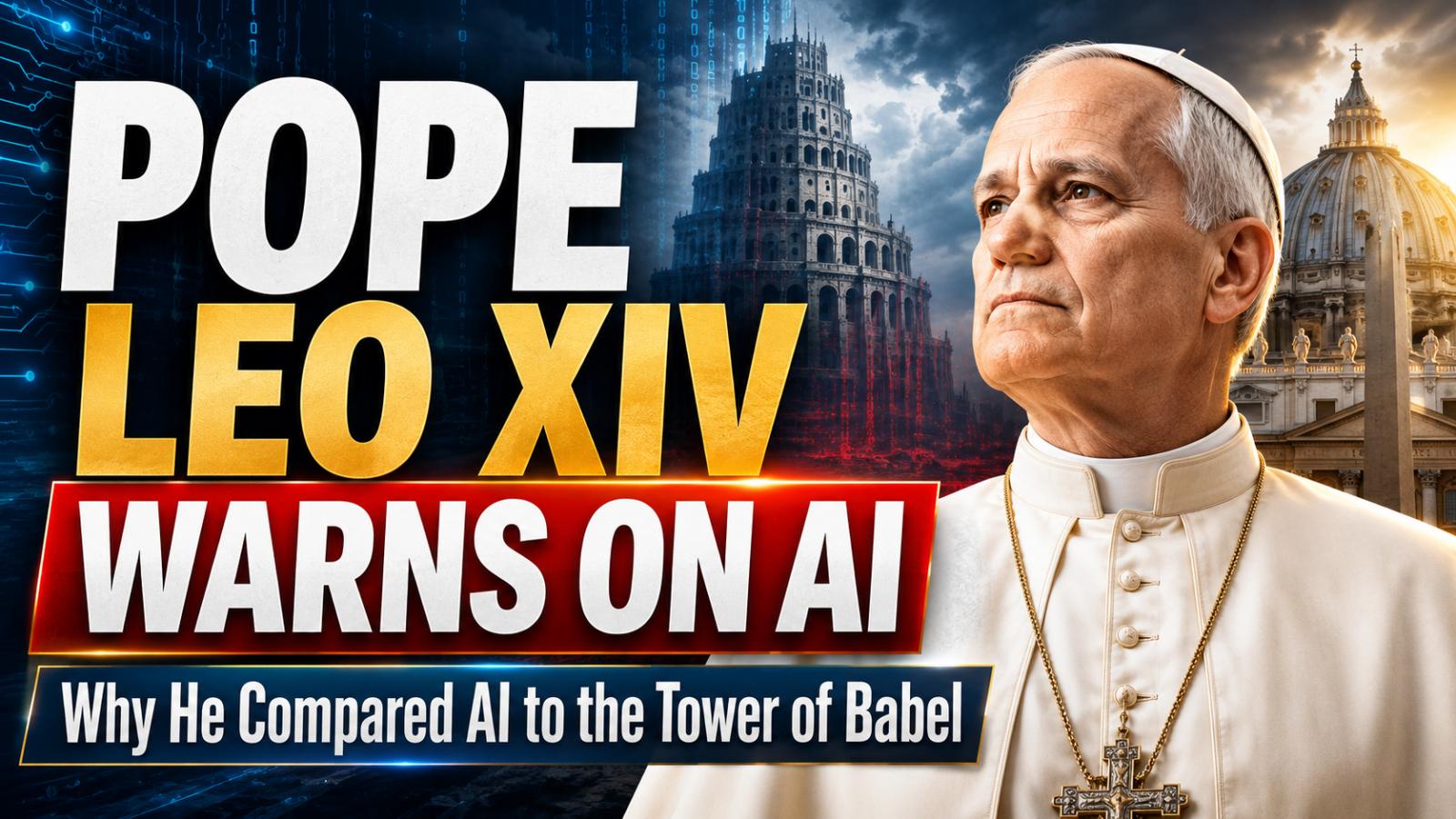
Pope Leo XIV’s AI warning has become an important global discussion because it is not simply about machines, software or future inventions. His concern is about humanity itself. In his first encyclical, Magnifica Humanitas: On Safeguarding the Human Person in the Time of Artificial Intelligence, published by the Vatican on May 25, 2026, the Pope warned that artificial intelligence must not become a force that controls human life, weakens human dignity or increases inequality.
The Pope is not saying that the world should reject artificial intelligence. His message is more practical and serious. AI can help in education, healthcare, research, communication, safety and daily life. But when it is developed only for power, profit, war or surveillance, it can become dangerous.
His warning is clear: artificial intelligence should serve people, not rule over them.
What did Pope Leo XIV say about artificial intelligence?
Pope Leo XIV warned that the world is moving too quickly in the race to build stronger AI systems. Countries, corporations and technology leaders are competing to create more powerful algorithms, larger datasets and faster automation tools. But speed without moral responsibility can create serious risks.
The Pope’s concern is not only about what AI can do. His deeper concern is about who controls AI, who benefits from it and who suffers because of it.
If artificial intelligence is controlled by only a few powerful companies or governments, ordinary people may lose control over their privacy, work, choices and future. AI can influence what people see online, how jobs are selected, how loans are approved, how policing is done and even how wars are fought.
That is why the Pope called for strong ethical AI rules, human supervision and responsible laws. Artificial intelligence must remain answerable to human values.
Why did Pope Leo XIV compare AI to the Tower of Babel?
Pope Leo XIV compared the modern AI race to the Tower of Babel because both represent the danger of ambition without wisdom.
In the Tower of Babel story, people tried to build a tower that reached the heavens. Their goal was not service, humility or human unity. Their goal was greatness, control and pride. The project became a symbol of human ambition losing its moral direction.
The Pope used this image to warn today’s world. Artificial intelligence can also become a modern Tower of Babel if it is built only to show power, defeat rivals, dominate markets or control societies.
The problem is not intelligence. The problem is pride without responsibility.
When technology grows faster than ethics, the result may not be progress. It may be confusion, division and harm.
What is the Tower of Babel?
The Tower of Babel is a biblical story from the Book of Genesis. According to the story, people once spoke one language and lived together. They settled in Shinar, also known as Babylonia, and decided to build a great city with a tower that reached the heavens.
They used bricks and tar to build higher and higher. But the purpose behind the tower was driven by pride. They wanted to make a name for themselves. Their ambition became greater than their responsibility.
According to the story, God confused their language. People could no longer understand each other. The community scattered, and the tower was left unfinished.
The meaning of the story is simple but powerful: when human beings build only for pride, power or control, even their greatest achievements can collapse.
How does the Tower of Babel connect to AI?
The Tower of Babel connects to AI because artificial intelligence is also a massive human project. It is being built by people across nations, companies, labs and governments. It has the power to change how the world works.
But just like Babel, AI can become dangerous if the goal is only to reach higher, move faster and become more powerful.
If AI is built without ethics, it may create a world where people no longer understand what is real, who is responsible or who is in control. Deepfakes, misinformation, job displacement, surveillance, algorithmic bias and autonomous weapons are not imaginary fears. They are real concerns in today’s digital world.
This is why Pope Leo XIV’s comparison matters. He is warning that technology without moral direction can create a world that looks advanced but becomes deeply divided.
What does “disarming AI” mean?
When Pope Leo XIV speaks about disarming artificial intelligence, it does not mean destroying AI or stopping all innovation. It means removing the dangerous use of AI as a weapon of control, manipulation or destruction.
Disarming AI means preventing artificial intelligence from being used to exploit workers, mislead voters, invade privacy, spread false information or make life-and-death decisions without human judgment.
It also means stopping the idea that whoever controls the strongest AI should control the future.
In simple terms, the Pope is asking the world to take the weapon-like power out of AI and bring it back under human responsibility.
Why human dignity is central to the AI debate ?
The Pope’s AI warning is built around one major idea: human dignity.
Human beings should never be treated as data points, tools, numbers or replaceable parts in a system. A person is more than productivity, online behavior, buying history or facial recognition data.
AI systems can process information faster than humans, but they do not have conscience, compassion or moral responsibility. They can recommend, calculate and predict, but they cannot truly understand human suffering.
That is why human dignity must stay at the center of AI development. Every AI law, AI rule and AI policy should ask one basic question: does this protect people or reduce them?
Why AI oversight is necessary ?
Artificial intelligence cannot be left to self-control. Companies may promise responsibility, but business pressure often rewards speed, scale and profit. Governments may promise safety, but political pressure may push them toward surveillance, military use or public control.
This is why independent AI oversight is necessary.
AI oversight means that powerful systems should be tested, reviewed and monitored. There should be clear rules about privacy, bias, safety, transparency and accountability. People should know when AI is being used to make decisions that affect them.
Without oversight, AI can become a hidden authority. It can shape lives without explanation. That is dangerous for democracy, justice and human freedom.
Why the AI race worries the Pope ?
The global AI race is becoming more intense. Companies want market dominance. Countries want strategic advantage. Investors want profit. Military powers want faster decision-making. Social media platforms want more user attention.
This race can push ethics to the side.
The Pope’s warning is important because the question is no longer whether AI can become powerful. It already is powerful. The real question is whether humanity has the courage to control it before it controls society.
A race without rules usually does not protect the weak. It protects the strongest. That is exactly why the Pope is calling for laws, accountability and moral responsibility.
What ethical AI rules should include ?
Ethical AI rules should not be vague slogans. They should be practical and enforceable.
AI systems should be transparent when they affect public life. People should know when they are interacting with AI. Sensitive decisions in healthcare, policing, employment, finance and education should not be left fully to machines.
There should be strong privacy protection. Data should not be collected or used without clear consent. AI should not be trained or deployed in ways that exploit vulnerable communities.
There should also be accountability. When AI causes harm, someone must be responsible. A company or government should not be able to blame the algorithm and escape responsibility.
What this means for ordinary people ?
Pope Leo XIV’s AI warning is not only for scientists, CEOs or politicians. It matters to ordinary people because AI is already entering daily life.
It affects job applications, school assignments, customer service, banking, online shopping, news feeds, social media, entertainment, medical tools and public safety. People may not always see AI, but AI may still be influencing their choices.
The Pope’s message is that people should not become powerless in front of technology. AI should make human life better, not make people dependent, confused or controlled.
Is the Pope asking for AI laws?
Yes, the Pope is calling for serious rules and responsible governance around artificial intelligence. His message supports ethical AI laws, international cooperation and strong oversight.
The main idea is that AI should not be controlled only by profit-driven companies or power-driven governments. It should be guided by the common good.
The common good means technology should benefit society as a whole, not just a small group of powerful people. If AI increases inequality, destroys trust or weakens human freedom, then it is not serving the common good.