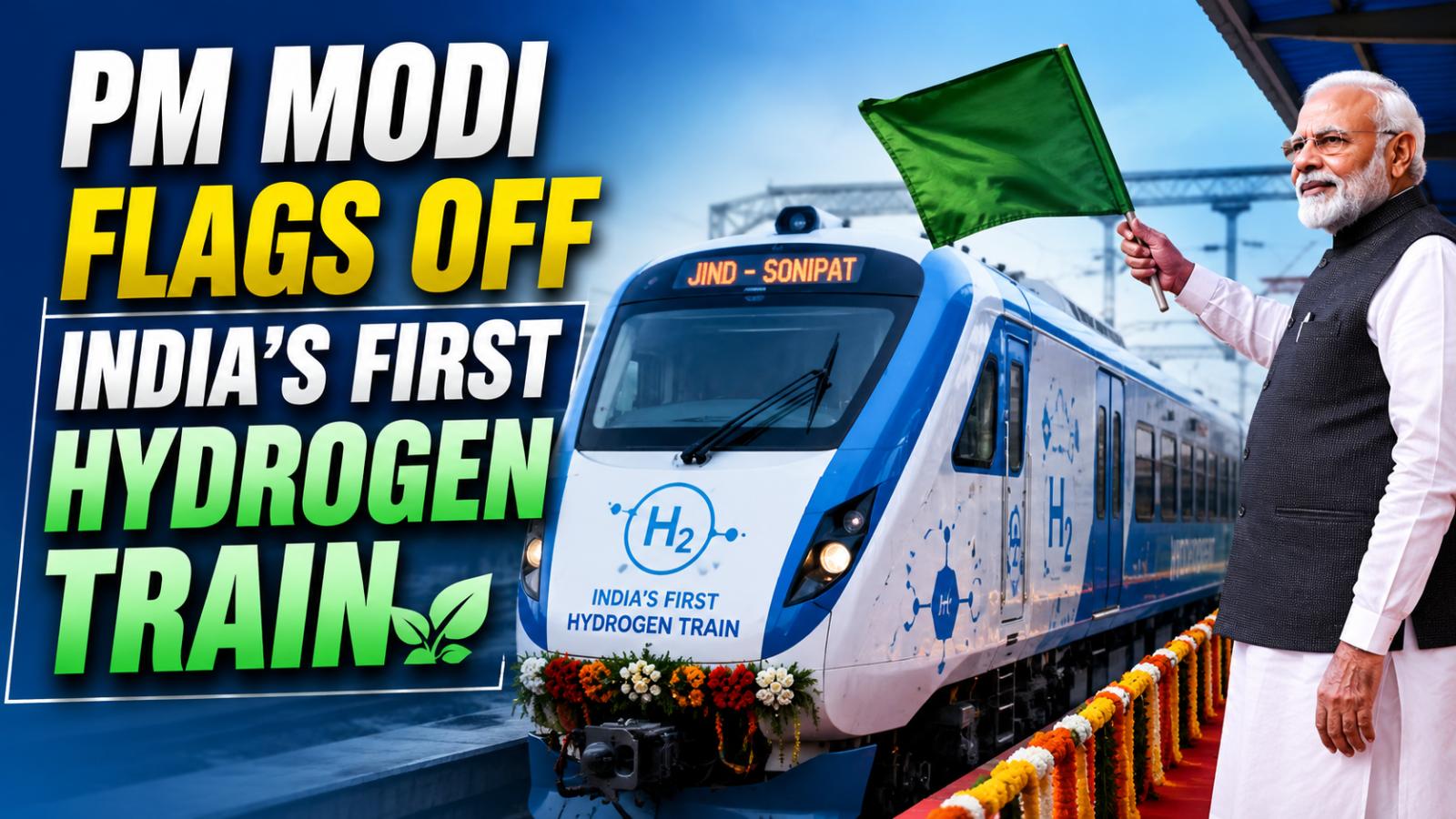
India’s first hydrogen train was flagged off by Prime Minister Narendra Modi at Jind railway station in Haryana. The fuel-cell train will operate on the Jind-Sonipat route, generating electricity on board while emitting water vapour and heat at the point of use.
Hydrogen Train Launch Marks Indian Railways Milestone
Prime Minister Narendra Modi on Friday, July 17, 2026, flagged off India’s first hydrogen-powered passenger train from Jind railway station in Haryana, marking a major step in Indian Railways’ efforts to introduce cleaner propulsion technologies. The train will operate between Jind and Sonipat on a dedicated Northern Railway section. Government broadcaster Akashvani had confirmed that the country’s first hydrogen train would begin its journey from Jind and serve the Jind-Sonipat corridor.
The project places India among a small group of countries exploring hydrogen-powered passenger rail. Its performance, operating costs and refuelling requirements will be closely watched as Indian Railways considers alternatives to diesel services on routes where full electrification may be difficult or expensive.
Hydrogen Fuel Cells Generate Electricity on Board
Unlike conventional electric trains that depend on overhead power lines, the new train produces electricity inside the trainset. Hydrogen stored on board is supplied to fuel cells, where it combines with oxygen from the atmosphere to generate electrical energy.
The electricity powers the train’s traction system, while water vapour and heat are produced as by-products. The system does not involve the combustion of coal or diesel and therefore avoids direct carbon dioxide and smoke emissions during operation.
However, the train’s overall environmental benefit will depend on how the hydrogen is produced. Hydrogen can be manufactured through several methods, including electrolysis and processes using natural gas, with lifecycle emissions varying according to the energy source.
Jind-Sonipat Route, Speed and Passenger Capacity
The hydrogen train will serve the approximately 89-kilometre Jind-Sonipat section in Haryana. It has an approved operational speed of up to 75 kmph on the dedicated route, while its reported design speed is 110 kmph.
Railway Board documents confirm approval for a 10-car hydrogen fuel-cell-based DEMU trainset on the Jind-Sonipat section. The formation includes hydrogen-powered driving cars and passenger coaches designed for regional travel.
Reports indicate that the train can accommodate about 2,600 passengers, making it significantly larger than many hydrogen trains currently operating or undergoing trials in other countries. A hydrogen production, storage and refuelling facility has also been established at Jind to support the service.
Train Safety Systems Detect Leaks and Heat
Because hydrogen is highly flammable, the train and its supporting infrastructure have been equipped with multiple safety measures. These include systems designed to detect hydrogen leaks, flames, smoke, abnormal heat and other potential risks.
Railway safety approval documents also require regular inspection of leak and flame detectors, trained personnel for critical operations, secure access to the hydrogen facility and round-the-clock monitoring of refuelling data. Technical staff are expected to accompany the train during the initial operating period to address possible problems.
The launch represents an important clean-transport experiment for India. Its long-term success will depend on reliable operations, safe hydrogen handling, affordable fuel production and the availability of low-emission hydrogen. A successful Jind-Sonipat service could support the wider adoption of hydrogen trains on suitable regional and heritage railway routes.