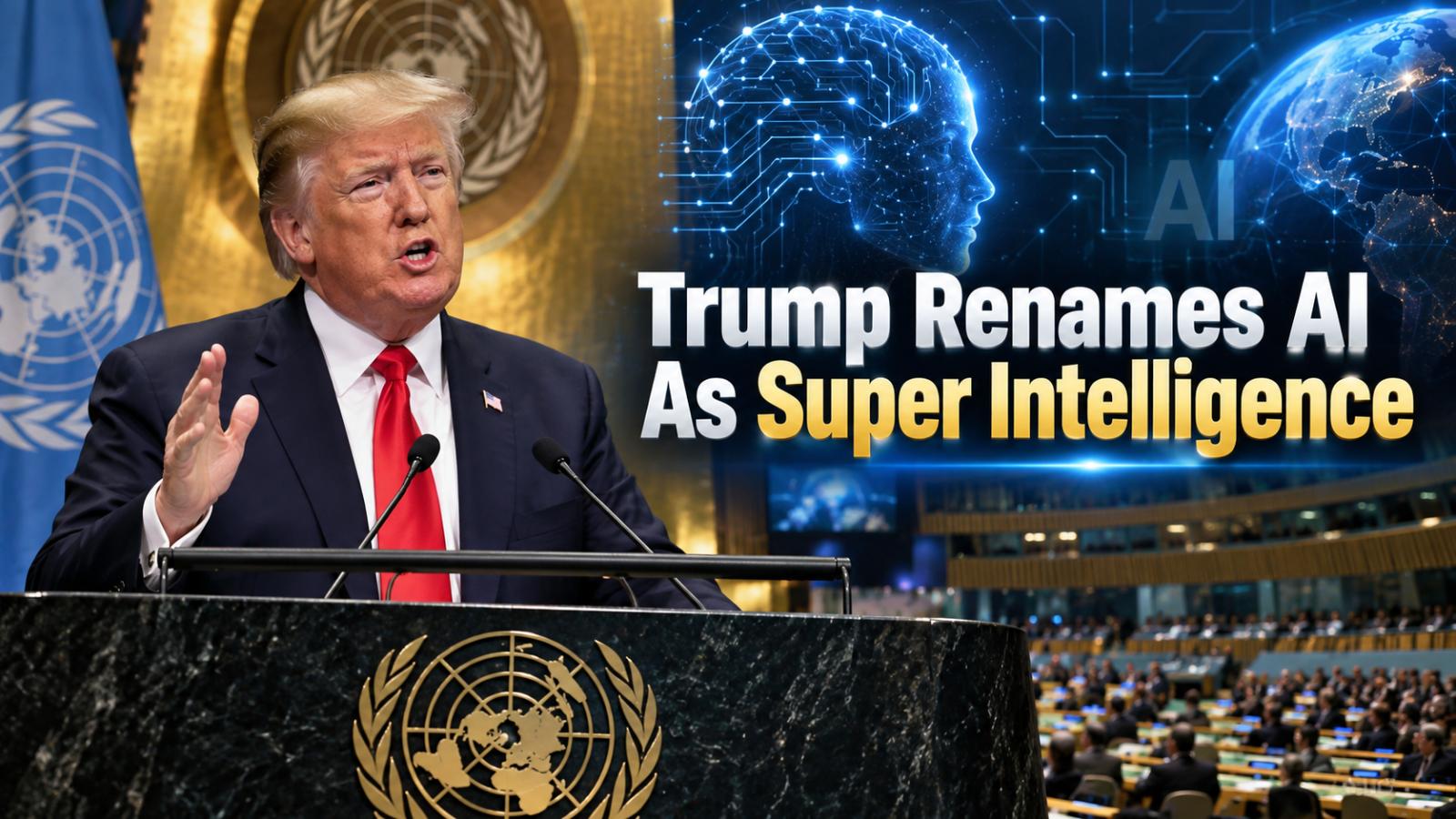
US President Donald Trump used his September 22 address to the 81st United Nations General Assembly to introduce a new term for artificial intelligence and reject stronger international control over the technology. The White House confirmed that Trump said AI would be “hereinafter officially called ‘Super Intelligence’,” while framing US leadership in the sector as a matter of national sovereignty.
Global AI rules rejected by Trump
Trump said the United States would oppose attempts to create what he described as a global system of control over artificial intelligence. His remarks placed technological sovereignty at the center of the US position and suggested Washington does not want international institutions setting binding limits on how American AI systems are developed.
The White House summary of the speech confirms that Trump rejected a “globalist scheme of control” and used the term “Super Intelligence” during his UN address. The comments come as AI governance has become a major diplomatic issue at the General Assembly, with governments debating safety, transparency and oversight.
UK AI standards push takes a different path
The United Kingdom is taking a more cooperative approach. Prime Minister Andy Burnham used UNGA week to promote international work on AI and said the UK would use its 2027 G20 presidency to advance common approaches to emerging technology.
The British government has said AI safety, standards and international cooperation will form part of its wider G20 agenda. The UK and US are also expanding cooperation on AI and autonomous systems in defence and security, showing that London is seeking both stronger standards and closer technological partnerships.
UN AI safeguards focus on human control
UN Secretary-General António Guterres presented a markedly different view from Trump. He warned that artificial intelligence is developing faster than many governments and institutions can respond and called for stronger international cooperation.
Guterres said countries with the greatest AI capabilities carry greater responsibility and urged them to establish channels for dialogue, testing and risk assessment. He also backed a multilateral AI risk-management framework and stressed that life-and-death decisions should not be handed entirely to machines.
Macron AI view stresses strategic autonomy
France is also pushing for a stronger multilateral role in AI governance. During UNGA week, France helped advance a coalition on AI and child protection backed by more than 20 states and several UN entities. The initiative calls for stronger accountability, independent evaluation and greater access to AI models and data for researchers.
President Emmanuel Macron has separately argued that countries should avoid becoming overly dependent on either the United States or China in strategic technologies, including AI. That broader strategic-autonomy position adds another layer to the global debate over who should control advanced AI systems.
AI governance debate widens at UNGA
The disagreement is becoming clearer. Trump is emphasizing national control, rapid innovation and resistance to international restrictions, while the UN and several European governments are advocating shared safeguards, oversight and cross-border standards.
The debate is no longer only about whether AI should be regulated. It is increasingly about who gets to write the rules: national governments, international institutions or the technology companies developing the most advanced systems. That question is likely to remain one of the defining technology-policy disputes of the current UNGA session.