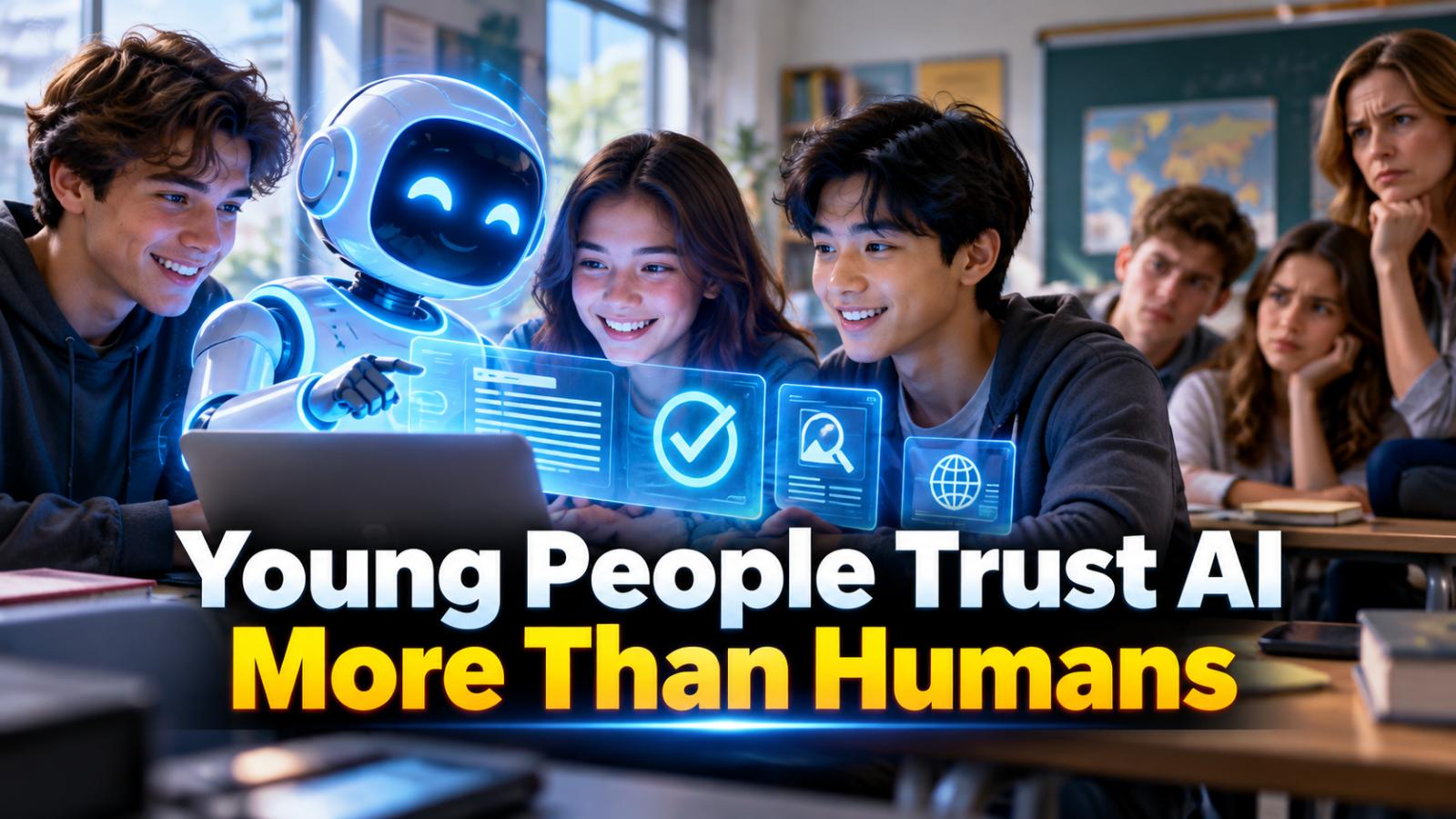
Almost half of young people in England now say they trust artificial intelligence more than a person to verify facts, according to new research that raises questions about how quickly education is adapting to AI. The survey also shows widespread AI use for learning, homework and understanding difficult topics.
Public First surveyed 4,000 people aged 11 to 24 for a report by Sir Anthony Seldon and technology investor Tim Bunting. It found 87% had used an AI tool, while 47% said they would trust AI to check a fact compared with 21% who would trust a person.
AI use reshapes how young people learn
AI has already become part of everyday education for many pupils. The source material says 63% of secondary school students use it for homework, while 77% turn to AI when they struggle to understand a topic.
The wider Public First findings show that AI use is especially high among younger teenagers, with adoption reaching 90% among 13- and 14-year-olds. Researchers also identified differences in access between social groups, suggesting that AI could widen existing education gaps if schools fail to provide equal guidance.
School trust faces a relevance challenge
The report warns that schools risk a “crisis of relevance” if classroom teaching does not reflect how rapidly students are adopting AI. Some 42% of respondents said AI had made school education less important, while only 9% believed schools and universities were preparing them very well for an AI-driven future.
The authors argue that education is still designed for an “AI-less world that no longer exists.” Their concern is not simply that students use AI, but that institutions may lose authority if pupils see technology as more useful, responsive or trustworthy than traditional learning systems.
Fact check habits raise critical-thinking concerns
The finding that 47% trust AI over humans for fact checking is particularly significant because AI systems can produce confident but incorrect answers. The report argues that schools should therefore teach students how to question AI output, verify sources and distinguish reliable evidence from plausible-sounding misinformation.
This creates an opportunity for teachers rather than making them less important. Human guidance can focus increasingly on judgment, context, source evaluation and responsible AI use instead of treating the technology simply as something to prohibit.
DfE response focuses on safer AI tools
The Department for Education says it is responding through curriculum reform, research and supervised AI tools. Government plans include testing AI tutoring systems with schools and investing up to £23 million to assess AI and education technology products and their effects on learning and teacher workload.
Prime Minister Andy Burnham’s government has also announced wider technical education reforms aimed at giving teenagers earlier access to skills training, employer links and technology-related pathways.
AI schools plan calls for faster reform
Seldon and Bunting argue that current measures still move too slowly. Their 10-point proposal calls for a rapid-response structure for AI education and a national network of 100 “AI champion” schools and colleges to test and share effective approaches.
The report’s central message is that banning or ignoring AI will not stop young people from using it. Schools will instead need to teach students when AI is useful, when it is unreliable and why human judgment remains essential.