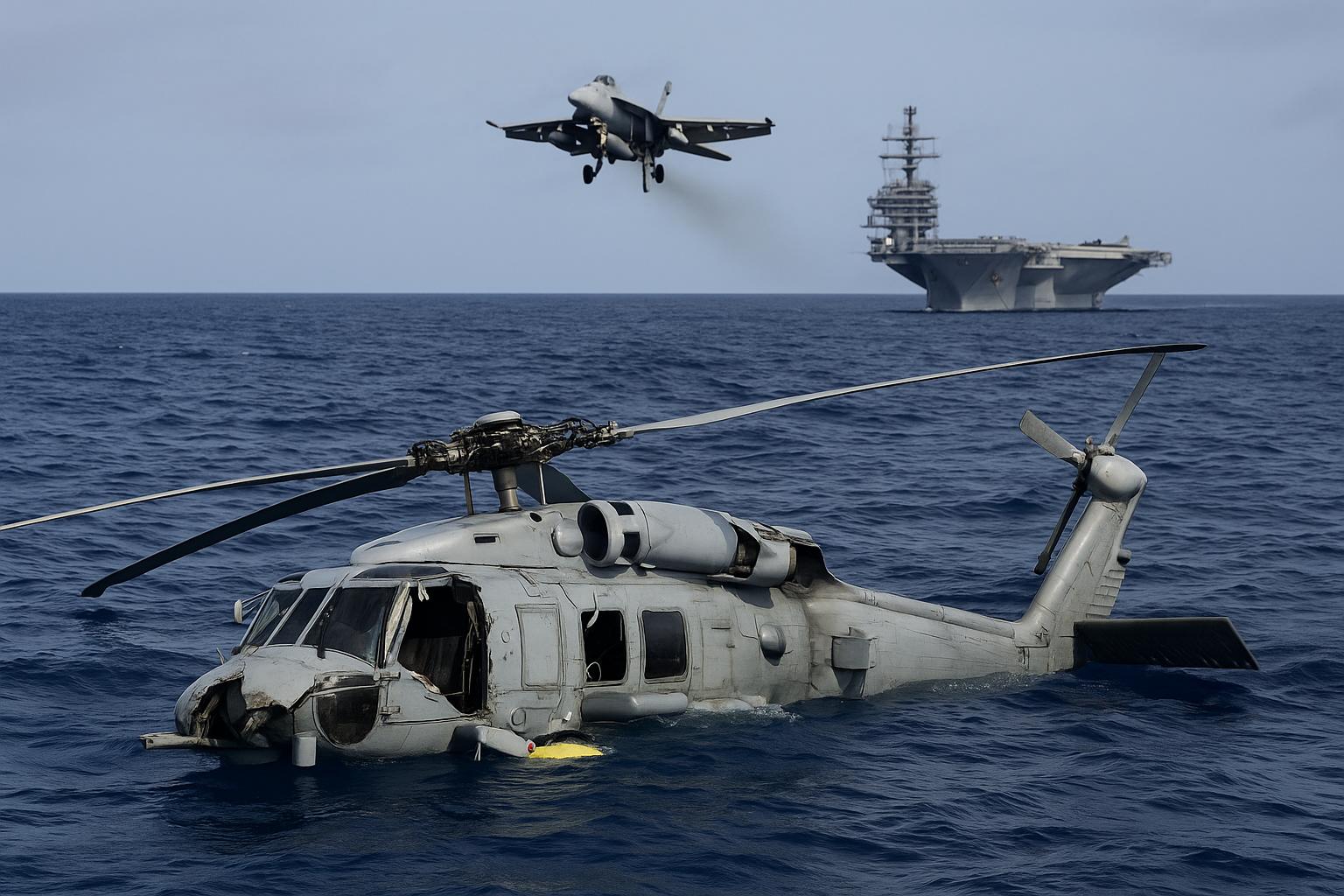
Amid heightened tensions in the Indo-Pacific, two separate US Navy aircraft — a helicopter and a fighter jet — crashed into the South China Sea on Sunday during routine operations. The incidents have reignited regional security concerns as the United States continues its strategic presence in the disputed waters, where China maintains sweeping territorial claims.
According to a statement from the US Pacific Fleet, the first incident involved an MH-60R Seahawk helicopter assigned to Helicopter Maritime Strike Squadron 73, known as the “Battle Cats.” The aircraft was operating from the aircraft carrier USS Nimitz when it went down at approximately 2:45 p.m. local time. The Navy confirmed that all three crew members aboard the helicopter were safely rescued shortly after the crash, thanks to a prompt search-and-rescue effort.
Roughly half an hour later, a second incident occurred involving an F/A-18F Super Hornet fighter jet assigned to Strike Fighter Squadron 22, the “Fighting Redcocks.” The aircraft also crashed during flight operations from the Nimitz around 3:15 p.m. local time. Both aviators successfully ejected and were recovered without serious injuries. The Navy has launched a detailed investigation into the causes of both crashes, emphasizing that the incidents occurred during standard training and operational procedures rather than combat activity.
While no fatalities or serious injuries were reported, the dual accidents highlight the inherent risks of naval aviation operations in one of the world’s most contested maritime zones. The South China Sea remains a focal point of geopolitical tension, with overlapping claims from China, the Philippines, Vietnam, Malaysia, Brunei, and Taiwan. Beijing asserts control over nearly the entire region, constructing artificial islands equipped with runways, radar systems, and missile batteries — moves widely viewed as an attempt to militarize the waters and assert dominance over key trade routes.
For the United States, maintaining freedom of navigation in these waters has long been a strategic priority. The USS Nimitz, one of the world’s largest and most experienced aircraft carriers, routinely conducts patrols in the Pacific as part of Washington’s efforts to ensure open access to international waters. Analysts note that such operations are intended to reaffirm US commitment to its allies in the Indo-Pacific and to counter Beijing’s growing maritime influence.
The crashes come at a time of renewed diplomatic strain between Washington and Beijing. Although recent months have seen attempts at dialogue and limited trade cooperation, military friction persists in the South China Sea, where close encounters between American and Chinese vessels have raised fears of miscalculation. Observers suggest that incidents like these — even accidental — could become flashpoints in an already volatile environment if misinterpreted or politicized.
The US Navy has not yet released technical details about the causes of the crashes, but officials have confirmed that safety reviews and maintenance checks are underway across carrier operations. The loss of advanced aircraft such as the F/A-18F Super Hornet, which costs over $60 million, represents not only a material setback but also a reminder of the high operational tempo and strain faced by naval forces deployed far from home bases. The MH-60R Seahawk, a versatile multi-mission helicopter, plays a key role in anti-submarine warfare, reconnaissance, and search-and-rescue missions — all crucial elements of carrier strike group readiness.
The USS Nimitz, commissioned in 1975, is the oldest active aircraft carrier in the US fleet and is slated for decommissioning next year after nearly five decades of service. Its continued operations underscore both the longevity and the logistical challenges of sustaining America’s global naval reach. The vessel has been a central component of US presence in the Indo-Pacific, serving as a visible symbol of deterrence and reassurance to regional partners.
As investigations proceed, defense analysts expect Washington to reaffirm its commitment to maintaining stability and open navigation in the Indo-Pacific. While both crashes are being treated as isolated accidents, they occur against the backdrop of a broader contest for influence between the United States and China — one increasingly defined not just by diplomacy and trade, but by air and sea operations in some of the world’s most strategically sensitive waters.