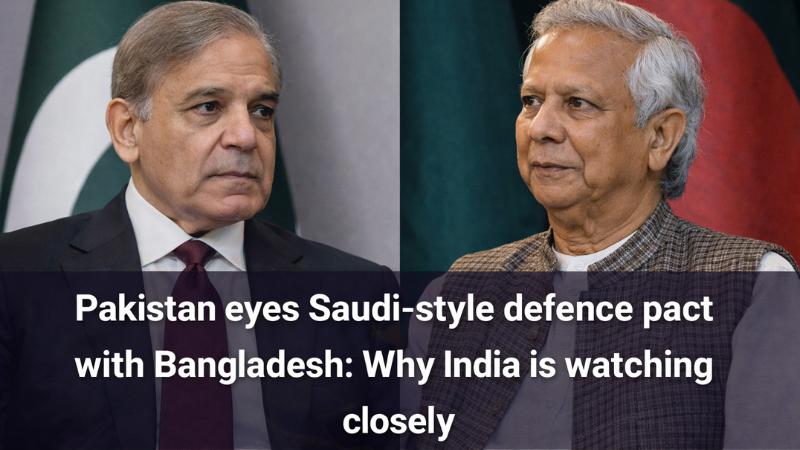
Pakistan’s recent diplomatic and military outreach to Bangladesh has triggered fresh speculation about a potential defence agreement that could significantly reshape regional security dynamics in South Asia. Over the past few months, several senior Pakistani military officials, including the chairperson of the Joint Chiefs of Staff Committee, the Navy chief, and ISI head Lt General Asim Malik, have made repeated visits to Dhaka. These developments come as Bangladesh’s interim leadership under Muhammad Yunus appears to be steering foreign policy away from India and closer towards Pakistan.
The heightened engagement is not coincidental. Pakistan is reportedly keen on sealing a defence pact with Bangladesh before the country heads to elections in the coming months. The proposed agreement is being compared to the strategic mutual defence pact Islamabad signed with Saudi Arabia earlier this year, which included a clause stating that aggression against one country would be treated as aggression against both. In Pakistan, that agreement was widely viewed as a deterrent aimed at India, particularly after tensions escalated earlier this year.
The possibility of a Pakistan-Bangladesh military agreement marks a dramatic shift, considering the two countries have not entered into such arrangements since Bangladesh’s liberation in 1971. Media reports suggest that both sides have already established a joint mechanism to draft the proposed deal. If finalised, the agreement could open the door to intelligence sharing, joint military exercises, and defence procurement cooperation.
While there is no official confirmation that nuclear cooperation would be part of the deal, the possibility has raised eyebrows in strategic circles. Pakistan’s defence understanding with Saudi Arabia included ambiguous references to nuclear capabilities, and any similar provision involving Bangladesh would have serious implications for regional stability. Analysts note that even without nuclear elements, enhanced military cooperation between Islamabad and Dhaka would represent a notable strategic shift.
The timing of the talks is also significant. With Bangladesh’s elections approaching and the Awami League barred from contesting, Pakistan appears eager to lock in an agreement under a leadership it views as favourable. Political uncertainty in Dhaka, combined with rising anti-India sentiment in parts of Bangladesh following recent unrest, has given Pakistan an opportunity to expand its influence.
For India, the prospect of a Pakistan-Bangladesh defence agreement raises concerns about a potential two-front security challenge. Strategists have long warned that Pakistan seeks to apply pressure on India simultaneously from the western and eastern fronts. A formal military understanding with Bangladesh could complicate India’s security calculus, particularly in its eastern region.
Statements from Pakistani political leaders have added to these concerns. Calls for a formal military alliance with Bangladesh, including assertions that Pakistan would stand with Dhaka in the event of an Indian attack, have underscored Islamabad’s strategic intent. Although Indian officials have not publicly commented, reports indicate that New Delhi is closely monitoring developments.
India is also watching Bangladesh’s political trajectory closely. A change in leadership following the elections could alter Dhaka’s foreign policy stance. Observers suggest that a government led by the Bangladesh National Party may be less inclined to pursue deep military ties with Pakistan compared to the current interim administration.
For now, the proposed defence pact remains unconfirmed. However, Pakistan’s sustained diplomatic push, coupled with Bangladesh’s internal political shifts, has ensured that the issue remains firmly on India’s strategic radar. Whether the deal materialises or stalls after elections, it highlights the evolving and increasingly complex geopolitics of South Asia.