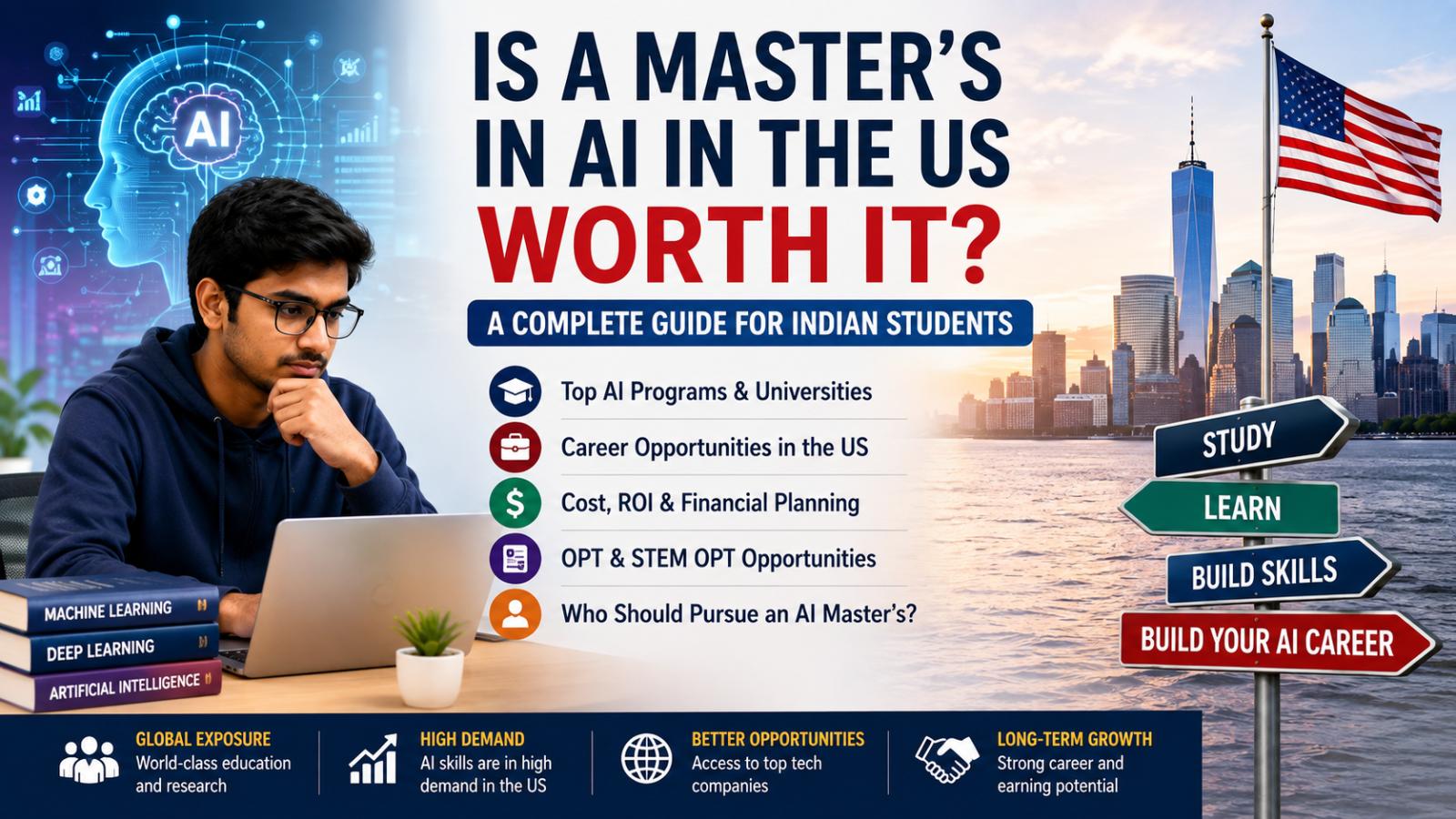
A master’s in AI in the US can provide Indian students with specialized skills and access to a large technology job market, but the decision requires careful evaluation of tuition, career goals, university quality and post-study work eligibility such as OPT and STEM OPT.
Is a US master’s in AI worth the investment?
Artificial intelligence has become an increasingly important area of the U.S. technology industry, leading more Indian engineering graduates and software professionals to consider specialized graduate degrees in the field.
A master’s in AI in the United States can provide access to advanced coursework, university research, projects and the U.S. technology job market. However, the degree should not be viewed as a guaranteed route to a high-paying job.
Students need to evaluate the university, curriculum, total cost, existing technical skills and likely career opportunities before making the investment.
What students learn in an AI master’s
AI programs vary between universities, but many focus on areas including machine learning, deep learning, programming, neural networks, data analysis and applied artificial intelligence.
For example, the University at Buffalo describes its AI-focused Engineering Science MS as a multidisciplinary program covering machine learning, AI programming, deep learning algorithms and advanced neural networks.
Students should compare curricula carefully rather than choosing a program simply because "AI" appears in the degree title.
Career opportunities after an AI degree
Graduates with strong technical foundations may pursue positions related to software development, machine learning, data science, AI engineering and other computing fields, depending on their skills and experience.
The U.S. Bureau of Labor Statistics projects employment of software developers, quality assurance analysts and testers to grow 15% between 2024 and 2034. BLS also identifies demand related to artificial intelligence as one factor contributing to growth in computer and mathematical occupations.
That outlook does not mean every AI graduate will find employment. Projects, internships, coding ability, interview preparation and prior work experience can significantly affect a candidate's competitiveness.
OPT and STEM OPT matter for international students
Employment authorization is another important consideration for Indian students studying in the United States on F-1 status.
Eligible F-1 students may apply for up to 12 months of Optional Practical Training related to their field of study. Students with qualifying STEM degrees may also be eligible to apply for a 24-month STEM OPT extension.
Students should confirm whether the specific degree and institution meet STEM OPT requirements rather than assuming every AI program automatically qualifies.
Who should consider an AI master’s?
A U.S. AI master’s may make more sense for students who already have foundations in computer science, programming, mathematics or software engineering and want deeper specialization.
Students primarily seeking a U.S. job without a clear academic or career reason for studying AI should compare alternatives such as computer science, data science and other technology programs before committing.
The potential value of the degree ultimately depends on the combination of university quality, cost, technical development, practical experience and the student's ability to convert graduate education into a competitive professional profile.